
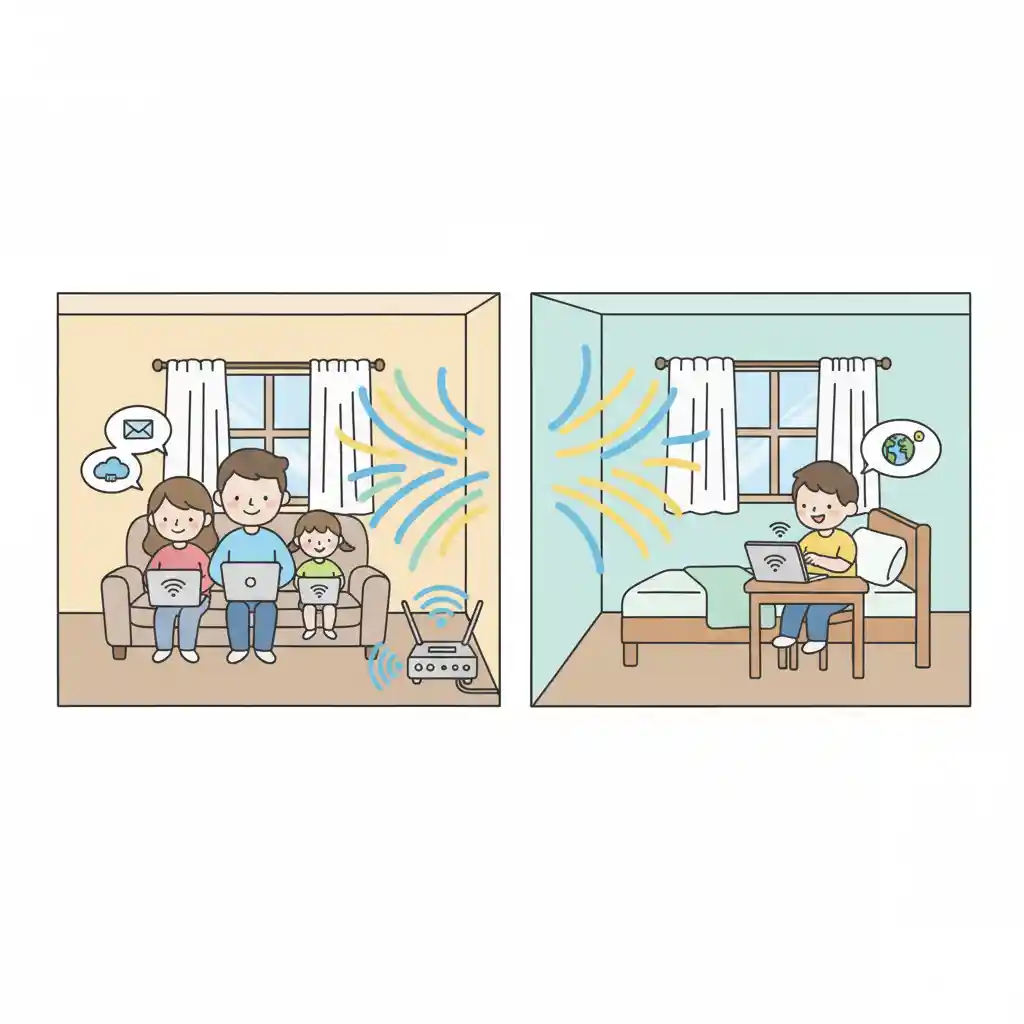
The Invisible Messenger
Imagine you're trying to talk to a friend in another room without opening the door. You might shout, and your voice (which is made of sound waves) might travel through the walls, though it would be muffled. Now, imagine a way to send messages, pictures, and even videos through those same walls, totally silently and super fast! That's exactly what Wi-Fi does.
Wi-Fi is like an invisible messenger service for your devices. It's how your tablet, phone, or computer connects to the internet without needing a tangled mess of wires. It uses special invisible waves to carry all the information you want, zipping it from your router to your device and back again, all without you ever seeing a thing.
Waves, Waves Everywhere!
So, what are these 'invisible waves'? They're called radio waves. You might know radio waves from, well, the radio! When you tune into your favorite music station, radio waves are carrying those songs through the air to your car or home stereo. Wi-Fi uses a very similar kind of radio wave, but instead of music, it's carrying internet data.
Radio waves are part of a bigger family called the 'electromagnetic spectrum,' which includes everything from the light you see, to X-rays that doctors use, and even the microwaves that heat your food. All these waves travel at the speed of light – that's super-duper fast! Unlike sound waves, electromagnetic waves don't need air or water to travel; they can even zoom through empty space.
Wiggling Through the Air
How do these waves actually 'wiggle'? Imagine throwing a pebble into a calm pond. Ripples spread out in circles. Wi-Fi signals are a bit like those ripples, but instead of water, they're spreading through the air, carrying little bits of information in their 'wiggles.' Each wiggle has a 'frequency,' which is how many times it wiggles per second, and a 'wavelength,' which is the distance between one wiggle and the next.
Wi-Fi typically uses two main frequencies: 2.4 Gigahertz (GHz) and 5 Gigahertz (GHz). Think of 2.4 GHz as a wave that can travel further and pass through walls a bit better, but it's not super speedy. The 5 GHz wave is much faster but doesn't travel as far and is more easily blocked. Your router often uses both, like having two different roads for traffic!
The Wall Whisperers
Now for the big mystery: how do Wi-Fi signals go through walls? When a radio wave hits an object, it can do a few things: it can bounce off (reflect), it can get soaked up (absorbed), or it can pass right through (transmit). Wi-Fi radio waves are pretty good at transmitting through common household materials like wood, plasterboard, and even most plastics.