
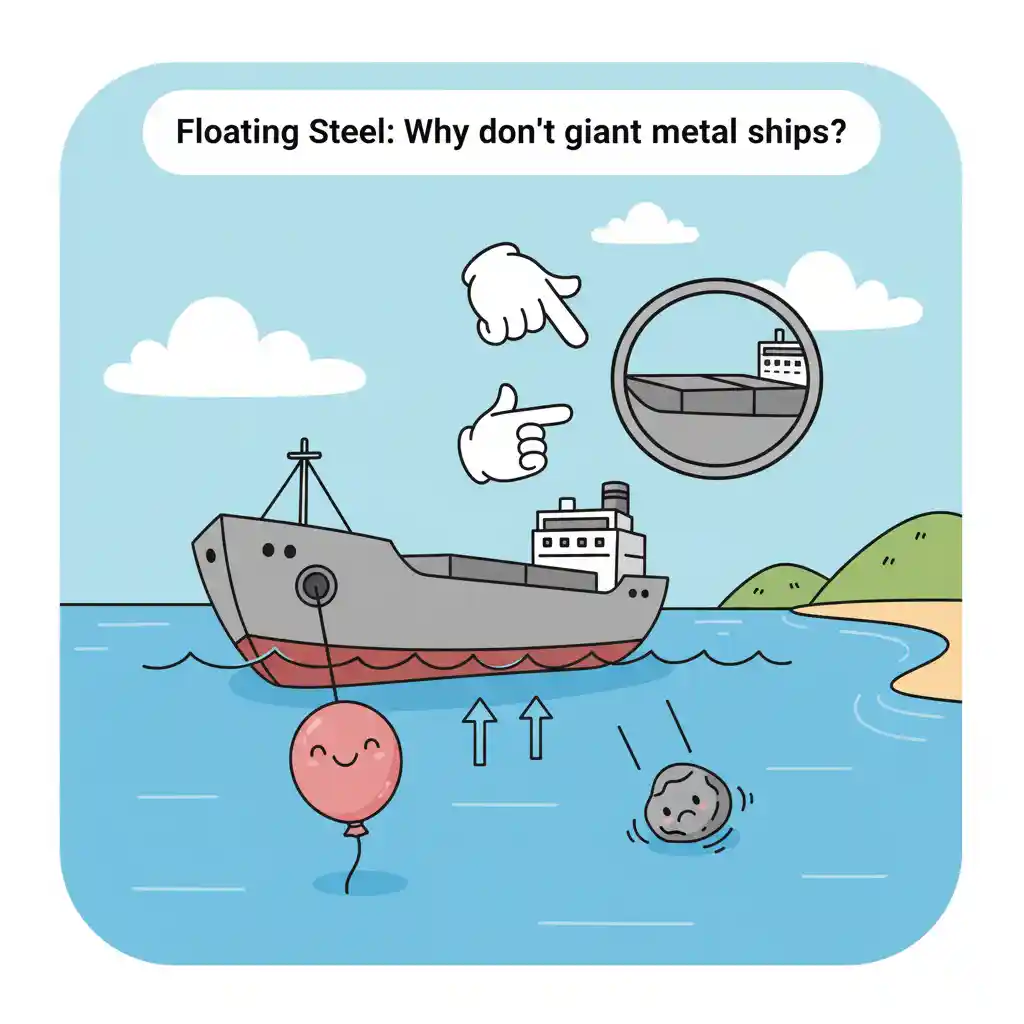
The Big Mystery: Heavy Metal That Floats?
Imagine you have a tiny pebble and a giant, shiny, metal cruise ship. If you drop the pebble into a bucket of water, plink! It sinks straight to the bottom. So, how on Earth does a massive ship, made of thousands of tons of heavy steel, not only float but also carry hundreds of people and tons of cargo across vast oceans? It's one of the coolest mysteries of science, and it all comes down to a special superpower called buoyancy!
You might think 'heavy things sink,' but that's not the whole story. The secret isn't just how heavy something is, but how much space it takes up and what it pushes out of the way.
Archimedes and the Bathtub Eureka!
Hundreds of years ago, a super-smart scientist named Archimedes had his big 'aha!' moment in a bathtub. He noticed that when he got into the bath, the water level went up. The water he pushed out of the way (or 'displaced') was equal to the space his body took up. This simple idea changed everything we know about floating!
Archimedes figured out that when an object is placed in water, the water pushes back on the object. This push-back is called an 'upward force' or 'buoyancy'. If this upward push from the water is stronger than the downward pull of gravity on the object (its weight), then the object floats! If gravity wins, it sinks.
Making Space: The Magic of Displacement
So, how does a big metal ship get enough upward push from the water? It's all about its shape! Imagine taking that pebble from earlier and smashing it flat into a super thin sheet of metal. If you carefully place that flat sheet on water, it might float. Why? Because now it's taking up much more space and pushing away more water than it did as a tiny, dense pebble.
Ships are designed to be hollow and spread out. Even though they're made of steel, they're mostly filled with air. This shape allows them to 'displace' (push aside) a huge amount of water. The weight of this displaced water is exactly what provides the buoyant force that keeps the ship afloat.
Density: The Floating Secret Weapon
Another way to think about it is 'density.' Density is how much 'stuff' is packed into a certain amount of space. A rock is very dense; it has a lot of 'stuff' packed into a small space. Water is less dense than a rock.