
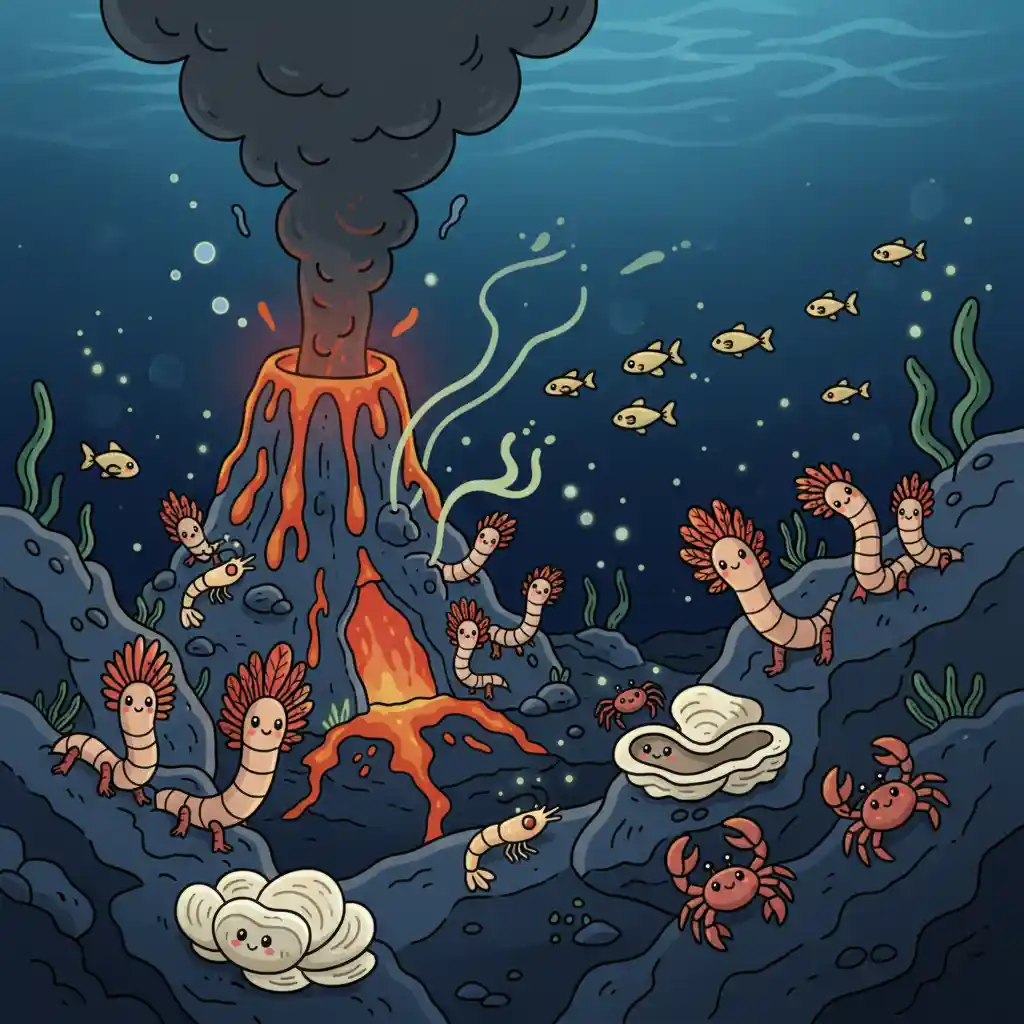
The Ocean's Dark Secret
Imagine diving into the ocean, deeper and deeper. The sunlight quickly fades, and soon you're in a world of complete darkness, colder than your refrigerator, and under pressure so great it could flatten a car! For a long time, scientists thought that nothing much could live in these extreme parts of the ocean. After all, plants, which are the base of most food chains, need sunlight to grow. So, if there's no sun, how could there be life?
This vast, mysterious realm is called the 'deep sea,' and it makes up over 90% of our planet's living space. Until about 50 years ago, we knew less about it than we did about the Moon! It seemed impossible that bustling communities could exist down there, but the ocean had a spectacular secret waiting to be discovered.
Fire Under the Sea: Underwater Volcanoes!
In 1977, something amazing happened. Scientists exploring the Pacific Ocean in a tiny submarine called Alvin were exploring a place called the Galápagos Rift. They weren't looking for life; they were looking for geological activity – basically, 'fire' under the sea where the Earth's crust pulls apart. And guess what they found? Real-life underwater volcanoes, bubbling hot water from cracks in the seafloor!
These aren't volcanoes that erupt with lava like Mount Vesuvius, but rather vents that spew out superheated water, sometimes as hot as 750°F (400°C)! And the biggest surprise? Around these fiery vents, they found incredible, never-before-seen creatures thriving in the pitch-black, crushing depths. It was like discovering an alien world right here on Earth!
Black Smokers and Chemical Soup
So, what exactly are these 'underwater volcanoes' called? They're known as 'hydrothermal vents.' Hydro means water, and thermal means heat. Imagine the Earth's crust as a giant puzzle with cracks. Cold ocean water seeps into these cracks, gets heated by magma (molten rock) deep inside the Earth, and then shoots back out through chimneys.
As the superheated water travels, it picks up lots of dissolved minerals and chemicals from the rocks, like hydrogen sulfide (which smells like rotten eggs, but is food for some creatures!). When this hot, mineral-rich water hits the freezing cold ocean water, the minerals suddenly solidify, forming giant chimney-like structures. Some of these vents spew out dark, cloudy water, rich in iron and sulfur, that looks just like black smoke, earning them the nickname 'black smokers'!