
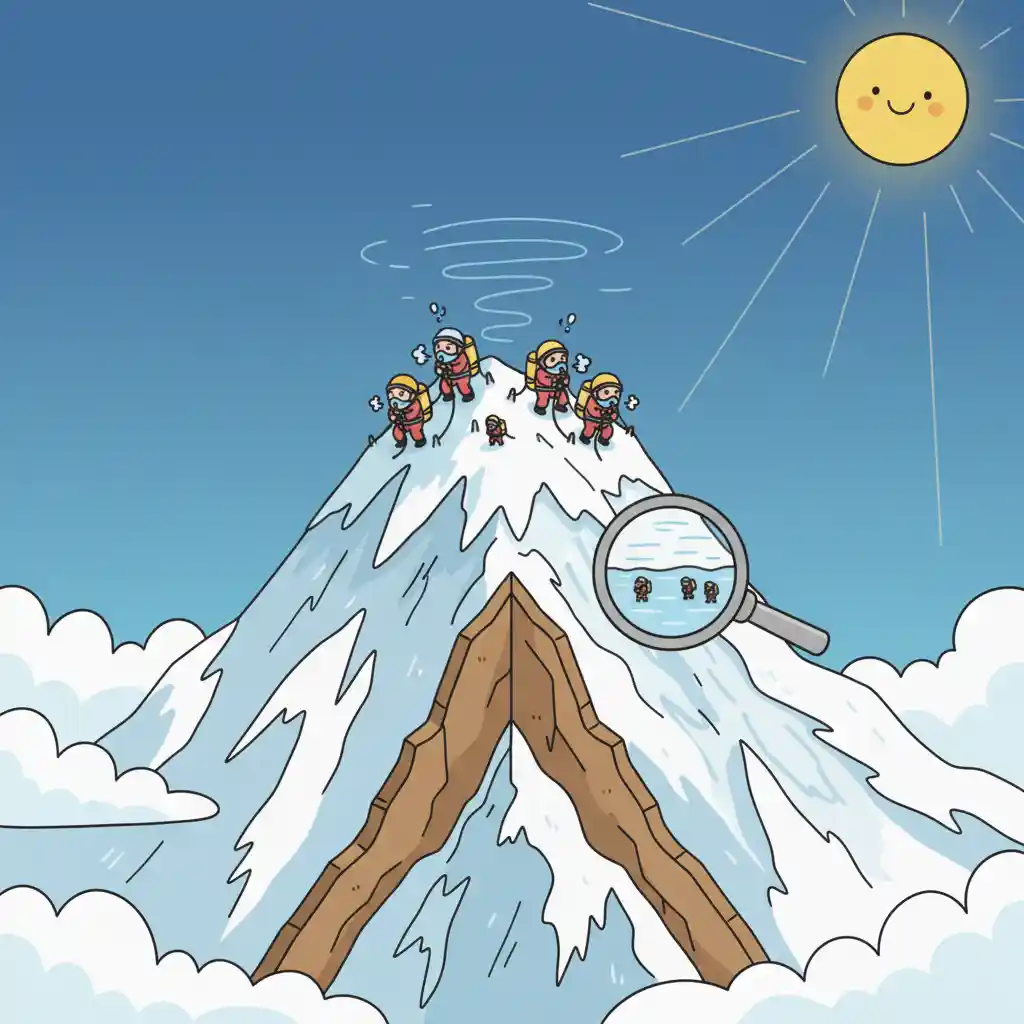
The Giant of the Sky
Imagine a mountain so tall, its peak touches the clouds, and sometimes even looks down on them! That's Mount Everest, the highest point on Earth, often called "Sagarmatha" (Goddess of the Sky) by the Nepali people. Reaching its top is one of the toughest adventures in the world, not just because it's a super steep climb, but because the air at the very top is incredibly strange – it’s super thin! It’s like trying to breathe underwater, but with no water around, just… less air. What makes this giant mountain grow so tall, and why does its air play such a tricky game? Let's find out!
Earth's Bumping Giants: How Mountains Are Made
Our Earth isn't one solid ball; it's more like a giant puzzle with huge, slow-moving pieces called "tectonic plates." Imagine these plates as massive rafts floating on a gooey, hot layer inside our planet. When two of these giant rafts crash into each other, something amazing happens! For Mount Everest, it was a colossal slow-motion car crash over millions of years. The plate carrying India actually bumped right into the plate carrying Asia! Instead of just crumbling, the land slowly buckled and folded upwards, like a rug being pushed from both ends, forming the magnificent Himalayan mountain range, with Everest as its tallest bump!
Everest's Growth Spurt!
Believe it or not, Mount Everest isn't finished growing! That slow-motion collision between the Indian and Eurasian plates is still happening. The Indian plate is continuously pushing northward into Asia, causing the land to keep rising. It's like a very, very slow-motion elevator! Scientists measure Everest's height with super-duper accurate tools and have found that it grows by a tiny amount each year – about 4 millimeters, which is roughly the thickness of two pennies stacked together! So, every year, Everest gets just a little bit taller, patiently reaching further and further into the sky.