
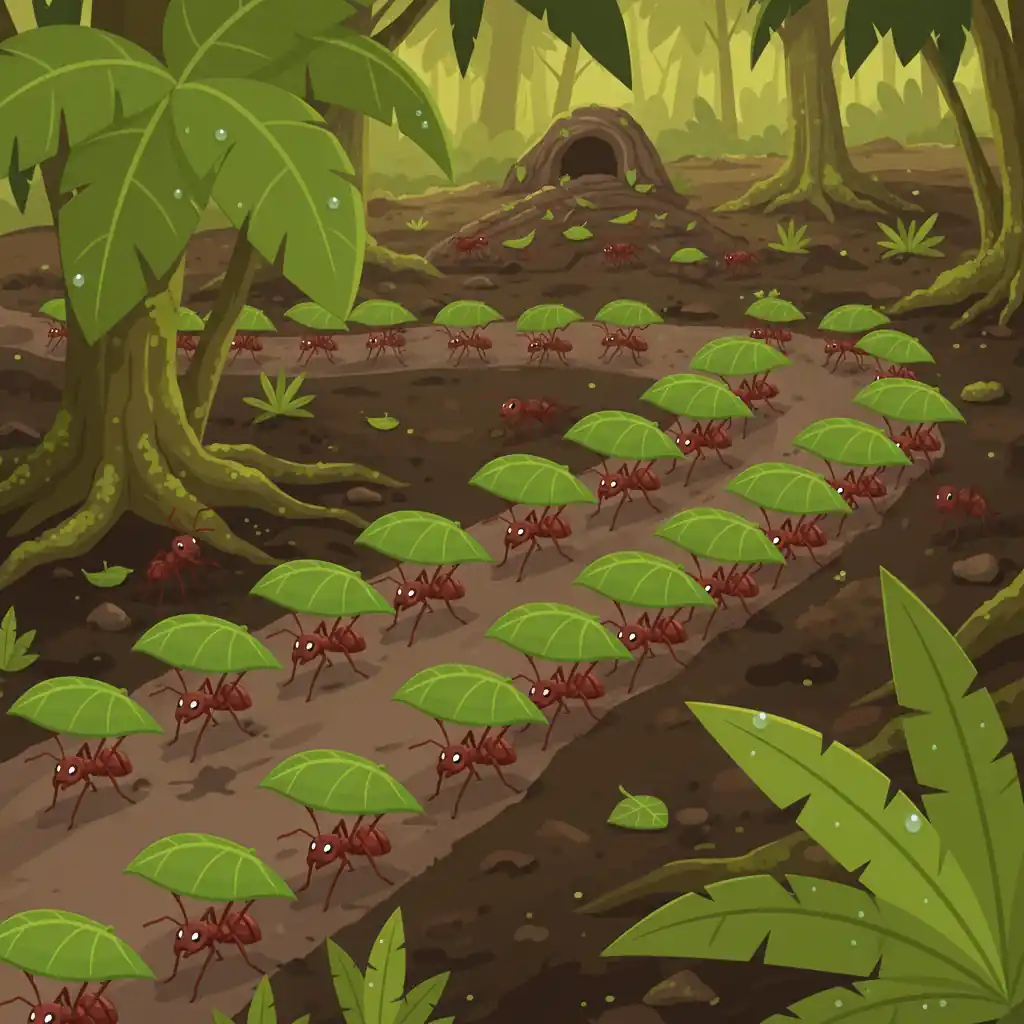
Meet the Tiny Gardeners!
Imagine a tiny ant, smaller than your pinky nail, carrying a piece of leaf many times larger than its whole body! It looks like a little green sail walking all by itself through the jungle. These incredible creatures are called leafcutter ants, and they are like the super-strong, super-organized gardeners of the rainforest. They live in huge families, sometimes with millions of ants living together, all working in perfect harmony to create mind-boggling underground cities.
They spend their days marching in long, organized lines, sometimes for hundreds of feet through the dense forest, each ant carefully balancing its precious green cargo on its head or back. It's truly an amazing sight, like watching a never-ending parade of tiny green umbrellas marching through the bustling jungle floor!
Why Carry Leaves? The Big Secret!
Now, here's a super cool secret about leafcutter ants: they don't actually eat the leaves they cut! That's right, those big green pieces aren't their lunch or dinner. Instead, they use the leaves to grow their own special food, a particular kind of mushroom or fungus. Think of it like a human farmer who doesn't eat the grass or hay he cuts from his fields. Instead, he feeds that grass to his cows, and then he drinks the cow's milk or eats its cheese.
The leafcutter ants are the farmers, and the leaves are the 'food' for their 'cows'—which are actually tiny, delicious fungi they cultivate underground! They carefully chew the leaves into a soft, pulpy paste and then meticulously place it in special, warm, and humid underground gardens where their fungus thrives.
Underground Cities and Super Highways
Leafcutter ants are truly incredible engineers and city planners! Their homes are not just simple holes in the ground; they are vast, complex, multi-level cities that can stretch for many feet both above and deep below the surface of the earth. Some of the largest nests discovered are so enormous, they could fill an entire house, boasting thousands of intricate tunnels, chambers, and specialized rooms.
To connect their bustling city to the distant patches of forest where they find the perfect leaves, they create elaborate 'super highways'. These are often smooth, clear paths, sometimes several inches wide and hundreds of feet long, worn down by millions of tiny ant feet. These highways are kept spotlessly clean by the ants themselves, ensuring a smooth, fast, and efficient commute for all their busy workers and their valuable cargo.
The Fungus Farm: Ant-Style Grocery Store
Deep inside their cozy, perfectly climate-controlled underground chambers, the ants have special rooms entirely dedicated to their incredible fungus farms. These aren't just messy piles of leaves; they are carefully tended gardens! When the worker ants bring the fresh leaf pieces home, other ants, even smaller ones called 'minims', take over. They meticulously chew the leaves into a soft, digestible mush. Then, they carefully place this mush onto the growing fungus garden.
The fungus then grows on this leaf mulch, digesting the plant material and transforming it into a soft, nutrient-rich food that the ants can easily eat. It's a perfect example of teamwork and a symbiotic relationship: the ants provide the ideal environment and food for the fungus, and in return, the fungus provides the ants with their only source of food. It's their very own underground grocery store, custom-grown for the colony!
Ants with Different Jobs: The Caste System
Just like in a busy human city where different people have different jobs (like doctors, teachers, builders, and chefs), leafcutter ant colonies have a remarkably organized system called a 'caste system'. This means there are different sizes of ants within the colony, and each size has a specific and crucial job to do, ensuring the colony runs smoothly.