
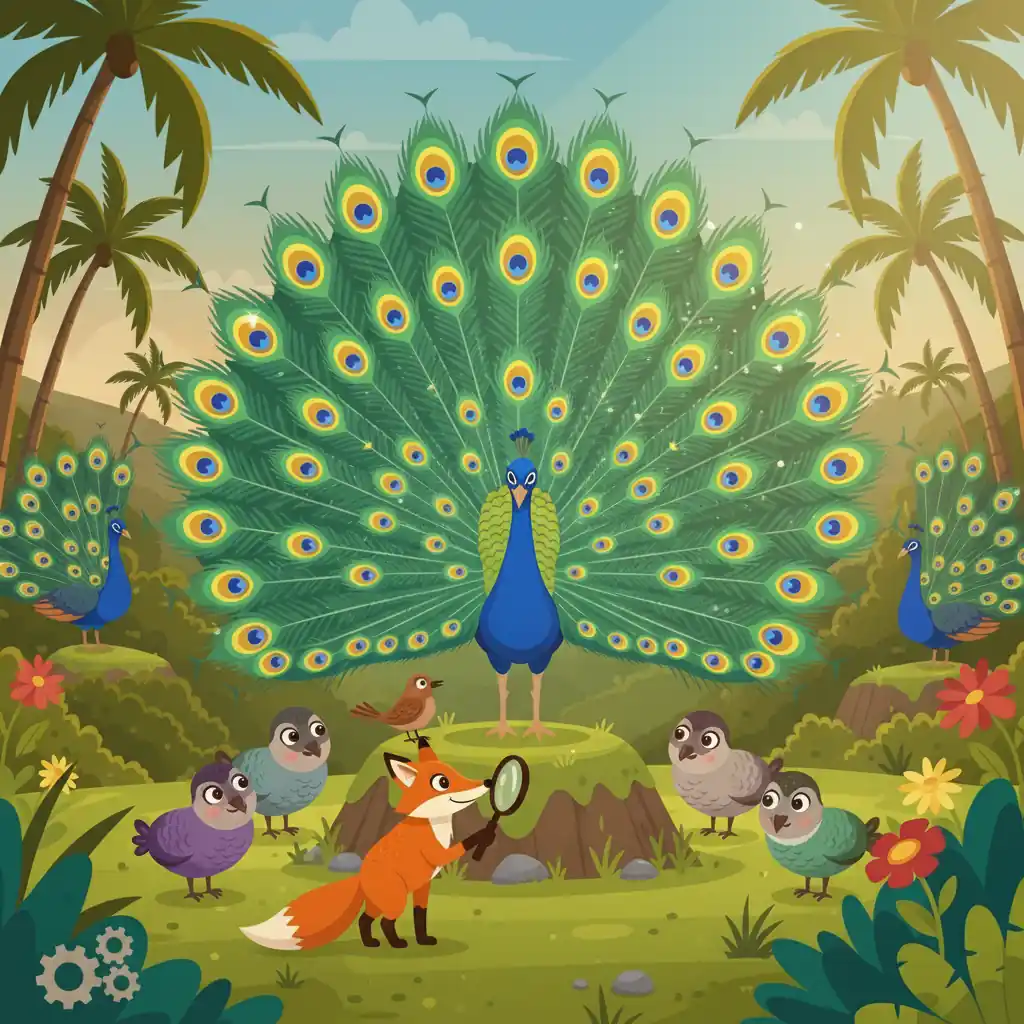
The Dazzling Mystery of the Peacock's Tail
Imagine a bird so magnificent, it looks like it stepped right out of a fantastical storybook! Peacocks, with their glorious, shimmering tails that fan out like a giant jewel-encrusted shield, are truly nature's superstars. But have you ever stopped to truly wonder why they possess such an incredible, over-the-top display? It's not just big and colorful; it's astonishingly heavy, incredibly hard to fly with, and screams, "Look at me!" to every hungry tiger, leopard, or wild dog lurking nearby. This seemingly impractical extravagance presents a huge puzzle for survival, doesn't it?
In a world where most animals evolve to blend into their surroundings, move quickly to escape danger, or conserve energy, the peacock's tail is a dramatic exception. It's like a living, breathing, giant billboard saying, "Here I am, come find me!" For a long time, even brilliant scientists like Charles Darwin, the father of evolutionary theory, were utterly baffled by this phenomenon. Why would evolution, the very process that meticulously sculpts creatures to survive and thrive, permit, let alone encourage, something so seemingly cumbersome and risky to become so spectacularly grand? This is the "Big Why" we're going to unravel today!
What's the Big Deal About That Tail?
Let's take an even closer look at this astounding tail, which scientists more accurately call a "train." It's not just long; it can grow up to a jaw-dropping 6 feet (almost 2 meters) in length! When fully fanned, it creates a massive, shimmering arc that can be over 7 feet wide. This makes the peacock seem like one of the largest flying birds on Earth, even though its actual body size is much smaller than its feather display. Each of the over 150 feathers that make up the train is tipped with a mesmerizing, iridescent "eye-spot," creating a hypnotic pattern.
These feathers aren't merely for aesthetics; they collectively weigh a considerable amount, adding significant bulk and drag that makes flying a laborious and energy-intensive task. Imagine trying to run a race while dragging a magnificent but heavy silk cape behind you! For a peacock, growing and meticulously maintaining such a magnificent tail consumes a huge amount of energy and vital nutrients every single year. Plus, consider the challenge of trying to hide from a stealthy predator like a leopard when you're adorned with a tail that long, wide, and brilliantly colored! It's akin to playing hide-and-seek while wearing a flashing neon sign and ringing bells. Clearly, there must be an extraordinarily compelling reason for this extraordinary display to have evolved.
Nature's "Survival of the Fittest" - Natural Selection
Before we dive deeper into the peacock's unique secret, let's briefly revisit a fundamental concept in nature: Natural Selection. This powerful force acts like a strict coach, constantly evaluating and selecting the most effective players for life's grand team. Animals with specific traits that significantly enhance their chances of survival (such as being exceptionally fast to outrun predators, possessing superb camouflage to remain hidden, or developing keen senses to find food) are far more likely to live long enough to reproduce.
When these advantageous traits help an animal survive longer and, crucially, produce more offspring, those useful characteristics are much more likely to be passed down through generations. Over countless years, these beneficial traits become more prevalent within a species. However, the peacock's tail, at first glance, appears to defy this logic! It seems to do the complete opposite: it makes them slower, highly visible, and drains a lot of precious energy that could be used for other survival activities. So, how could the very mechanism of natural selection, which champions efficiency and survival, possibly favor such a spectacular, yet seemingly detrimental, fashion statement? This is where another, equally powerful, type of selection comes into play.
The "Beauty Contest" - Sexual Selection and Peahen Power
Here's where the captivating secret sauce of the peacock's tail truly comes into play: it's not solely about surviving; it's also, and perhaps even more critically, about reproducing! While natural selection fine-tunes an animal's ability to live, another incredibly powerful evolutionary force called sexual selection specifically influences an animal's ability to attract a mate and successfully have babies. In the fascinating world of peacocks, the peahens—the female peacocks—are the discerning judges of this extraordinary "beauty contest." They hold the ultimate power to choose which males they will allow to father their offspring.
And what exactly do these discerning peahens look for? They are overwhelmingly drawn to the biggest, brightest, most vibrant, and most exquisitely "eye-spotted" tails! It's as if they're holding up a score card and demanding, "Show me your most impressive genetic advertisement!" A male peacock proudly displaying a truly spectacular tail is, in essence, making a bold declaration: "Look at me! I am so incredibly strong, so remarkably healthy, and so exceptionally skilled at finding food and cleverly avoiding predators, that I can not only survive but also flourish while growing and carrying this enormous, heavy, and flashy tail. I must surely possess super-duper 'good genes' that would be perfect for our babies!"