
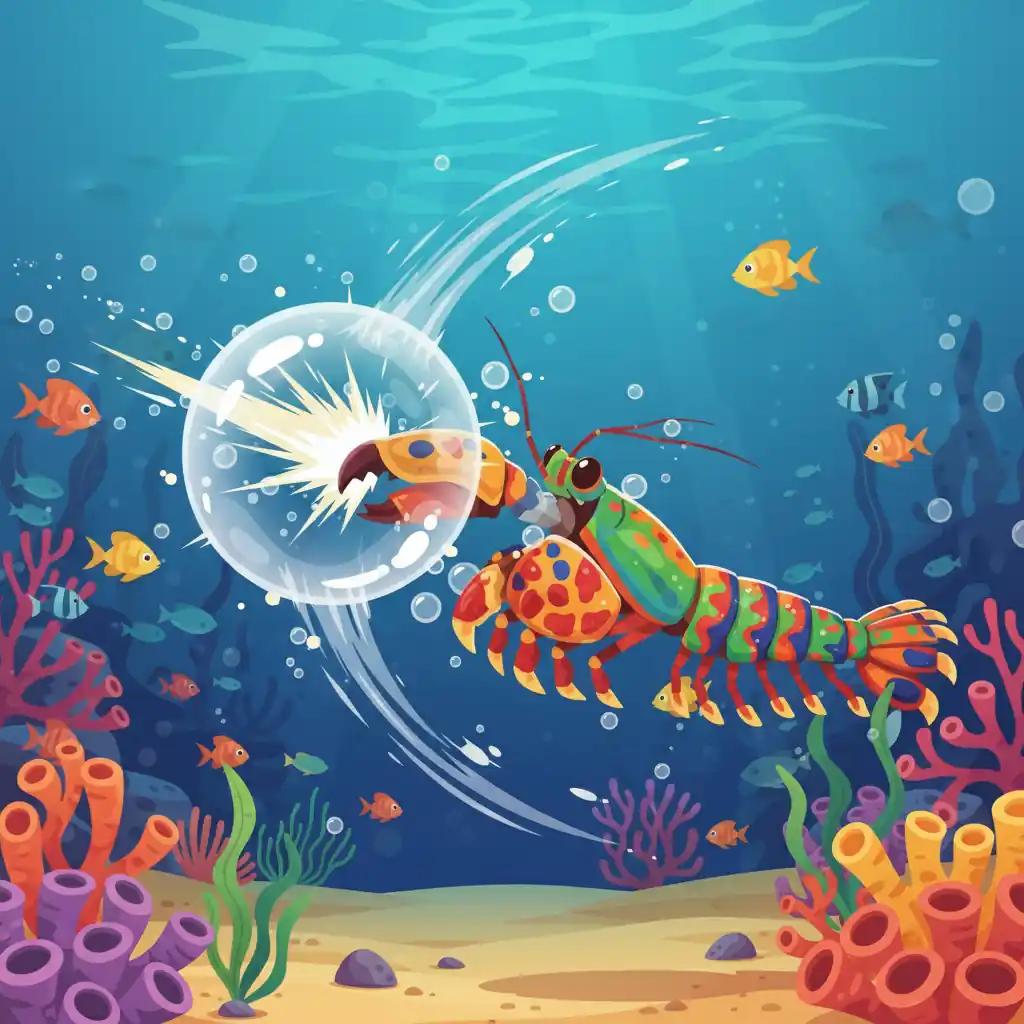
Meet the Mantis Shrimp: Tiny Terror of the Ocean!
Imagine a creature living in the colorful coral reefs, no bigger than your hand, that can throw a punch faster than a bullet and create an explosion underwater! Sounds like something out of a superhero comic, right? Well, meet the mantis shrimp, often called the 'thumb-splitter' or 'prawn killer' for good reason. These aren't your average shrimp; they're dazzlingly colored, with eyes that are out of this world, and a secret weapon that makes them one of the most incredible hunters in the entire ocean. Forget about gentle swimming; these guys are all about speed and shockwaves!
Mantis shrimp come in many shapes and sizes, often sporting bright blues, greens, and reds, making them look like underwater jewels. But don't let their beauty fool you. Hidden beneath their exoskeletons is a spring-loaded mechanism that powers the most astonishing strike in the animal kingdom. They spend most of their lives tucked into burrows in the sand or rocks, patiently waiting for an unsuspecting crab, snail, or fish to swim by. When they decide it's time to eat, watch out! You're about to witness nature's very own 'bullet punch' in action.
The Fastest Punch in the West (and East!): How It Works
There are two main types of mantis shrimp, and their weapons are slightly different. Some are 'spearers,' which have sharp, barbed claws that they quickly extend to impale soft-bodied prey like fish. Think of them as tiny, lightning-fast fencers. But the real stars of our story are the 'smashers.' These incredible creatures have club-like forelimbs, often called dactyl clubs, that are incredibly dense and strong, like tiny hammers made of super-tough ceramic.
How do smashers create such an explosive punch? It's all about stored energy, much like pulling back a slingshot as far as it can go before letting it snap forward. The mantis shrimp's club is connected to a special 'saddle' on its back. Muscles pull this saddle way, way back, storing an enormous amount of potential energy. A tiny latch holds this energy in place, like a finger holding a stretched rubber band. When the mantis shrimp decides to strike, it simply releases the latch, and BAM! All that stored energy is unleashed in less than two-thousandths of a second. This strike is so fast, it reaches speeds of up to 50 miles per hour, making it one of the fastest movements in the entire animal kingdom relative to its size!
Unpacking the 'Bullet': The Mechanics of Power
Let's zoom in on the physics of this amazing punch. The mantis shrimp's 'club' is made of a unique material that's super-hard on the outside and softer and springier on the inside, preventing it from breaking. Scientists are even studying it to build stronger materials for human use! When the mantis shrimp pulls its dactyl club back, it's not just using brute force. It's using a complex system of muscles and spring-like tendons that act like a giant coil.
Imagine trying to throw a tennis ball. You use your muscles directly. Now imagine winding up a toy car with a spring. When you let go, the spring does all the work, launching the car much faster than you could push it! The mantis shrimp's punch is like that toy car on steroids. Its muscles contract slowly, storing energy, then a tiny latch releases it all at once, accelerating its club from zero to 50 mph in the blink of an eye. The impact force is hundreds of times its own body weight, enough to crack open the hardest clam shells and even shatter aquarium glass!
The Incredible Cavitation Bubble: Underwater Explosion!
The actual 'explosion' isn't just the club hitting something. That's only half the story! The mantis shrimp's punch is so incredibly fast that it actually pushes the water away from its club with such force that it creates tiny, super-hot bubbles. This phenomenon is called 'cavitation.' Think about a boat propeller spinning very fast; sometimes it creates tiny bubbles behind it. The mantis shrimp does this, but on a super-charged level!