
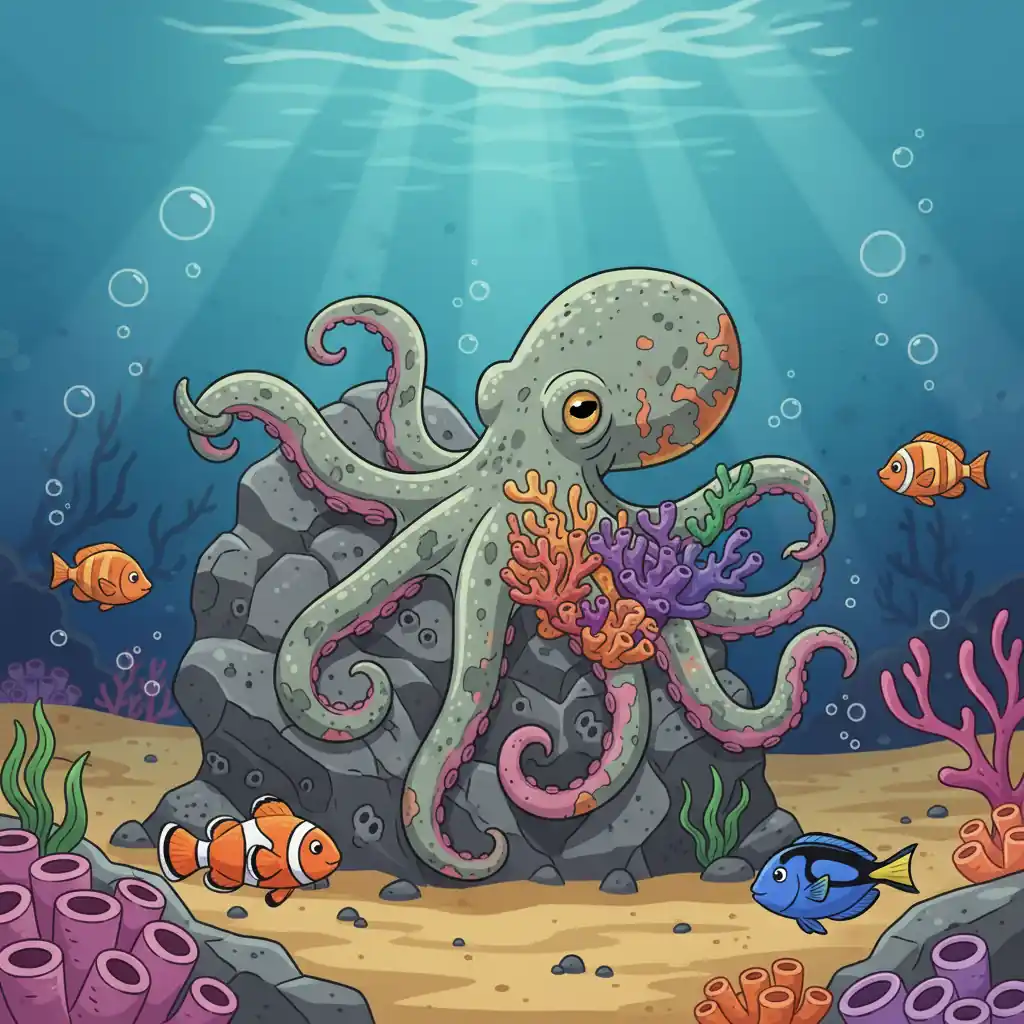
The Ultimate Costume Change Artists
Imagine you're playing hide-and-seek, but instead of just ducking behind a tree, you could instantly become the tree! Or a rock! Or even a pile of seaweed! That's exactly what octopuses can do, making them the ocean's undisputed champions of disguise. They are like magical chameleons on super-speed, transforming their skin in the blink of an eye to blend perfectly with their surroundings.
From a smooth, bright white to a bumpy, mottled brown, an octopus can rewrite its entire 'outfit' in less time than it takes you to snap your fingers. This incredible ability isn't just for looking cool; it's how they survive. It helps them hide from hungry sharks and sneaky moray eels, and it also helps them sneak up on their own lunch, like crabs and fish. It's a superpower of camouflage!
Your Skin's Magic Paint Palette: Chromatophores!
How do they do it? The secret lies in special cells in their skin called 'chromatophores' (say: kro-MA-toh-fores). Think of these cells like tiny, elastic balloons filled with different colors—red, yellow, brown, and black. Each chromatophore has tiny muscles attached to it, like strings on a puppet.
When an octopus wants to change color, its brain sends a signal to these muscles. If the muscles pull, the 'color balloon' stretches wide, spreading its pigment and making that part of the skin colorful. If the muscles relax, the balloon shrinks back, and the color disappears! By controlling thousands of these little balloons, stretching some and shrinking others, the octopus can create almost any pattern or shade it needs.
Beyond Color: Light and Sparkle!
But an octopus's disguise isn't just about color. Have you ever seen something that seems to shimmer or change color when you look at it from different angles? Octopuses have cells for that too! They have 'iridophores' (eye-RID-oh-fores) which are like tiny mirrors that reflect light, creating shiny, iridescent blues, greens, and silvers.
And then there are 'leucophores' (LOO-koh-fores). These cells scatter all wavelengths of light, making them appear white. This is super important because it helps the octopus match the brightness of its environment. If they are hiding in bright sand, they can activate their leucophores to appear whiter and blend in even better. It's like having built-in light reflectors!
Instant Makeover: Changing Shape and Texture
Imagine trying to hide from a scary monster, but your skin is smooth and flat, while all around you are bumpy rocks. That wouldn't work very well, would it? Luckily for octopuses, they can change the texture of their skin too! They have special muscles that can raise little bumps and spikes called 'papillae' (pah-PILL-ee).
In a flash, a smooth-skinned octopus can erupt with spiky papillae to look exactly like a jagged rock or a patch of coral. Or, if it's hiding in soft sand, it can flatten its skin completely. This ability to instantly change from sleek to spiky (and back again!) makes their camouflage unbelievably effective, fooling even the keenest eyes of predators and prey.