
The Scholar's Endless Night
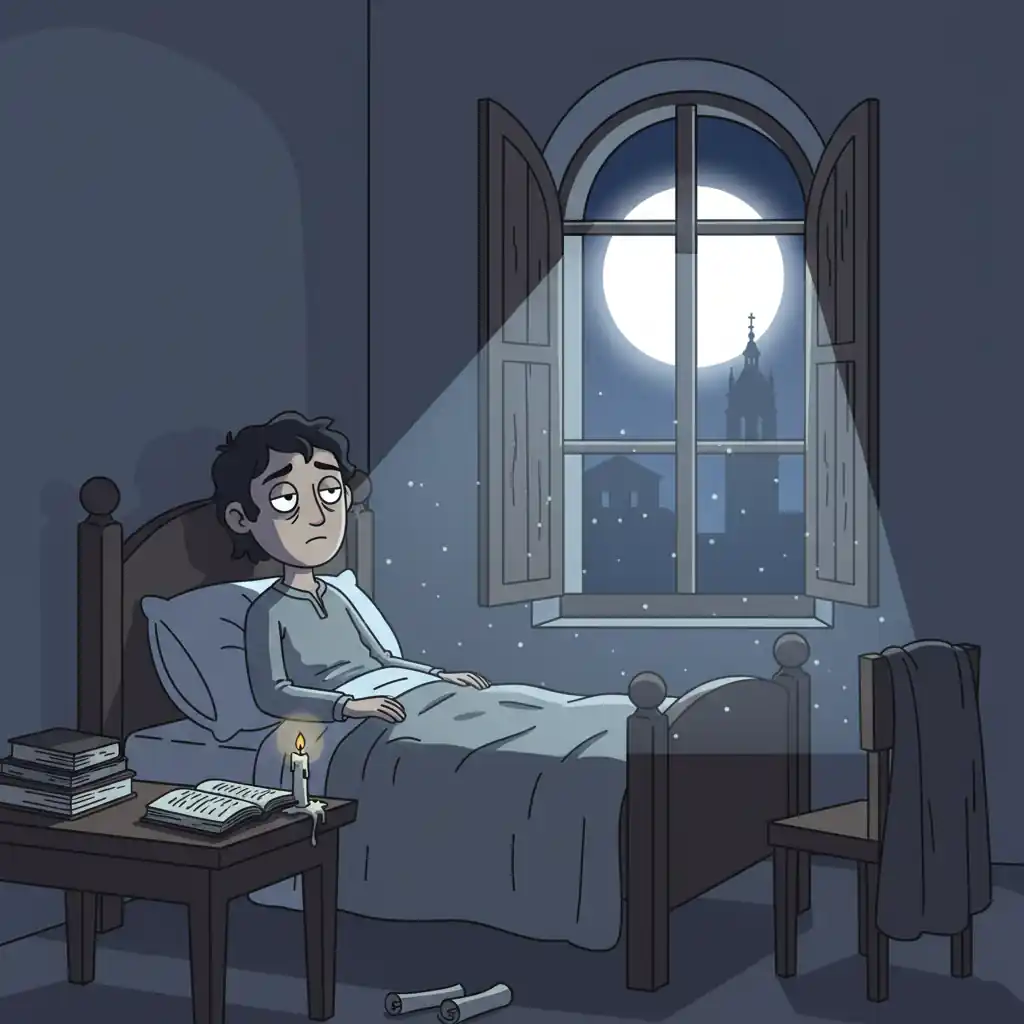
Four hundred years ago, in the ancient city of Salamanca, lived a young scholar named Tomás. He was a bright student, known for his quick wit and even quicker handwriting. But like many students facing a mountain of books, Tomás knew anxiety well.
His final exams loomed. Philosophy, Latin, Rhetoric – each subject felt like a personal challenge. The weight of it all pressed down on him, especially as night fell.
One particular night, the air was cool and still. The moon, a sliver of silver, peeked through his narrow window. Inside his small room, a single candle flickered, casting long shadows of his open books across the wall.
Tomás lay in bed, staring up at the ceiling. He had spent the day poring over scrolls and treatises. His mind, usually sharp, now felt like a runaway horse, galloping through every possible question he might be asked.
He tried to relax. He counted sheep, then counted the cracks in his ceiling. He tried to think of nothing. Nothing worked.
The hours crawled by. The candle burned lower. The moon moved slowly across the sky. Yet, Tomás remained wide awake. His eyes simply refused to close for good.
The Stubborn Eyelids
Tomás pushed himself up, leaning against the cold stone wall. He rubbed his eyes, feeling the dry, gritty sensation. He closed them tightly, squeezing them shut, hoping to force them into submission.
But it was no use. The moment he relaxed, they sprang open again. They felt light, disconnected, stubbornly independent. It was as if they actively resisted the simple act of staying closed.
He thought about how sleep usually felt. When sleep came easily, it was like a gentle adhesive. His eyelids would soften, grow heavy, and then subtly stick together, sealing out the world.
Tonight, there was no such glue. There was no stickiness, no natural bind. His eyes were loose, free to snap open at the slightest flicker of thought or sound. Every time he tried to 'stick' them shut, they just bounced back.
It was a frustrating, almost comical battle. His eyelids, usually so cooperative, had turned rebellious. They would not 'peg'. They would not 'glue'.
The first faint streaks of dawn appeared. Birds began to chirp. The candle finally sputtered out. Tomás slumped back, utterly defeated by his own eyes.
A New Way to Describe Wakefulness
The next morning, haggard and exhausted, Tomás met his fellow scholars. They asked him how he had fared, ready to share their own tales of late-night study.
“I couldn’t,” Tomás declared, his voice rough with fatigue. “I couldn’t even glue my eyes shut for a second. No pegué ojo.”
His friends paused. The image was immediate and powerful. They understood. It wasn't just 'sleeping badly'; it was a complete failure of the eyes to seal themselves for rest.