
Order in the Chaos
The year is 1476. Spain is a wild, untamed land. Villages are isolated. Bandits roam freely. People live in constant fear, hoping for protection that rarely comes.
King Ferdinand II of Aragon and Queen Isabella I of Castile have big plans. They are busy uniting Spain, but they also want order. They want peace. Especially outside the castle walls and major cities.
Their solution is revolutionary for its time: The 'Santa Hermandad' – the Holy Brotherhood. This is not just a local militia. It's a national police force, the first of its kind.
Their mission is clear: patrol the roads, protect pilgrims, hunt down thieves, and bring royal justice to the most remote corners of the kingdom. They are a symbol of royal authority, riding into the lawless regions.
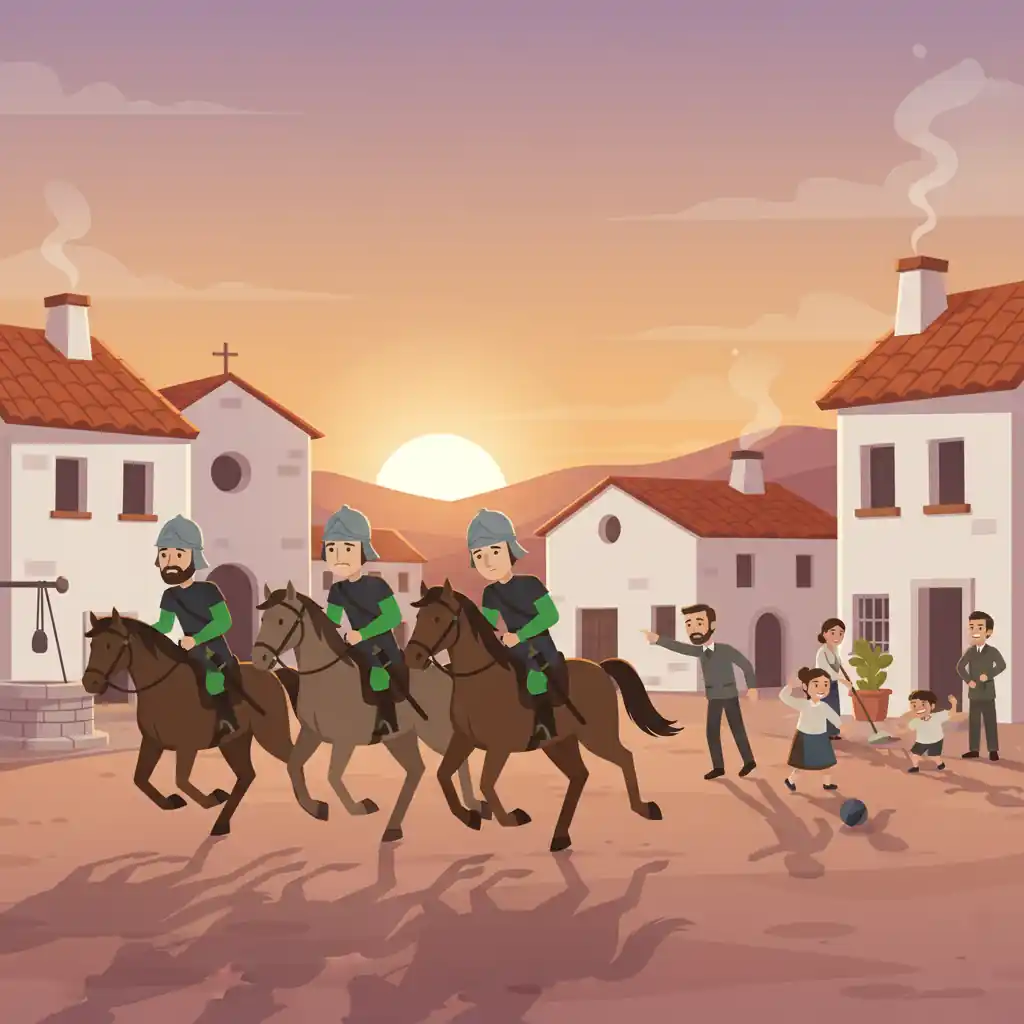
The Hermandad has a distinct uniform. Their tunics are practical, sturdy. But the most recognizable feature? Bright, unmistakable green sleeves worn on each arm. Easy to spot from a distance.
These 'Green Sleeves' become a new sight. A promise. Villagers, tired of endless raids and local feuds, greet the news with hope. Finally, someone powerful will answer their cries. Justice will ride into town, swiftly and decisively.
But Spain is a vast country. News travels slowly. Roads are often little more than goat paths. And danger, as it always does, moves with brutal speed.
The Long Road to Justice
Imagine a small, quiet village nestled deep in a valley. One night, a band of ruthless outlaws descends. They raid homes, steal livestock, inflict harm, and sow terror. Then, as quickly as they appeared, they vanish into the darkness.
The villagers, shaken but determined, immediately send for the Hermandad. Their fastest rider is dispatched, galloping for miles, pushing horse and self to the limit, desperate to reach the nearest outpost.
That outpost might be a full day’s ride away. Once there, the message needs to be processed. The Hermandad then has to gather its men, prepare their horses, and assemble provisions. This takes another day, sometimes two.
The journey back is just as arduous. Mountain passes, winding rivers, muddy trails, or scorching plains. All contribute to the inevitable delay. Justice, it seems, travels at a pace entirely its own.
By the time the Green Sleeves finally arrive, usually dusty, tired, and grim-faced, days have passed. Often four, five, or even six days. Sometimes more than a week.
The scene has changed dramatically. The chaos is over. The villagers have already buried their dead, tended to their wounded, and begun the heartbreaking task of cleaning up their ruined homes.
The bandits? Long gone. Vanished with their loot, probably a hundred miles away, enjoying their spoils. There is no fresh trail to follow. No culprits to catch. Just the quiet, sorrowful aftermath of a crime.
The Hermandad would dismount. They’d survey the scene. They’d ask questions. But everyone knew it was too late. Their presence was a comfort, perhaps, but offered no practical help for this particular tragedy.
This pattern repeated constantly. The Green Sleeves were brave and dedicated. But the sheer geography, poor roads, and primitive communication systems of 15th-century Spain constantly undermined their efforts.
Their bright green sleeves, once a symbol of hope, slowly became a symbol of something else entirely: futility.
A Sarcastic Welcome
Over time, the villagers learned a harsh lesson. When disaster struck, they were largely on their own. They cleaned up, mourned, and simply tried to move on. Help, when it finally arrived, was always an afterthought.