
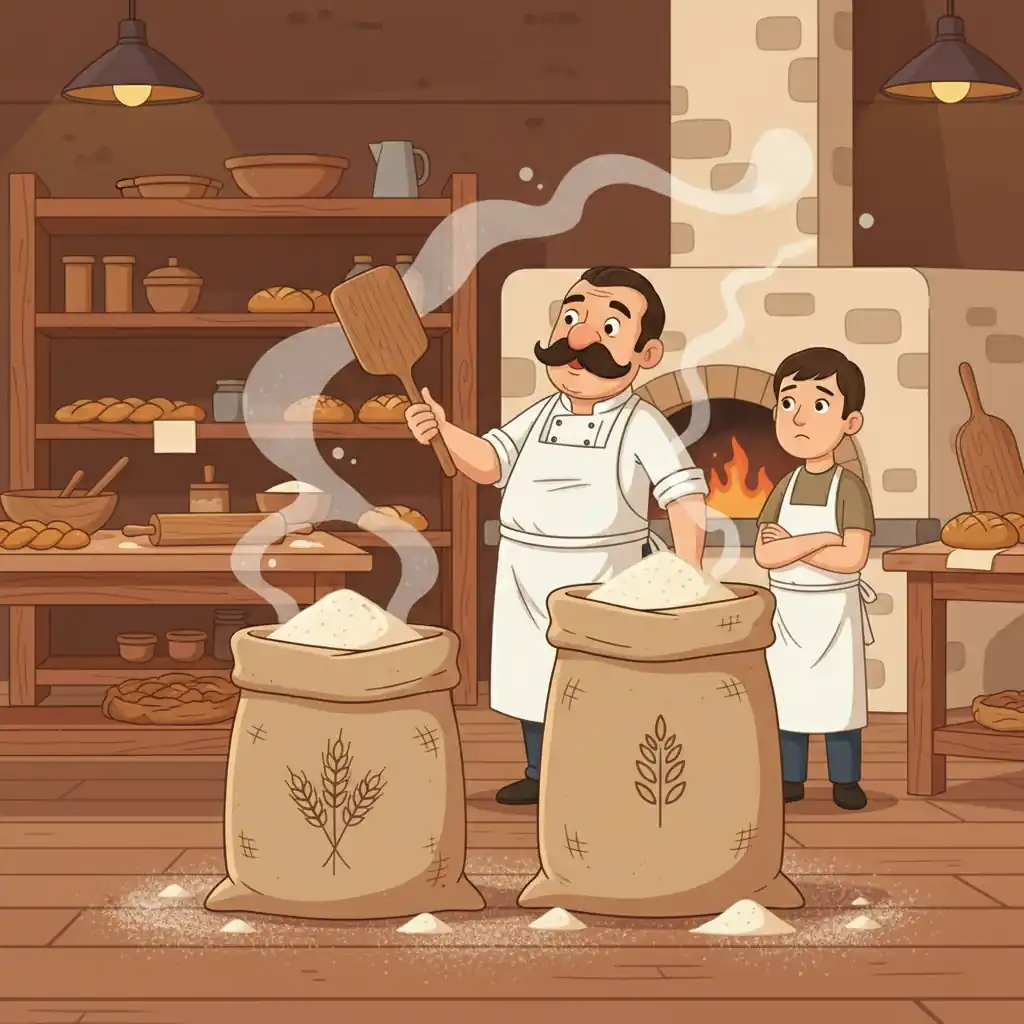
The Village Mill
Centuries ago, in a sun-drenched valley in Andalucía, stood the bustling village of Los Molinos. Its name, 'The Mills,' was no accident. A vital part of village life revolved around the steady grind of the water wheels, turning farmers' grains into life-sustaining flour.
Every harvest season, farmers lined up with their heavy sacks. Each sack held grain of the highest quality. But they were not all the same. Some sacks contained golden wheat, destined for crusty white loaves. Others held dark, earthy rye, perfect for dense, hearty bread. And then there was barley, often used for animal feed or specialty baking.
The villagers understood the difference. Each grain had its purpose. Mixing them carelessly would ruin a batch, turning perfect ingredients into something unusable.
Maestro Esteban ran the main mill. He was a man with hands permanently dusted white and an eye as sharp as a falcon. He knew every farmer by the feel of their sacks, by the specific aroma of their harvest. To him, flour wasn't just flour. It was the soul of bread, and souls had distinct characters.
He taught his apprentices the importance of segregation. 'This sack,' he'd instruct, pointing, 'is for the white bread. That one, for the dark bread. Never confuse them. They are different worlds, even if they both nourish us.'
The Mix-up
One crisp morning, a new apprentice named Ricardo started his shift. He was young, eager, but sometimes a little too quick to assume. He watched as farmers unloaded their sacks. Wheat, rye, barley—to Ricardo, they all looked like pale, dusty bags of grain.
Maestro Esteban had just finished grinding a large batch of fine wheat flour for the week's most popular bread. The empty flour bin stood ready for the next order. A farmer arrived with a heavy sack of rye.
'This is for the dark loaves, Maestro,' the farmer confirmed. 'Special order for the monastery.'
Maestro Esteban nodded, preparing to clean the millstones for the different grain. But before he could, Ricardo, trying to be helpful, hoisted the rye sack onto his shoulder.
'I'll just add it to this bin, Maestro!' Ricardo announced, heading for the wheat flour container. 'It's all flour, right? Saves a step.'
The Maestro's eyes widened. He lunged forward, grabbing Ricardo's arm just as he was about to tilt the sack.
'Stop!' Esteban's voice cracked like a whip. The entire mill went silent. The farmers paused their conversations. The grinding stones stopped their hum.
The Master's Correction
Ricardo froze, the heavy sack of rye flour still balanced precariously. He looked confused. 'But Maestro, it's just flour.'
Esteban slowly took the sack from Ricardo, placing it gently on a separate stone slab. He picked up a pinch of the finely ground wheat from the bin. Then he took a pinch of rye from the sack. He showed them to Ricardo.
'Look closely, boy,' Esteban said, his voice calmer now, but still firm. 'This wheat flour makes soft, airy bread. It rises high. This rye flour makes dense, heavy bread. It has a different taste, a different texture.'
'You cannot mix them for the same recipe. If you try to bake wheat bread with rye flour, or rye bread with wheat flour, you will get nothing good. You will waste everything.'