
The Great Schism
The year 1378. A terrible time for the Catholic Church. Two men claimed the papacy. One in Rome, one in Avignon, France. The Great Western Schism tore through Europe. Kingdoms split their loyalties. Bishops chose sides. It was a true crisis of faith and power. People across the continent cried out for unity. They demanded an end to the spiritual chaos.
In the Kingdom of Aragon, a sharp-witted cardinal observed the turmoil. His name was Pedro de Luna. He was known for his sharp intellect. His cunning mind. His iron will. In 1394, the Avignon cardinals elected him their Pope. He became Benedict XIII. He took a solemn oath. He promised to heal the Church's wounds. He would even resign, he declared, if it meant peace and an end to the schism.
But Pope Benedict XIII was a man of fierce conviction, perhaps too much so. He quickly came to see himself as the sole, true Pope. The legitimate successor to Saint Peter. He was number thirteen in the Avignon line of Popes. This numerical designation was more than just a title; it was his identity. It represented his unshakeable claim. He believed in his divine right. He would not surrender it. Not for any king. Not for any council. Not for anything.
The World Withdraws
The world's patience wore thin. Years bled into decades. The schism continued, fueled by Benedict's stubbornness. Kings across Europe grew tired of the division. They demanded a resolution. The simplest solution was clear: both Popes should step down.
France, a long-time supporter of Avignon, dramatically withdrew its allegiance from Benedict. Castile soon followed suit. Then Scotland, and other smaller states. His support base crumbled rapidly. Benedict was losing his kingdom, piece by piece.
His own cardinals, once loyal, now pleaded with him to resign. They implored him to consider the Church's suffering. They reminded him of his sacred oath. Benedict refused every plea. His resolve was like granite. He interpreted their pleas as weakness. As personal betrayal. He believed he was the true Pope. How could he abandon his divine mission?
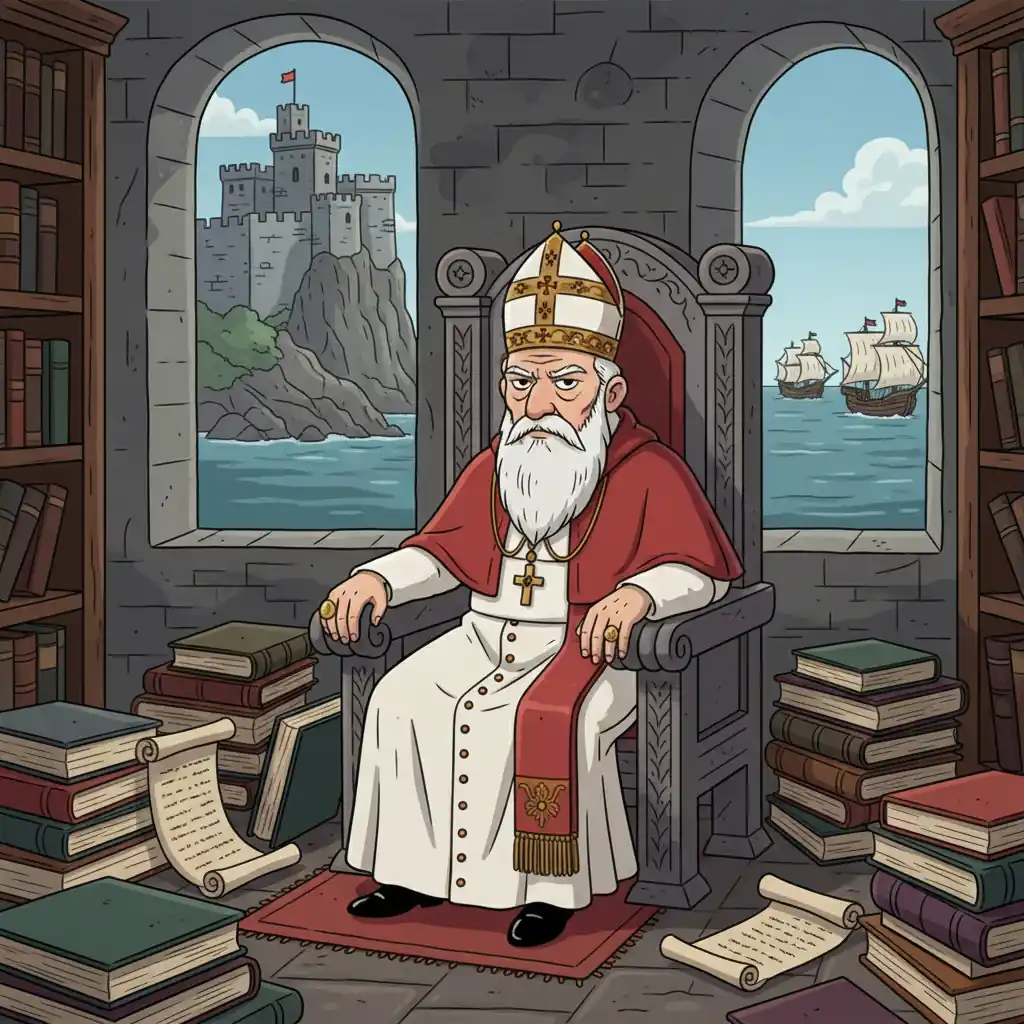
One by one, his cardinals abandoned him. They slipped away from his palace. They vanished into the night, seeking peace elsewhere. This left him utterly isolated. Alone. He retreated to his impregnable fortress. Peñíscola. A magnificent castle perched high on a rock. It jutted out defiantly into the Mediterranean Sea. Its thick, ancient walls stood strong. A natural, formidable stronghold.
Here, in his stone sanctuary, Benedict remained. A Pope without a flock. A leader without followers. Only a handful of truly loyal servants chose to stay by his side. Perhaps they genuinely believed in his unwavering claim. Or perhaps they simply felt compassion for the aged, defiant man.
The Siege of Peñíscola
The wider Church had indeed moved on. In 1417, the Council of Constance finally elected a new, undisputed Pope: Martin V. The Great Western Schism was officially over for almost everyone. But not for Benedict XIII. He was formally declared a heretic. An antipope. He was stripped of all titles. All ecclesiastical power. He became an outcast. A historical anomaly.
But Benedict XIII did not care. He scorned the decrees from Constance. He dismissed the authority of the Council. He was still Pope, he insisted. "Benedict XIII, True Pontiff." He continued his daily routine within Peñíscola's walls. He walked the sea-battered ramparts. He immersed himself in his vast library, a true scholar. He wrote endless letters. They were addressed to kings. To rival cardinals. To the new Pope in Rome.
These letters were utterly ignored. They were never even acknowledged. They piled up, gathering dust in his study. Yet, he signed every single one. "Benedict XIII." That number. It was his essence. His identity. His unbreakable, unyielding claim. The outside world saw an old man clinging to a pathetic fantasy. Benedict saw himself as the last true defender of spiritual truth.