
The Farmyard Observation
Centuries ago, in the sun-drenched farmlands of rural Spain, life moved with the rhythms of nature. Farmers rose with the sun, tending their fields and their animals. Every creature on the farm had its purpose, and its quirks. None more so, perhaps, than the turkey.
Turkeys, especially the young ones, were a source of endless amusement and occasional frustration. They were gangly creatures, all neck and legs, still learning how to navigate the world without tripping over their own feet. Their movements were jerky, often a flurry of awkward flapping and clumsy steps.
A young pavo, a turkey, had a voice that was just as undeveloped as its coordination. It made a series of odd, gurgling sounds, a sort of half-gobble that hadn't quite found its full resonant power. They seemed perpetually surprised by their own noises.
But the most striking thing about these birds was their skin. When agitated or excited, the bare skin around their heads and necks would flush with color. From pale pink, it could turn a brilliant, embarrassing red in a heartbeat. It was an unmistakable visual signal of their inner turmoil, or perhaps just their general fluster.
Farmers, accustomed to observing every detail of their livestock, noted these traits. They saw the young turkeys bumbling around, making strange noises, and blushing like a ripe tomato. It was a common sight, a part of daily farm life, and it rarely failed to bring a smile or a shake of the head.
The Blushing Teen
In these same villages, children grew up surrounded by these animals. And just like the turkeys, children had their own awkward stages of growth.
Meet Mateo, a boy on the cusp of manhood. One day he was a child, the next he seemed to sprout overnight, all arms and legs. He tripped over invisible obstacles, bumped into doorframes, and couldn't quite figure out where his feet were supposed to go.
His voice, once steady, began to crack at inconvenient moments, jumping from a deep rumble to a high-pitched squeak. It was as unpredictable as a summer storm.
But Mateo's most defining characteristic, common among many his age, was his blush. A simple question from an adult, an unexpected compliment, or even just being looked at directly could send a wave of crimson across his face, from his neck to the tips of his ears.
He’d stammer, look at his shoes, and desperately wish the ground would swallow him whole. His friends, experiencing similar changes, understood completely. The adults, however, found it quite amusing.
The Comparison
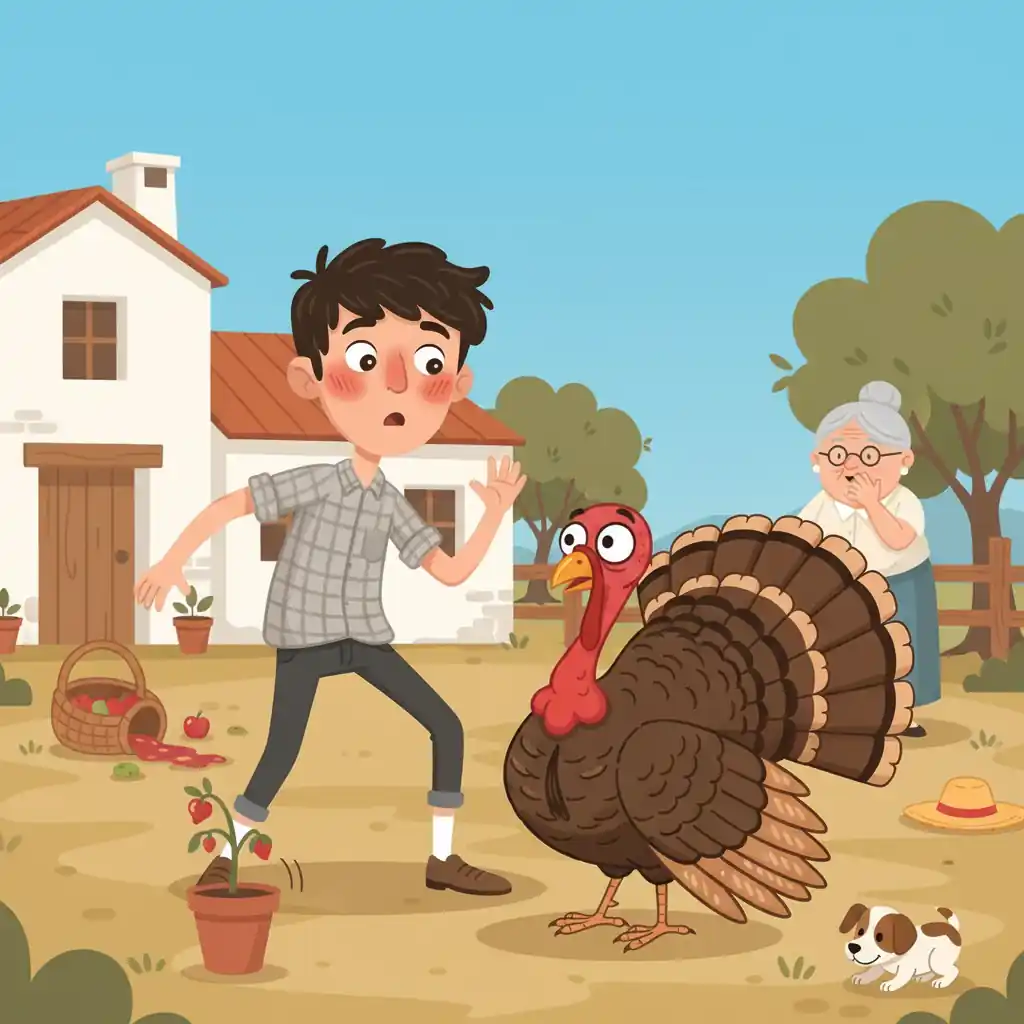
One sunny afternoon, Abuela Carmen sat on her porch, shelling peas. Her sharp eyes watched the bustling farmyard. A young turkey, startled by a sudden breeze, flapped its wings wildly, tripped, and then puffed up its neck, turning a vivid red.
A moment later, her grandson Mateo stumbled past, nearly dropping a basket of apples. When Abuela Carmen called out a gentle inquiry about his day, Mateo’s face immediately flushed a deep, undeniable scarlet. He mumbled a response, his voice cracking twice, and then hurried away.
Abuela Carmen watched him go, a knowing smile playing on her lips. She looked from the retreating figure of her grandson to the still-flustered turkey. The similarities were striking.
She chuckled softly, shaking her head. “Ay, pobre Mateo,” she murmured to herself. “Está en la edad del pavo.” He is in the age of the turkey.