
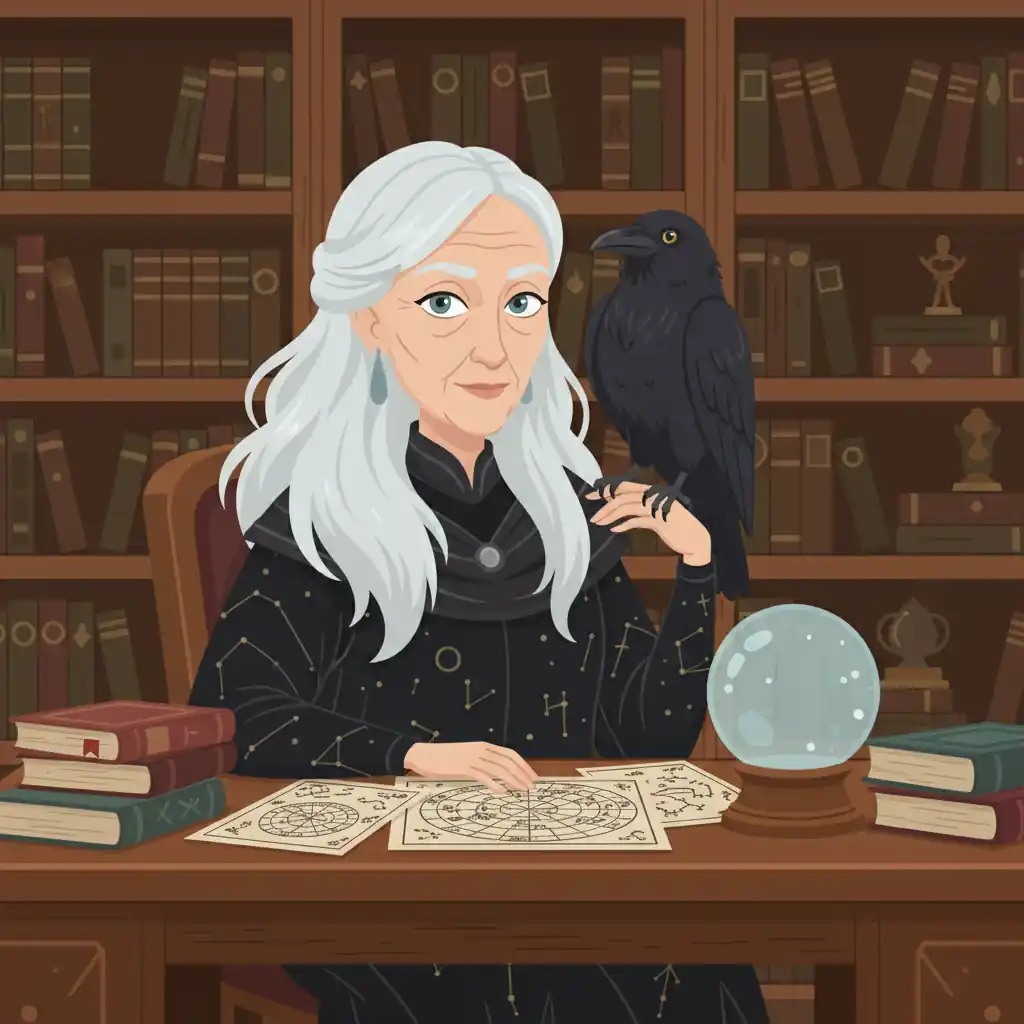
PROLOGUE: THE ENGLISH ECCENTRIC AND HER FAMILIAR
In the mid-20th century, as the world teetered between rigid tradition and burgeoning counterculture, a peculiar figure emerged from the quiet lanes of England to stride onto the global stage. She was Sybil Leek, a woman who, with her striking appearance, eloquent speech, and an ever-present pet jackdaw named Hotfoot Jackson perched on her shoulder, would redefine the public image of witchcraft. She wasn't the wart-nosed hag of fairy tales; she was an erudite, aristocratic-sounding woman who spoke of ancient wisdom, natural healing, and the cosmos with a calm authority that captivated millions. Her ascent marked a seismic shift, pulling the esoteric from the shadows of superstition into the spotlight of popular culture.
Leek didn’t just claim to be a witch; she lived it publicly, unapologetically, and with an undeniable flair for the dramatic. She presented witchcraft not as devil worship or black magic, but as an ancient, nature-based spirituality, a philosophical path rooted in astrology, numerology, and the reverence for life itself. For many, she was their first exposure to a modern witch, and she made the concept seem not just acceptable, but fascinating.
Yet, beneath the polished persona and the media savvy lay a life far stranger and more complex than any of her numerous books could fully capture. She traversed bohemian Europe, mingled with artists and aristocrats, endured wartime hardship, and found solace among Romany travelers and ancient woodlands. Her story is a tapestry woven with genuine spiritual seeking, shrewd self-promotion, and an unshakeable belief in her unique destiny, making her one of the most enigmatic and influential figures in the modern occult revival.
Leek's journey from the mystical heart of the New Forest to the bustling talk shows of America was anything but conventional. She navigated skepticism and adoration with equal measure, always maintaining an air of elegant defiance. The 'Queen of Witchcraft' wasn't just a title bestowed by the media; it was a role she inhabited with every fiber of her being, a testament to her audacity and an enduring legacy that continues to shape our understanding of the esoteric even today.
Hotfoot Jackson: The Ultimate Familiar
Sybil Leek's pet jackdaw, Hotfoot Jackson, was more than just a companion; he was a walking, squawking extension of her eccentric brand. He accompanied her almost everywhere, perching on her shoulder during lectures, television appearances, and even during grocery runs. She claimed he would alert her to danger, find lost objects, and occasionally even predict the future with his raucous caws. This intelligent bird, with his piercing eyes and mischievous demeanor, solidified her image as the archetypal witch with her familiar, making her instantly recognizable and undeniably memorable to a fascinated public.
ACT I: A LINEAGE FORGED IN THE NEW FOREST
Sybil Leek was born in Stafford, England, in 1917, though her own narratives often painted a more mystical origin story, deeply intertwined with the ancient landscape of the New Forest. She claimed direct lineage from a long line of hereditary witches and Romany travelers, a narrative that, while difficult to verify historically, became a cornerstone of her public persona and a powerful part of her mystique. This claim of a hereditary, unbroken chain of wisdom distinguished her from emerging Gardnerian Wiccans, who relied on initiation.
Her childhood was anything but conventional. Raised in an old house bordering the New Forest, a place steeped in folklore and pagan history, Leek received no formal schooling. Instead, her education came from private tutors and, more significantly, from an eclectic mix of family friends and an extensive library. Her grandfather, a Russian linguist, introduced her to the occult, filling her young mind with esoteric texts and philosophical debates. Her mother, too, cultivated an unconventional social circle, featuring writers, artists, mystics, and even the occasional Romany visitor.
It was among the Romany people, whom her family frequently hosted, that Leek claimed to have truly found her spiritual grounding. She spent long periods immersed in their culture, learning their lore, their methods of divination, and their deep connection to the natural world. This early exposure instilled in her a profound respect for nature and an intuitive understanding of hidden energies, shaping her view of witchcraft as an ancient, earthy wisdom rather than a nefarious practice.
The Whispers of the Old Ways
Leek often recounted childhood experiences in the New Forest that cemented her belief in her path. She spoke of witnessing ancient rituals and ceremonies performed by local covens, practices she insisted were passed down through generations, predating the modern revival of Wicca by decades. Whether these were literal observations or a romanticized reimagining of local folklore, they fueled her conviction that she was 'born a witch,' distinct from those who chose the path later in life.
She developed psychic sensitivities early on, experiencing vivid dreams, premonitions, and a heightened awareness of unseen presences. These experiences, far from being dismissed, were nurtured within her unconventional household, reinforcing her belief in a world beyond the mundane. This environment fostered a deep intellectual curiosity alongside her mystical inclinations, allowing her to later articulate complex occult concepts with a surprising blend of academic rigor and spiritual passion.
The New Forest, with its ancient trees, barrows, and hidden glades, became a potent symbol in her life story. It was the crucible where her unique identity was forged, a blend of aristocratic eccentricity, Romany mysticism, and deep-rooted English paganism. This foundational period, however romanticized, provided the bedrock for the formidable public persona she would later construct, positioning herself as a genuine inheritor of an ancient tradition in a world eager for new spiritual answers.
ACT II: FROM BOHEMIAN EUROPE TO AMERICAN SHORES
At the tender age of 16, Sybil Leek made her first bold leap into an unconventional life, running away to marry a much older artist and sculptor. This union propelled her into the bohemian art scenes of Paris and Vienna, where she mingled with intellectuals, avant-garde artists, and free-thinkers. This period was formative, exposing her to diverse philosophies, spiritual movements, and the unconstrained creativity that would later define her public image. She absorbed various cultural influences, from the salons of Parisian intellectuals to the esoteric societies rumored to exist in Central Europe.
Her time on the continent ended abruptly with the outbreak of World War II and the tragic death of her husband. She returned to England, now a widow, and navigated the grim realities of wartime. She continued her occult studies, delving deeper into astrology, numerology, and the history of witchcraft. The austerity of post-war England led her to open an antique shop, a venture that not only provided a livelihood but also allowed her to indulge her passion for history and unique artifacts.
It was during this time that her association with the burgeoning modern witchcraft movement in England began to solidify. While she famously claimed to be a hereditary witch and never underwent initiation into a coven, she was aware of Gerald Gardner and the nascent Gardnerian Wicca movement. Leek often positioned herself as a representative of an older, purer form of witchcraft, a 'white witch' whose lineage predated Gardner's formalized traditions. This subtle distancing allowed her to maintain her unique authority, even as modern Wicca gained traction.
The Shifting Tides and a New World
Her growing public profile, particularly in the 1950s and early 1960s, began to attract both admiration and considerable controversy in Britain. The staid British society, while accustomed to eccentrics, wasn't quite ready for a self-proclaimed witch who spoke openly about her practices. She faced scrutiny, ridicule, and even threats, pushing her to consider a new horizon.
In 1964, seeking broader acceptance and perhaps a more receptive audience, Sybil Leek made the pivotal decision to move to the United States. She arrived in the midst of the burgeoning counterculture and New Age movements, a society hungry for alternative spiritualities and rebellious figures. America, less bound by the rigid social conventions of old Europe, was ready for someone like Leek—someone articulate, exotic, and unafraid to challenge norms. The timing of her arrival was impeccable, aligning perfectly with a cultural shift towards spiritual exploration and a fascination with the esoteric.
Upon landing on American shores, Leek quickly found herself a sensation. Her unique blend of Old World charm, intellectual depth, and unapologetic embrace of witchcraft immediately set her apart. She was exotic, elegant, and intelligent, a stark contrast to the sensationalized media portrayals of witches at the time. This newfound stage in America would allow her to transform from a controversial English eccentric into a global media personality, the undeniable 'Queen of Witchcraft'.