
PROLOGUE: THE WHISPERS FROM THE EARTH
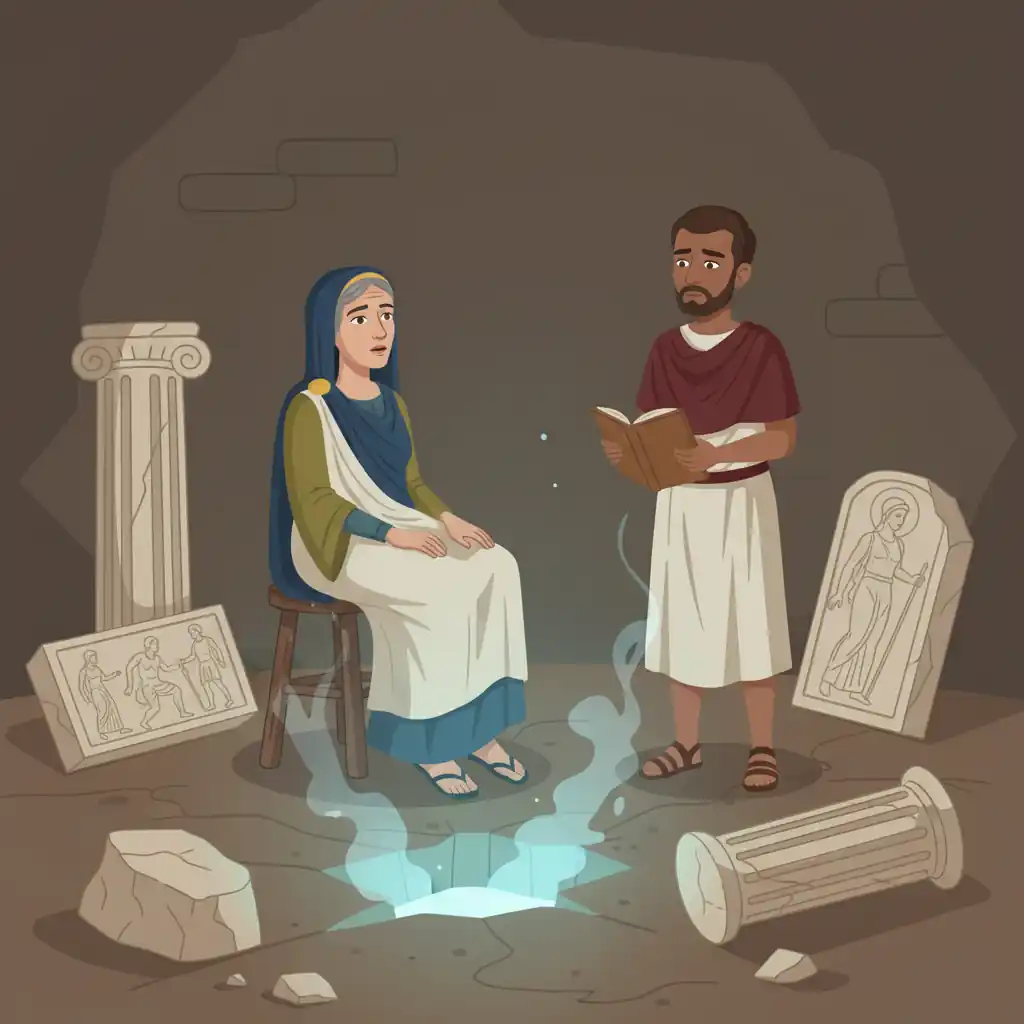
For nearly a thousand years, a small, unassuming woman sat on a tripod above a chasm, her mind adrift in a drug-induced haze, delivering prophecies that shaped the very course of ancient Greek civilization. This was the Pythia, the Oracle of Delphi, a figure shrouded in mystery, whose cryptic pronouncements from the Temple of Apollo were considered the very voice of the gods. Empires rose and fell, wars were waged, and colonies founded, all on the strength of her hallucinatory whispers.
Imagine a world without science, where the inexplicable was simply divine. In this world, Delphi, nestled in the rugged slopes of Mount Parnassus, was the ultimate nexus between mortals and immortals. It was considered the omphalos – the 'navel of the world' – marked by a conical stone. Pilgrims from across the Mediterranean flocked to this sacred precinct, not to gaze upon grand temples (though they were certainly there), but to hear the raw, unfiltered truth from a priestess high on otherworldly fumes.
The Pythia herself was no exotic beauty or powerful queen. She was typically an older woman, chosen from the local community, often illiterate, who lived a life of quiet devotion. Her power did not come from her intellect or social standing, but from her perceived ability to channel Apollo, to succumb to an altered state of consciousness induced by what the ancients called pneuma – a divine breath or vapor rising from the earth. What exactly was this 'divine breath'? Was it truly supernatural, or was there a more grounded, albeit still extraordinary, explanation for her trance-like states?
This is the story of that peculiar phenomenon, a narrative woven from the threads of geological oddities, ancient ritual, and the profound human yearning for answers. It's a journey into a strange intersection of geology, psychology, and spiritual belief, where the line between natural phenomena and divine intervention blurred, captivating the minds of the ancient world and continuing to intrigue us today.
ACT I: THE HOLY SITE AND THE HOLLOWED ROCK
Delphi was not chosen for its beauty, but for its strangeness. Long before Apollo laid claim to the site, it was revered as a powerful, chthonic place, sacred to Gaia (Mother Earth) and guarded by her monstrous serpent son, Python. The story goes that Apollo, a young, vigorous god, slew Python, claiming the sanctuary for himself. This act, however, didn't erase the older, darker energies of the place; it simply overlaid them with his radiant light, creating a unique synthesis of the earthly and the divine.
The geography of Delphi is key to understanding its mystic aura. Perched on the south-western spur of Mount Parnassus, the sanctuary overlooked a deep valley, surrounded by towering cliffs known as the Phaedriades ('Shining Ones'). It was a site prone to earthquakes, where rockfalls were common, and subterranean springs bubbled to the surface. For the ancient Greeks, such a volatile landscape was a clear sign of a powerful, living earth, a place where the underworld could breach the surface.
Early forms of prophecy at Delphi were likely even more primitive and visceral, perhaps involving animal sacrifices where omens were read from entrails, or observations of natural phenomena interpreted as divine signs. The introduction of the Pythia, sitting on a tripod over a fissure, marked a shift to a more direct, human conduit for prophecy, but one still deeply rooted in the physical peculiarities of the locale. The tripod itself was not just a seat; it was a ritual apparatus designed to connect the priestess to the very source of the pneuma.
Historians and archaeologists long dismissed the 'fumes' as a purely mythological embellishment. After all, classical writers like Strabo and Plutarch explicitly described vapors rising from a chasm. But in the 19th and early 20th centuries, scientists found no evidence of such fissures or gases. Delphi, they concluded, was a grand illusion. It wasn't until the late 20th century that a re-examination of the geology, combined with a fresh look at ancient texts, began to challenge this cynical view, suggesting that the ancients might have been remarkably accurate in their descriptions.
The very rock upon which the Temple of Apollo stood was not inert. It was a dynamic, fractured landscape, perfectly positioned for the kind of geothermal activity that could have produced the hallucinogenic vapors. This blend of ancient belief and modern scientific inquiry makes Delphi not just a historical site, but a fascinating case study in the intersection of faith, geology, and altered states of consciousness. The stage was set, not just by myth, but by the very bones of the earth.
ACT II: THE RITUAL AND THE SEATED PRIESTESS
The Pythia was not merely a medium; she was the central figure in an elaborate sacred drama. She wasn't just any woman; she was chosen from among the local women of Delphi, often from humble origins, and crucially, she had to be of unimpeachable character. Initially, she was a young maiden, but after a particularly scandalous incident where a Pythia was abducted, it was decided that only women over 50 (or at least no longer of child-bearing age) would serve. She would then live a chaste life within the sanctuary, dedicated entirely to Apollo, adopting a simple, unadorned lifestyle that belied her immense influence.
The consultation day was a meticulously choreographed affair. It began with the hoi Hosioi, the five sacred men who assisted the Pythia, and the prophetai, her interpreters, performing preliminary rituals. A goat would be led to the altar and sprinkled with cold water; if it shivered, it was a good omen, and Apollo was deemed ready to speak. If not, the consultation was postponed. This seemingly minor detail underscores the deep respect for omens and the belief that the gods, not humans, dictated the schedule.
The Pythia herself underwent a rigorous purification ritual. She would bathe in the sacred waters of the Castalian Spring, a cold mountain stream known for its purity. She would then drink from the spring and chew leaves from the sacred laurel tree—a plant often associated with prophetic visions. These acts were believed to cleanse her spirit and prepare her body to receive the divine pneuma. This was not a quick process; it was a slow, deliberate immersion into the sacred.
Finally, she would descend into the adyton, the innermost sanctuary of the temple, a dimly lit, sacred space strictly off-limits to all but herself and the assisting priests. Here, she would take her seat on the infamous bronze tripod, directly over the supposed chasm from which the vapors rose. The exact nature of this chasm has been a subject of intense debate for centuries, but ancient accounts consistently describe her inhaling these fumes. As the vapors took effect, the Pythia would enter a trance, sometimes calm and serene, sometimes violent and frenzied, uttering sounds, phrases, or disjointed words that were then 'translated' by the prophetai into the poetic dactylic hexameter that would be delivered to the supplicants.
This entire ritual underscored the Pythia's role as a vessel, not an originator, of the divine message. Her personal identity dissolved, making way for the voice of Apollo. The process was designed to elevate the experience beyond mere human consultation, transforming it into a direct encounter with the divine, filtered through the body and mind of an ordinary woman made extraordinary by circumstance and chemical reaction.