
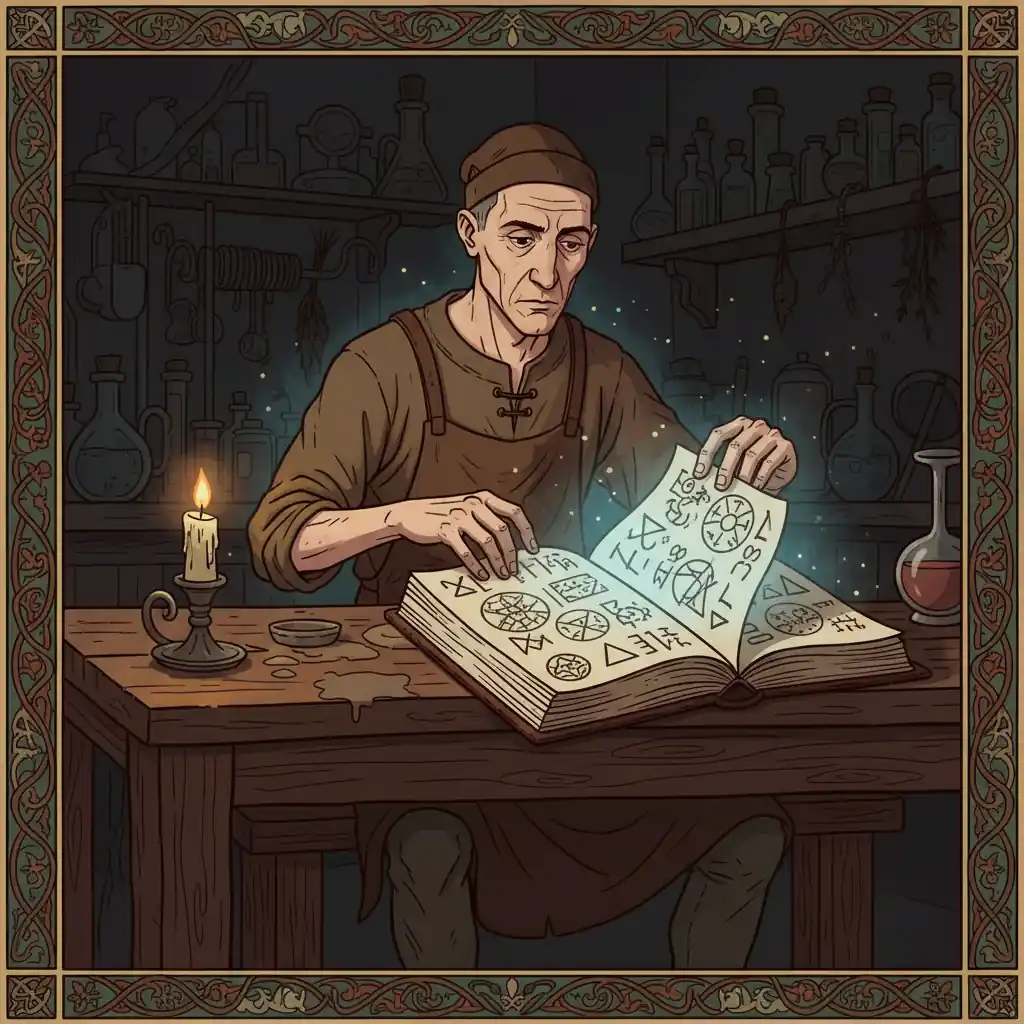
PROLOGUE: THE BOOK OF ABRAHAM THE JEW
Paris, 1378. A city of mud, plague, and towering cathedrals. For most, life was a brutal cycle of toil and prayer. But in a small, cramped shop near the Church of Saint-Jacques-de-la-Boucherie, a humble public scribe was about to stumble upon a secret that would reshape his destiny and ignite a legend still whispered today. His name was Nicolas Flamel.
Flamel was no aristocrat or warrior. He was a meticulous copyist, a man of letters in an age where literacy was a rare and valuable commodity. He rented out his services, creating beautiful, illuminated manuscripts for nobles and recording legal documents for merchants. It was in the course of his trade, or so the story goes, that he acquired a strange, ancient book for a mere two florins—a sum far too small for such a relic.
The book was unlike anything he had ever seen. Old, heavy, and bound not in leather but in sheets of thinly beaten copper, engraved with peculiar glyphs. It contained not text but a series of unsettling, intricate drawings and a language that defied all comprehension. Its author was given only as 'Abraham the Jew, Prince, Priest, Levite, Astrologer, and Philosopher to the Tribe of Levi.' The title of the book itself was equally cryptic: 'The Book of Hieroglyphic Figures.'
This was no ordinary text. It was a grimoire, a blueprint for an impossible quest: the discovery of the Philosopher's Stone, the mythical substance said to turn base metals into gold and grant eternal life. Flamel, a man of meticulous order, found himself plunged into a world of esoteric symbols, spiritual allegories, and the dangerous pursuit of alchemy.
For twenty-one years, the book remained an enigma. Its pages, filled with bizarre illustrations of serpents, kings, gardens, and allegorical figures, mocked his every attempt at translation. It was a puzzle that consumed him, a silent, copper-bound challenge that promised infinite wealth and immortality, yet yielded only frustration.
ACT I: THE SCRIBE'S OBSESSION AND THE SPANISH PILGRIMAGE
Nicolas Flamel's obsession with the 'Book of Abraham the Jew' was not merely intellectual; it became an all-consuming fire. He would spend hours poring over the copper pages, tracing the arcane symbols, cross-referencing them with every obscure text he could find. His wife, Perenelle, a woman of sharp intellect and considerable means herself, watched as her husband, usually so grounded, became increasingly drawn into the labyrinthine world of hermetic philosophy.
The book itself was a masterpiece of misdirection. Each illustration was accompanied by short, cryptic verses written in a language that seemed to be a blend of Latin, Greek, and an unknown ancient tongue. It described processes of creation and destruction, purification and transformation, but never explicitly revealed the methods. It spoke of 'red children' and 'white children,' of 'the dragon' and 'the king,' all metaphors for the alchemical stages and substances.
Flamel realized that a simple linguistic translation was not enough. He needed an interpreter of symbolism, someone who understood the secret language of the alchemists, a lineage of hidden wisdom that had been persecuted and driven underground for centuries, particularly among Jewish scholars who had preserved ancient texts and traditions.
In 1382, driven by a sudden, desperate insight from a dream, Flamel decided he needed to seek a 'master'—a Jewish scholar who might hold the key. This was a perilous decision. Medieval Europe was rife with anti-Semitism. The persecution of Jews, often accused of sorcery and heresy, was common. Spain, however, with its rich intellectual exchange between Christian, Muslim, and Jewish cultures, still harbored pockets of advanced learning, albeit under increasing pressure.
Flamel undertook a pilgrimage, ostensibly to Santiago de Compostela, but with a secret secondary mission. He traveled for months through bandit-infested roads and suspicious towns, his precious copper book hidden amongst his meager belongings. He sought out synagogues and Jewish communities, discreetly inquiring about scholars who possessed knowledge of 'hidden arts' or 'ancient wisdom.'
His search eventually led him to a man named Master Canches, a Jewish physician and scholar in León. Canches, a man of deep learning, was intrigued by Flamel’s earnestness and the strange book he carried. Upon seeing the illustrations, particularly the opening image depicting a winged caduceus, serpents, and a desert scene, Canches' eyes reportedly lit up with recognition.
The 'Book of Abraham the Jew' is believed by some scholars to be a lost text, while others argue it was an invention by Flamel to legitimize his later wealth and alchemical claims. The earliest known complete version of Flamel's own 'Book of Hieroglyphic Figures' (his explanation of Abraham's book) only appeared in print in 1612, over 200 years after his death, casting a shroud of mystery over its true origins.
ACT II: UNLOCKING THE MAGNUM OPUS
Master Canches immediately recognized the book as an authentic, though exceedingly rare, work of ancient alchemy. He explained to Flamel that the illustrations were not meant to be literal but were a complex series of allegories, a 'language of the birds' understood only by initiates. The figures described the entire 'Great Work' (Magnum Opus)—the process of creating the Philosopher's Stone—from beginning to end.
Canches began to decipher the symbolic language, explaining the stages of Nigredo (blackening or decomposition), Albedo (whitening or purification), and Rubedo (reddening or perfection). He spoke of the 'secret fire', the raw materials, and the precise timing dictated by astrological conjunctions. He revealed that the 'Book of Abraham' was not merely about transmuting lead into gold, but about a profound spiritual transformation, a path to enlightenment that paralleled the material process.
Flamel spent weeks under Canches' tutelage, eagerly absorbing every word, every nuance. He transcribed Canches' explanations, creating his own key to the esoteric symbols. The years of frustration began to melt away, replaced by a thrilling sense of understanding. However, their collaboration was tragically cut short. On their journey back to France, Master Canches fell gravely ill and died in Spain, taking many of his deeper insights to his grave. Flamel returned to Paris with a heavy heart, but armed with enough knowledge to continue the work.
Back in Paris, Flamel and Perenelle dedicated themselves to the alchemical pursuit with renewed vigor. They set up a discreet laboratory, perhaps in the cellar of their home, and began the arduous, dangerous work. Alchemy was not a quick process. It required specialized furnaces, precise control of heat, rare and often poisonous ingredients, and an almost superhuman patience. Many aspiring alchemists died from inhaling toxic fumes or from accidental explosions.
The legend claims that it took Flamel several more years of relentless experimentation, following the instructions gleaned from Canches and his own insights. He worked with lead, mercury, sulfur, and various acids, carefully observing the changes, the colors, the precipitates. It was a painstaking, often disheartening process, filled with failures and false starts.
Then, on a cold January day in 1382, an astonishing event supposedly occurred. Flamel claimed to have achieved the first stage of the Great Work, creating the 'white stone'—a substance capable of transmuting base metals into silver. A few months later, on April 25th of the same year, he announced the completion of the ultimate goal: the 'red stone', the true Philosopher's Stone, capable of transmuting silver into pure gold.
Flamel stated that Perenelle was not just a supportive wife but an active participant in his alchemical endeavors. He often referred to her as his 'faithful companion' and described how they worked side-by-side in their laboratory. This detail is unusual for the era, suggesting a partnership that was ahead of its time and a rare acknowledgment of a woman's intellectual role in a scientific (albeit esoteric) pursuit.
ACT III: THE GOLDEN AGE AND PUBLIC BENEFACTION
With the discovery of the Philosopher's Stone, Flamel's life was transformed. He and Perenelle, who had previously been comfortable but not wealthy, suddenly found themselves possessing an unimaginable fortune. The gold they supposedly created was not just for personal enrichment; Flamel’s narrative emphasizes his philanthropic endeavors, a crucial aspect that lent credibility to his claims and shielded him from accusations of sorcery.
Between 1382 and 1400, Nicolas Flamel and Perenelle embarked on an extraordinary building spree. They financed the construction of fourteen hospitals, three chapels, and seven churches in and around Paris. They funded the repair of others and established alms houses for the poor. They endowed charities and provided free housing for the indigent.
One of their most famous contributions was the 'Maison de Nicolas Flamel' on rue de Montmorency, built in 1407. This house, still standing today, bears curious carvings on its facade: symbols of suns, moons, angels, and even a cryptic 'F' (for Flamel) with a serpent entwined. These carvings, according to later occultists, were secret alchemical ciphers, hidden messages for those with eyes to see.