
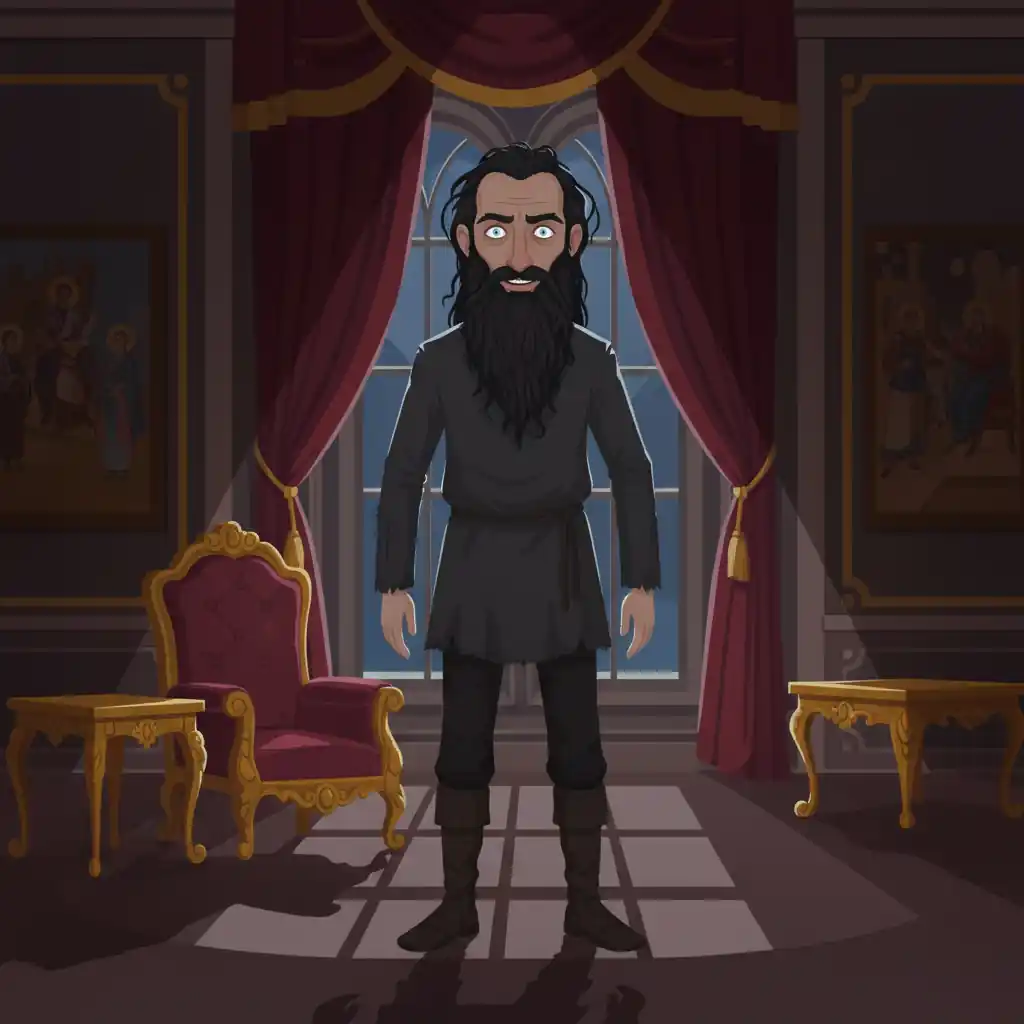
PROLOGUE: THE WHISPER IN THE WINTER PALACE
The year is 1916. Imperial Russia, an empire built on centuries of autocratic rule, stands on the precipice of collapse. The First World War rages, draining the nation of its youth and its resolve. Food riots simmer in the capital, whispers of revolution grow louder, and the Romanov dynasty, which has reigned for three hundred years, seems to be losing its grip on reality. But the most bizarre and unnerving symptom of this decay is not found on the battlefields or in the breadlines, but within the gilded, labyrinthine corridors of the Winter Palace itself.
Here, in the intimate chambers of Tsar Nicholas II and Empress Alexandra, a figure of extraordinary and unsettling power holds court. He is not a general, nor a minister, nor a Grand Duke. He is a scruffy, illiterate peasant from the Siberian wilderness, a self-proclaimed 'holy man' with hypnotic eyes and a notoriously dissolute lifestyle. His name is Grigori Rasputin, and his shadow has fallen across the very heart of the empire, whispering counsel, dispensing 'healing,' and, as many believed, steering the destiny of Russia towards ruin.
How did such a man, a 'muzhik' (peasant) with the manners of a barnyard brute and the moral compass of a goat, come to command the absolute devotion of the Empress and, through her, the Tsar? This is the story of an improbable rise, a reign of unsettling influence, and a spectacular, bloody downfall—a tale that embodies the dark, superstitious undercurrents of a dying empire, where faith, manipulation, and desperation converged to create one of history’s most infamous and enigmatic figures.
ACT I: FROM SIBERIAN MUD TO HOLY MAN
Grigori Yefimovich Rasputin was born in 1869 into a peasant family in the remote Siberian village of Pokrovskoye, along the Tura River. His name, 'Rasputin,' is often translated as 'debauchee' or 'dissolute one,' stemming from the Russian word rasputnyi (распутный). While some sources argue it was a common surname in his region, its later resonance with his scandalous reputation feels almost prophetic.
Young Grigori was largely uneducated, possibly illiterate, and worked the land like any other peasant. There is no clear record of a particularly pious or mystical youth. Instead, local accounts suggest a reputation for petty thievery and a generally unruly character. The turning point in his life came around the age of 18 or 19. A deep spiritual crisis or revelation prompted him to leave his village and embark on a pilgrimage to a monastery near Verkhoturye.
This pilgrimage marked his transformation into a strannik, a holy wanderer. For years, he roamed across Russia, visiting monasteries, holy sites, and conversing with ascetics and hermits. During this period, he developed the distinctive traits that would define his public persona: a penetrating, almost hypnotic gaze, a magnetic personal charm, and an unusual ability to articulate complex spiritual ideas in simple, compelling language. He cultivated a rough, unkempt appearance, believing physical discomfort brought him closer to God. This was a common path for self-proclaimed 'holy men' in rural Russia, who often held significant sway over the superstitious peasant population.
His 'healing' abilities, particularly his purported talent for stopping bleeding, began to emerge during this time. Whether through genuine spiritual gift, folk remedies, or sheer psychological power, he developed a reputation that preceded him. Rumors of his unorthodox spiritual practices, however, also began to circulate. Some historians suggest he may have been influenced by the Khlysty, a radical sect that practiced ecstatic rituals, including flagellation and orgiastic behavior, believing that through sin one could achieve a deeper repentance and closer communion with God. While Rasputin never formally joined the sect and rejected such claims, his later behavior fueled these suspicions.
By the early 1900s, Rasputin had gained a significant following in his home region. His rough wisdom, combined with an undeniable charisma and alleged prophetic insights, made him a compelling figure. He began to attract the attention of local clergy and, eventually, a network of society women in St. Petersburg who were fascinated by mysticism and spiritualism. These were the unwitting gatekeepers who would introduce the Siberian peasant to the most isolated and vulnerable family in Europe.
Despite his later reputation for debauchery, Rasputin was married to Praskovia Fyodorovna Dubrovina and had three surviving children. His family remained in Pokrovskoye throughout his period of influence in St. Petersburg, living a relatively quiet life, though they did benefit from his newfound wealth and connections.
ACT II: THE IMPERIAL GATEKEEPER
Rasputin’s true ascent began when he arrived in St. Petersburg in 1903 (or possibly 1905). He quickly found an eager audience among the capital's upper crust, many of whom were disillusioned with the official church and seeking spiritual novelty. He was introduced to figures like Archimandrite Theophan, the inspector of the St. Petersburg Theological Academy, and later, through the Montenegrin princesses Grand Duchess Militza and Anastasia (who were obsessed with spiritualism and the occult), he finally gained access to the imperial court.
The Romanov royal family lived a life of isolated opulence, guarded by layers of ceremony and secrecy. Their greatest vulnerability, a closely held secret from the Russian public, was the health of their only son and heir, Alexei Nikolaevich. The Tsarevich suffered from hemophilia, a brutal, incurable genetic disorder that caused severe internal bleeding from even the slightest bump or bruise. Each bleeding episode was agonizing, potentially fatal, and left Empress Alexandra, his mother, in a state of constant, unbearable terror.
Western doctors, with all their advanced knowledge, could do little more than manage symptoms and offer comforting words. Aspirin, a common painkiller at the time, actually worsened Alexei's condition due to its blood-thinning properties. The despairing Empress, a devout but highly superstitious woman, began to seek solace and miracles from holy men, mystics, and spiritualists. When Rasputin was finally presented to the imperial couple in 1905, he arrived as a beacon of hope in their darkest hour.
Rasputin’s initial meetings with Alexei were nothing short of miraculous from Alexandra's perspective. During severe bleeding crises, when doctors were helpless, Rasputin would sit by the boy’s bedside, pray, and talk to him. Almost immediately, Alexei's bleeding would slow or stop, and his pain would subside. The exact mechanism of Rasputin's 'healing' remains a subject of intense debate. Theories range from genuine hypnotic abilities that could calm Alexei and reduce stress (which can exacerbate bleeding) to simply advising the doctors to stop prescribing aspirin. Whatever the method, the effect was profound and undeniable to the desperate parents.
From that moment, Rasputin's position at court became unassailable in Alexandra's eyes. She believed him to be a God-sent prophet, the only man who could save her beloved son and, by extension, the Romanov dynasty. For the Empress, Rasputin was not just a healer but a direct channel to divine power, a living saint. Nicholas II, though wary and often disgusted by Rasputin's behavior, could not deny the man who held the key to his son's survival. To remove Rasputin was to risk Alexei's life, a price Alexandra was unwilling to pay. Thus, the Siberian peasant became the de facto gatekeeper to the imperial family's most intimate fears and, increasingly, their political decisions.
One of Rasputin's most dramatic interventions came in 1912, when Alexei suffered a life-threatening hemorrhage during a family vacation in Poland. Doctors believed the Tsarevich was dying. Empress Alexandra sent a desperate telegram to Rasputin, who was back in Siberia. His reply: 'The Lord has seen your tears and heard your prayers. Do not grieve. The Little One will not die. Do not allow the doctors to bother him too much.' Miraculously, Alexei soon began to recover, solidifying Alexandra’s unwavering faith in him.
ACT III: THE WEB OF INFLUENCE AND DEBAUCHERY
With his influence over Empress Alexandra solidified, Rasputin's role quickly expanded beyond the Tsarevich's sickroom. He began to offer 'advice' on matters of state, ranging from ministerial appointments to military strategy. As the Tsar was often weak-willed and Alexandra increasingly relied on Rasputin, his recommendations carried immense weight. He would often suggest individuals for high office based on personal favors, bribes, or simply an intuitive dislike of current officeholders. Ministers who opposed him found themselves swiftly dismissed, replaced by individuals perceived as more amenable to his 'wisdom'.
This political interference created a volatile, unstable government. Competent officials were removed, replaced by often unqualified sycophants. The bureaucracy became a revolving door, further destabilizing a nation already reeling from social unrest and the looming threat of war. Rasputin's pronouncements, often vague and enigmatic, were interpreted by the Empress as divine guidance, leading to disastrous decisions that alienated the nobility and the public.
Parallel to his growing political influence, Rasputin maintained a notoriously dissolute lifestyle. While publicly presenting himself as a devout holy man, in private he was a notorious womanizer and drunkard. He frequented bathhouses and taverns in St. Petersburg, where he often engaged in drunken orgies and sexual encounters. He famously claimed that to truly repent, one must first deeply sin, a twisted theological justification for his behavior that resonated with some of his followers but disgusted the moral establishment.
His sexual escapades were legendary. Women from various social strata, drawn by his mystique, charisma, or perhaps morbid curiosity, fell under his spell. He would often receive petitions and favors from women in exchange for his 'blessings' or promises to intercede with the Empress. The rumors and scandals surrounding his lifestyle became widespread, eroding the public's respect for the imperial family, who continued to harbor him despite overwhelming evidence of his depravity. The common joke was that 'the Tsarina rules with Rasputin, and Rasputin rules with his penis.'