
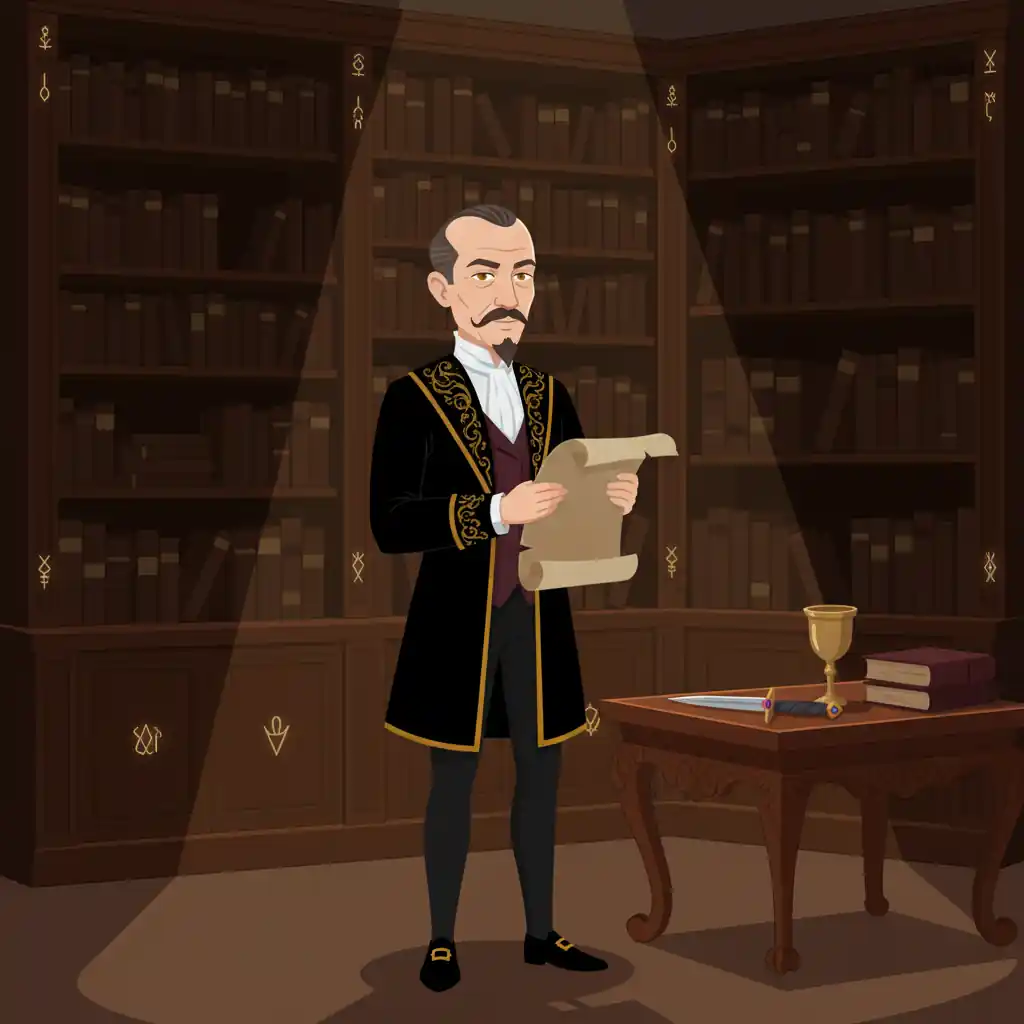
PROLOGUE: THE BEAST IS BORN
For over a century, the name Aleister Crowley has conjured images of dark rituals, blasphemy, and unbridled decadence. Dubbed 'The Wickedest Man in the World,' a moniker he ironically embraced and cultivated, Crowley was far more than a mere sensationalist. He was a poet, a mountaineer, a chess master, a spy, a drug addict, and, most enduringly, the self-proclaimed prophet of a new spiritual age: Thelema.
To truly understand the phenomenon of Aleister Crowley, we must strip away the layers of tabloid sensationalism and delve into the peculiar crucible of his upbringing. Born Edward Alexander Crowley in 1875 in Royal Leamington Spa, Warwickshire, his early life was anything but 'wicked.' It was steeped in the rigid, fundamentalist dogma of the Plymouth Brethren, an evangelical Christian sect known for its austere piety and literal interpretation of the Bible. His father, Edward Crowley, was a wealthy retired brewer who dedicated his life to the Brethren, preaching extensively.
Young Edward grew up in a world of biblical sermons, strict moral codes, and the constant threat of eternal damnation. Christmas and birthdays were forbidden, considered pagan celebrations. Yet, even as a child, a fierce rebelliousness simmered beneath the surface. When his mother, Emily Bertha Bishop, referred to him as 'the Beast'—echoing the biblical Beast of Revelation—after one of his tantrums, it was less an insult and more a prophetic title he would later adopt with relish. It was this early, suffocating environment that ultimately forged the defiant, iconoclastic figure he would become.
His father's death when Crowley was just eleven years old plunged him deeper into the Brethren's world, but it also opened the door to a nascent intellectual awakening. Tutored privately, he excelled, particularly in Latin and Greek. He soon found the Brethren's teachings intellectually stifling and emotionally repressive. He began to question, to doubt, and to secretly indulge in forbidden pleasures. This early rebellion against a God of wrath would define his life's work.
By the time he enrolled at Trinity College, Cambridge, in 1895, the transformation was well underway. He cultivated a bohemian lifestyle, pursuing poetry, chess, and mountaineering. He became an accomplished alpinist, undertaking several daring climbs. More crucially, he began to shed his birth name, preferring 'Aleister'—a deliberate attempt to distance himself from his past and craft a new identity. It was also during this period that his intellectual curiosity turned decisively towards mysticism, alchemy, and the forbidden arts. The seeds of 'the Beast' were fully planted, ready to sprout into something magnificent and terrifying.
Crowley was a world-class mountaineer, making several significant ascents in the Alps and even attempting K2, the world's second-highest mountain, in 1902. He was a member of the Alpine Club, but his growing notoriety and unconventional lifestyle eventually led to his quiet expulsion.
ACT I: INTO THE GOLDEN DAWN: MAGICK AND MACHIAVELLIANISM
The late 19th century was fertile ground for esoteric orders, a counter-current to the scientific rationalism of the Victorian age. In this landscape, the Hermetic Order of the Golden Dawn shone brightest. Founded in 1888, it was a secret society dedicated to the study and practice of ceremonial magic, alchemy, astrology, and Qabalah. For Aleister Crowley, it was a beacon, a portal to the hidden knowledge he craved. He joined in 1898, eager to immerse himself in its ancient wisdom and complex rituals.
The Golden Dawn attracted some of the era's most brilliant, eccentric, and occasionally volatile minds. William Butler Yeats, the future Nobel laureate, was a prominent member. So too were Florence Farr, an actress and suffragist, and Arthur Edward Waite, a prolific occult writer. The Order promised a hierarchical system of initiation, guiding members through progressively more advanced magical practices. Crowley, with his voracious intellect and intense drive, devoured the teachings, rapidly ascending the grades.
However, Crowley was not content to merely be a student. He believed he was destined for greatness, and his ambition often clashed with the established hierarchy. His primary mentor and the Order's co-founder, Samuel Liddell MacGregor Mathers, initially saw potential in Crowley, but soon recognized a formidable, perhaps dangerous, will. Crowley, for his part, initially revered Mathers, but grew disillusioned with what he perceived as Mathers' tyrannical control and inability to deliver higher initiations.
The turning point came in 1900, during what became known as the 'Battle of Blythe Road.' The London temple of the Golden Dawn had rebelled against Mathers' remote leadership from Paris. Mathers, still officially the Head of the Order, tasked Crowley—who had previously travelled to Paris to pledge renewed loyalty—with reclaiming the temple. What followed was a confrontation ripped from the pages of a gothic novel.
Crowley, dressed in Highland regalia (his family had Scottish roots, and he often wore a kilt) and accompanied by a solicitor, attempted to physically take control of the London headquarters on Blythe Road. He was met by Yeats and other members, who blocked his entry. Accounts vary, but it escalated into a near-brawl, with Crowley allegedly resorting to 'magical attacks' against the rebellious members, including a supposed 'vampire attack' using a wax effigy of Mathers. The London contingent eventually secured a court injunction against Crowley, effectively banning him from the premises.
This incident cemented Crowley's reputation as a chaotic, disruptive force within the occult community. He was no longer just an earnest student; he was a renegade, willing to use any means, magical or mundane, to achieve his will. Expelled from the Golden Dawn, he would spend the next few years traveling, continuing his magical experiments independently, and refining his own unique blend of ceremonial magic—a path that would lead him to claim prophethood.
During his Golden Dawn years, Crowley bought Boleskine House, a remote estate on the shores of Loch Ness in Scotland. He intended to use it for an elaborate ritual to evoke the demon Abramelin, which required months of purification. He claimed the ritual was successful, though incomplete, and left a potent, strange atmosphere at the house for decades. Jimmy Page of Led Zeppelin later owned Boleskine for many years.
ACT II: CAIRO & THE BOOK OF THE LAW: THE BIRTH OF THELEMA
In 1903, Aleister Crowley, now largely self-taught in the arcane arts and still seeking his true path, married Rose Edith Kelly, the impulsive sister of a close friend. Their union was tumultuous, a whirlwind of passion and escalating eccentricity. After a period in Ceylon (modern-day Sri Lanka) where Crowley immersed himself in yoga and Eastern mysticism, the couple embarked on a honeymoon to Cairo, Egypt, in 1904. It was here, amidst the ancient mysteries of the pharaohs, that Crowley’s life—and the course of modern occultism—would fundamentally change.
Rose, initially uninterested in Crowley’s magical pursuits, began to exhibit strange behavior. She would fall into trances, uttering cryptic messages. Crowley, skeptical at first, dismissed her as merely being playful or inebriated. However, her pronouncements grew increasingly specific and insistent. She told him that a powerful entity was trying to contact him, instructing him to perform a particular invocation on three consecutive days, beginning on April 8th.
Reluctantly, Crowley complied. On April 8th, 9th, and 10th, 1904, in their flat near the Boulak Museum, something extraordinary (or, depending on your perspective, profoundly disturbing) occurred. Rose, in a trance, began to channel an entity calling itself Aiwass. Crowley, serving as the scribe, meticulously recorded the words spoken through her. The result was a text of three chapters, each dictated on a successive day, which would become known as Liber AL vel Legis, 'The Book of the Law.'
This slim volume would form the bedrock of Crowley’s new religion, Thelema. Aiwass proclaimed a new Aeon, an age ushered in by Crowley, replacing the old, dying god forms. The core tenets of this new philosophy were shockingly simple, yet radical: 'Do what thou wilt shall be the whole of the Law' and 'Love is the law, love under will.'
These maxims were not, as many misinterpreted, a license for hedonistic abandon. For Crowley, 'Do what thou wilt' meant discovering and pursuing one’s true purpose or 'True Will,' undistracted by external social, moral, or religious constraints. 'Love under will' implied that all actions, if aligned with one’s True Will, were acts of love, in harmony with the cosmos. It was a philosophy of radical self-determination, an individualism that bordered on anarchism.
Crowley was initially hesitant to accept his role as the prophet of this new Aeon. The text itself was dense, often contradictory, and full of veiled references. He even tried to destroy the manuscript at one point, fearing its implications. But the sheer force of its message and the conviction that something profound had occurred eventually compelled him to embrace his destiny. He adopted the title 'To Mega Therion,' Greek for 'The Great Beast' (666), fulfilling the childhood prophecy and solidifying his infamous persona. Cairo was not just a honeymoon; it was the birthplace of a spiritual revolution, or at least, a grand magical experiment.
When Crowley first transcribed *The Book of the Law*, he was so puzzled by some of its obscure passages and numerical puzzles that he initially dismissed it. It was only years later, after further study and what he claimed was direct guidance from Aiwass, that he fully accepted its authenticity and his role as its prophet.
ACT III: THE ABBEY OF THELEMA: A HELL ON EARTH?
With The Book of the Law as his foundational text and his identity as 'The Beast 666' firmly established, Crowley set out to manifest his vision. In 1920, he acquired a dilapidated farmhouse in Cefalù, a remote fishing village on the northern coast of Sicily. This would become the Abbey of Thelema, a commune intended as a magical training college and a living laboratory for the principles of his new religion. He envisioned a place where aspirants could shed societal conditioning and dedicate themselves fully to discovering and enacting their True Will.
Life at the Abbey was a radical departure from conventional society. The walls were covered in vivid, often disturbing, murals painted by Crowley himself, depicting demons, gods, and erotic scenes. Daily routines included rigorous magical rituals, yoga, and meditation. But the Abbey quickly gained notoriety for its more scandalous practices: free love, communal living, and the ceremonial use of drugs like hashish and cocaine, which Crowley believed could aid in spiritual exploration.
Sex Magick, a controversial practice for which Crowley became infamous, was a central tenet. He taught that sexual energy, when consciously directed, could be a powerful tool for magical manifestation and spiritual attainment. These practices, combined with his public advocacy for drug use and his open defiance of Christian morality, fueled sensationalist press reports across Europe, painting the Abbey as a den of debauchery and Black Magick.
Crowley presided over a revolving cast of disciples, some genuinely dedicated, others drawn by curiosity or a desire for escape. Among them was Leah Hirsig, his 'Scarlet Woman,' and Raoul Loveday, a young Oxford student and his wife, Betty May. The atmosphere was intense, sometimes intoxicating, but also deeply unsettling for some. Hygiene was often neglected, and resources were scarce. Crowley's charisma held the fragile community together, but his dictatorial nature and propensity for harsh 'magical tests' created significant tension.
The tragic death of Raoul Loveday in 1923 provided the spark for the Abbey's downfall. Loveday, suffering from acute enteritis, died at the Abbey, supposedly after drinking contaminated spring water or, as some lurid reports claimed, after participating in a ritual involving the sacrifice and consumption of cat's blood. Betty May, Loveday's grieving wife, fled to England and sold her story to the sensationalist John Bull magazine, portraying Crowley as a satanic monster responsible for her husband's death.
The ensuing international scandal reached Benito Mussolini, Italy's fascist dictator. Already wary of foreign eccentrics and keen to project an image of moral rectitude for his new regime, Mussolini issued an expulsion order against Crowley and all his followers. In May 1923, 'The Wickedest Man in the World' and his controversial Abbey were unceremoniously shut down, leaving behind a legacy of both revolutionary spiritual exploration and deeply disturbing tales of excess.
Crowley famously had a goat living in the Abbey, which often wandered into the dining room. He referred to it as his 'familiar' and included it in some of his rituals, further cementing the 'satanic' image in the public imagination, despite Thelema having no direct connection to Satanism.
ACT IV: THE WANDERER: ADDICTION, PENURY, AND ENDURING INFLUENCE
Expelled from Sicily, Aleister Crowley entered a more nomadic and difficult phase of his life. For the next two decades, he wandered across Europe—Paris, Tunis, Berlin, and eventually back to England—a controversial figure constantly grappling with dwindling finances, escalating drug addiction, and a persistent desire to propagate Thelema. The grand experiment of the Abbey was over, but the prophet remained, albeit a increasingly ragged one.
Crowley's lifelong struggle with asthma led him to self-medicate with heroin, a habit that spiraled into full-blown addiction. This was not a secret; he was quite open about it, even believing that drugs, used consciously and ritually, could be tools for magical consciousness. However, the reality of addiction was brutal: constant cravings, the indignity of seeking prescriptions, and the drain on his already meager finances. His physical appearance deteriorated, and his notorious temper became more pronounced.
Despite his personal struggles, Crowley remained incredibly prolific. He continued to write voluminously, producing some of his most significant works during this period. Magick in Theory and Practice, published in 1929, became a cornerstone of modern occult literature, a comprehensive guide to his magical system. His multi-volume autobiography, The Confessions of Aleister Crowley, begun in 1929, was a candid, often self-aggrandizing, but undeniably fascinating account of his life and philosophy, deliberately crafted to shock and provoke.
He tried to re-establish a foothold for Thelema in various locations, but the widespread condemnation and his dwindling reputation made it difficult. He relied heavily on the patronage of a few loyal disciples and wealthy acquaintances, often living in genteel poverty. He was frequently embroiled in legal battles, especially regarding child support for his various offspring, further cementing his image as an irresponsible libertine.
Crowley continued to engage with the counter-culture and avant-garde artists of the time. In Berlin, during the Weimar Republic, he mingled with intellectuals and artists, embracing the city's decadent atmosphere. He even participated in art exhibitions, showcasing his own often crude, surrealist paintings. He sought to influence, to provoke, to shatter conventional morality wherever he went.
By the late 1930s and into the 1940s, Crowley was a ghost of his former self. His health was failing, exacerbated by his drug use and bohemian lifestyle. He spent his final years in a boarding house in Hastings, England, still writing, still receiving a trickle of curious visitors, and still grappling with his legacy. He was, by then, largely forgotten by the wider public, dismissed as an eccentric relic of a bygone era. Yet, the seeds of his influence had already been scattered, waiting for a new generation to discover them.
Crowley was an avid chess player and even considered a career as a professional chess master before dedicating himself fully to occultism. He claimed to have achieved considerable success in chess tournaments during his time at Cambridge and later in Europe.
ACT V: THE UNHOLY LEGACY: FROM WEIRD TO MAINSTREAM
Aleister Crowley died on December 1, 1947, in Hastings, England, at the age of 72. His official cause of death was chronic bronchitis and myocardial degeneration, hastened by his long-standing heroin addiction. The funeral, held at a local crematorium, was as unconventional as his life. His friends and followers, including the poet Louis Wilkinson, recited passages from The Book of the Law and Crowley's own 'Hymn to Pan,' a defiant celebration of pagan sensuality. It was a final, theatrical flourish for a man who had choreographed his own legend.
For years after his death, Crowley remained a marginalized figure, primarily known to a small circle of occultists and sensationalist journalists. His reputation as 'The Wickedest Man in the World' lingered, but his works were largely out of print, dismissed as the ramblings of a madman. However, the counter-cultural explosion of the 1960s provided fertile ground for a dramatic resurgence of interest in his life and philosophy.
Suddenly, Crowley was everywhere. The Beatles famously included his image on the cover of their iconic 1967 album, Sgt. Pepper's Lonely Hearts Club Band, placing him alongside historical figures and cultural icons. This single act catapulted Crowley's likeness into mainstream consciousness, igniting curiosity in a new generation searching for alternative spiritual paths and challenging societal norms. Soon, rock musicians and artists began to openly acknowledge his influence.
Perhaps no one was more influenced than Jimmy Page, the guitarist for Led Zeppelin. Page was an obsessive collector of Crowleyana, acquiring Boleskine House (Crowley's former estate on Loch Ness) and even founding a bookshop dedicated to occult literature. Led Zeppelin's music was imbued with references to Crowley's writings and Thelemic philosophy, further cementing the occultist's connection to rock and roll and the burgeoning fascination with the esoteric.
Today, Crowley's influence extends far beyond music. He is recognized as a pivotal figure in the development of modern Western esotericism, impacting various forms of ceremonial magic, chaos magick, and even some branches of modern Satanism (though Thelema itself is distinct from Satanism). His emphasis on individual will, self-deification, and the exploration of altered states of consciousness resonated deeply with movements seeking liberation from traditional authority.
Revisiting the label 'The Wickedest Man in the World,' it becomes clear that Crowley deliberately cultivated this persona. It was a strategic, if dangerous, act of rebellion against the stifling morality of his Victorian upbringing. He saw himself as a liberator, a prophet challenging humanity to cast off dogma and embrace its divine potential. While his methods were often extreme, his personal life chaotic, and his pronouncements controversial, his core message of 'Do what thou wilt' continues to provoke thought and inspire a diverse range of practitioners.
Crowley created his own tarot deck, the Thoth Tarot, with artist Lady Frieda Harris. It's one of the most widely used and influential tarot decks in the world, renowned for its complex symbolism and artistic depth, completed just before his death.
ACT VI: THE POLITICS OF MEMORY: THE ENDURING ENIGMA
Aleister Crowley's legacy is not a settled matter; it is a battleground of interpretation, a mirror reflecting humanity's ongoing fascination and fear of the unknown. Was he a charlatan, a depraved opportunist, or a visionary prophet whose teachings were simply too far ahead of his time? The answer depends entirely on the lens through which one views him.
To his detractors, Crowley remains a symbol of hedonistic excess, a destructive force who dabbled in dangerous magic and led impressionable minds astray. They point to his drug addiction, his promiscuity, his often-cruel treatment of followers, and the scandals that plagued his life as evidence of his inherent wickedness. His adoption of the 'Beast 666' moniker, far from being ironic, is seen as a deliberate embrace of evil, a blasphemy against sacred traditions.
To his adherents, however, he was a courageous pioneer, a radical philosopher who dared to challenge the oppressive moral and religious strictures of his era. They highlight his profound intellectual curiosity, his extensive knowledge of esoteric traditions, and the liberating potential of his philosophy of Thelema. For them, 'Do what thou wilt' is not a call to anarchy but an imperative for authentic self-discovery and the alignment of individual purpose with cosmic will. His flaws, they argue, were simply the human failings of a revolutionary figure.
The paradox of Crowley is that both narratives contain elements of truth. He was undoubtedly a complex, contradictory individual—brilliant and self-destructive, charismatic and manipulative, a profound mystic and a flamboyant showman. He understood the power of myth and crafted his own legend with meticulous care, ensuring his infamy would outlive him. His public persona as 'the wickedest man' was a shield, a provocation, and a marketing tool all rolled into one.
Moreover, Crowley's influence continues to permeate popular culture, often in subtle and unexpected ways. Beyond the obvious references, his emphasis on breaking taboos, exploring consciousness, and asserting individual will can be seen in various artistic movements, psychological theories, and new age spiritualities. He forced a confrontation with uncomfortable truths about human nature and the boundaries of belief.
Ultimately, Aleister Crowley remains an enigma. He challenged not only the God of his childhood but also the very concept of morality, dogma, and objective truth. His life was a grand, often catastrophic, magical experiment designed to test the limits of human experience and spiritual possibility. Whether one sees him as a villain or a visionary, a charlatan or a prophet, his impact on the occult, on the counter-culture, and on our understanding of forbidden knowledge is undeniable. The Beast may be gone, but his cult—and the questions he posed—live on.