
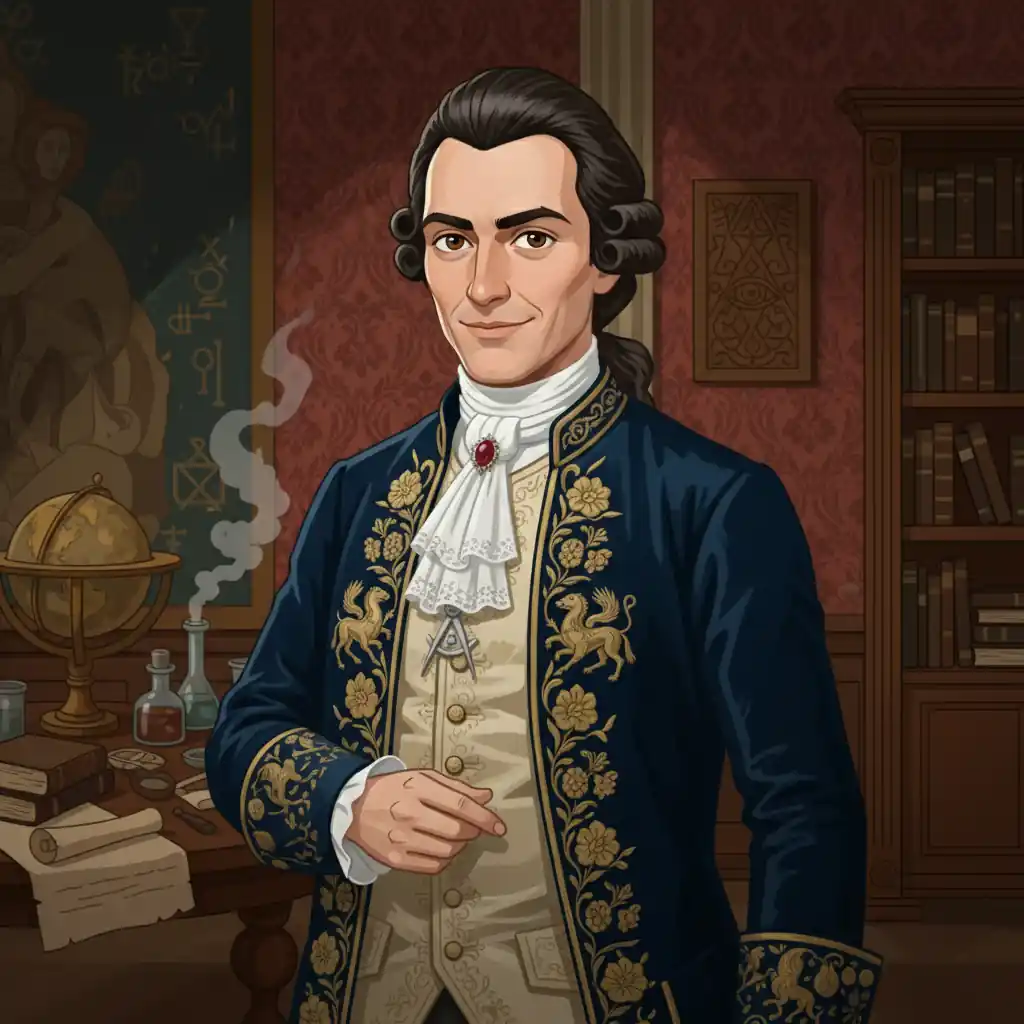
PROLOGUE: THE SHADOW AND THE STAGE
The Enlightenment was a paradox. While reason sought to banish superstition, the salons and courts of Europe remained fertile ground for the mystical, the miraculous, and the downright fraudulent. Into this glittering, credulous world stepped an enigma: Count Alessandro di Cagliostro. He was a sorcerer, a healer, an alchemist, a prophet, and—ultimately—a master showman whose life story reads like a grand opera of ambition, deception, and tragic hubris.
Imagine a man who claimed to have lived for millennia, who spoke of walking with ancient Egyptian pharaohs, of possessing the Philosopher's Stone, and of communing with spirits. This was no street-corner charlatan; Cagliostro walked among kings and queens, mesmerized philosophers, and extracted fortunes from the wealthiest families in Europe. He offered not just cures, but immortality. Not just gold, but enlightenment. In a world teetering on the brink of revolution, he promised salvation, both spiritual and material.
His entry into any European capital was an event. Carriage full of servants, exotic animals, a beautiful wife, and a retinue of devoted followers. His reputation preceded him, whispered from Venice to St. Petersburg, from London to Naples. He was the cure for all ills, the key to all secrets, the master of all mysteries. He arrived as a whirlwind of rumor and spectacle, leaving behind a trail of miracles, controversies, and emptied purses.
But behind the smoke and mirrors, the grand titles, and the fantastical claims, lurked a far more mundane reality. Who was this man who captivated an entire continent? Was he a genuine initiate of ancient wisdom, a visionary misunderstood by his age, or simply the most audacious con artist to ever grace the stage of European aristocracy? The truth, as always, is a complex tapestry woven with threads of desperation, theatrical genius, and unbridled greed.
This is the story of a man who built an empire of illusion, whose genius lay not in magic, but in understanding the deepest desires and most profound vulnerabilities of the human heart, particularly those encased in powdered wigs and silken gowns. It is the story of the Sorcerer of the Court, whose magic ultimately turned on himself.
ACT I: THE SICILIAN STREET RAT
Before he was Count Cagliostro, grand master of the Egyptian Rite, he was Giuseppe Balsamo, born in Palermo, Sicily, in 1743. His origins were anything but noble. He was the son of a petty tradesman, an orphaned street urchin in a city ripe with poverty and superstition. From an early age, Balsamo displayed a precocious cunning and an utter disdain for honest labor.
His childhood was a masterclass in petty thievery and deception. He learned to forge documents, pick pockets, and mimic voices. His first real foray into charlatanism came when he convinced a local silversmith that he knew the location of a hidden treasure. The silversmith, duped by Balsamo's elaborate rituals and promises, gave him money for 'magical tools'—which Balsamo promptly absconded with. This early triumph confirmed a fundamental truth for young Giuseppe: people wanted to believe.
Sent to a monastery by his family in a futile attempt to instill discipline, Balsamo instead used his time to learn Latin, Greek, and the rudiments of chemistry and herbalism. He absorbed knowledge like a sponge, not for spiritual enlightenment, but for practical application in his budding career of deception. He copied ancient texts, learned about medicinal plants, and observed the theatricality of religious rites—all tools he would later adapt for his own 'magical' ceremonies.
He escaped the monastery and returned to a life of street hustles, quickly graduating from small-time scams to more ambitious frauds. He posed as an alchemist, selling worthless potions as 'elixirs of eternal youth.' He dabbled in necromancy, claiming to summon spirits for grieving families. He even ran a protection racket, using his theatrical flair to convince local merchants that he could ward off evil spirits for a fee.
Palermo, however, became too small for his ambitions, and his increasingly brazen schemes attracted unwanted attention. After a particularly nasty con involving a wealthy marquis and a rigged lottery, Balsamo fled Sicily, leaving behind a trail of debts, enraged victims, and a warrant for his arrest. He embarked on his travels with little more than his wits, a talent for languages, and an unwavering belief in his own extraordinary destiny.
His early mentor was a shadowy Greek alchemist named Althotas, who claimed to be immortal. While the existence of Althotas is debated—many believe he was a complete fabrication by Balsamo—the story itself served to legitimize Cagliostro’s later claims of ancient knowledge and mystical lineage. Regardless, Balsamo learned quickly how to blend exoticism with esoteric claims, how to project an aura of profound wisdom, and how to exploit the human desire for secrets and miracles. He was a natural actor, and the world was his stage.
ACT II: THE GRAND TOUR OF DECEPTION
Giuseppe Balsamo’s journey from Sicilian scoundrel to European 'Count' was a masterclass in rebranding. He drifted across Italy, Greece, Egypt, and Malta, gathering bits of esoteric lore, alchemical jargon, and theatrical rituals. In Malta, he claimed to have studied with the Grand Master of the Knights of Malta, a reputed alchemist, further burnishing his fabricated credentials. It was during these wanderings that the persona of 'Count Alessandro di Cagliostro' began to coalesce.
His secret weapon, beyond his charisma, was his wife, the stunning and equally ambitious Lorenza Feliciani (later renamed Seraphina). Beautiful, intelligent, and utterly devoted to their shared enterprise, Seraphina played an indispensable role, often acting as a medium in Cagliostro’s séances, her beauty and supposed psychic abilities adding to the allure. Together, they were an unstoppable duo.
Arriving in Courland (modern-day Latvia) in 1779, Cagliostro unveiled his magnum opus: the Egyptian Rite of Freemasonry. This wasn't merely a social club; it was a theatrical, mystical spectacle designed to appeal to the bored, status-hungry aristocracy. He claimed to have resurrected an ancient Egyptian form of Freemasonry, far superior to the common European lodges. His rites promised not only moral regeneration but also physical immortality, the transmutation of base metals into gold, and direct communication with 'spirit guides.'
His ceremonies were meticulously crafted to impress. Candidates were subjected to elaborate initiations, complete with dramatic lighting, smoke, chanting, and strange symbols. Cagliostro, dressed in robes adorned with mystical emblems, would speak in an enigmatic, prophetic tone, often invoking ancient Egyptian deities or 'angels.' He offered his followers 'elixirs of life' (often cheap wine mixed with herbs) and performed 'miraculous healings' through hypnotic suggestion or simple sleight of hand.
He was a shrewd judge of character, tailoring his pitches to his audience. To the sickly, he offered miraculous cures. To the avaricious, promises of untold wealth. To the spiritually bereft, a direct line to the divine. His fame exploded, and soon, Cagliostro lodges sprung up across Europe, from Russia to Poland, from Germany to France. His followers included dukes, duchesses, cardinals, and even potential revolutionaries, all desperate for a glimpse behind the veil of ordinary existence.
His travels saw him in the most glittering courts: Catherine the Great of Russia, initially intrigued, eventually dismissed him as a charlatan. Frederick the Great of Prussia scoffed. Yet, countless others, including the powerful Cardinal de Rohan in France, fell under his spell. Cagliostro understood that the upper echelons of society, despite their wealth and education, were just as susceptible to the allure of the unknown—and often even more so, given their access to resources and their profound boredom.
He was a living legend, a celebrity of the highest order, dining at the finest tables, commanding immense fees for his 'services,' and constructing a narrative of himself that stretched back to ancient Egypt. But the higher he climbed, the more precarious his perch became. The sheer scale of his deception meant that a single misstep could send his meticulously constructed world crashing down.
ACT III: PARIS AND THE DIAMOND NECKLACE AFFAIR
The apogee and nadir of Cagliostro’s career converged in Paris, the heart of pre-revolutionary Europe, in 1785. Here, he encountered Cardinal Louis de Rohan, a man of immense wealth and influence, but deeply in debt and desperately seeking to regain the favor of Queen Marie Antoinette. Rohan, a true believer, became Cagliostro's most ardent patron, pouring vast sums into his 'Egyptian Rite' and his promises of alchemical gold.
Cagliostro’s opulent lifestyle in Paris was legendary. He held lavish séances where he claimed to summon spirits, selling 'elixirs' for exorbitant prices, and hosting banquets where guests were encouraged to share their deepest secrets. He positioned himself not just as a mystic, but as a benefactor to the poor, offering free medical advice and distributing alms, further enhancing his public image among the common people, which irked the established elite.