
The Burden of Whispers
In ancient Japan, in a quiet village nestled among green hills, lived a young man named Ren.
Ren had sharp ears. He also had an even sharper craving for knowledge.
Every rumor, every piece of gossip, every secret shared behind closed doors—Ren wanted to hear it all.
He believed knowledge was power. Knowing everything, he thought, would keep him safe. It would help him make the best choices.
But Ren was rarely at peace. His brow was always furrowed. His eyes darted around, always searching for the next bit of news.
He worried about what he heard. He worried even more about what he might hear but missed.
A harsh word about a distant lord kept him awake. A bad harvest prediction made him hoard food he didn't need.
He carried the weight of the entire village's potential problems on his young shoulders.
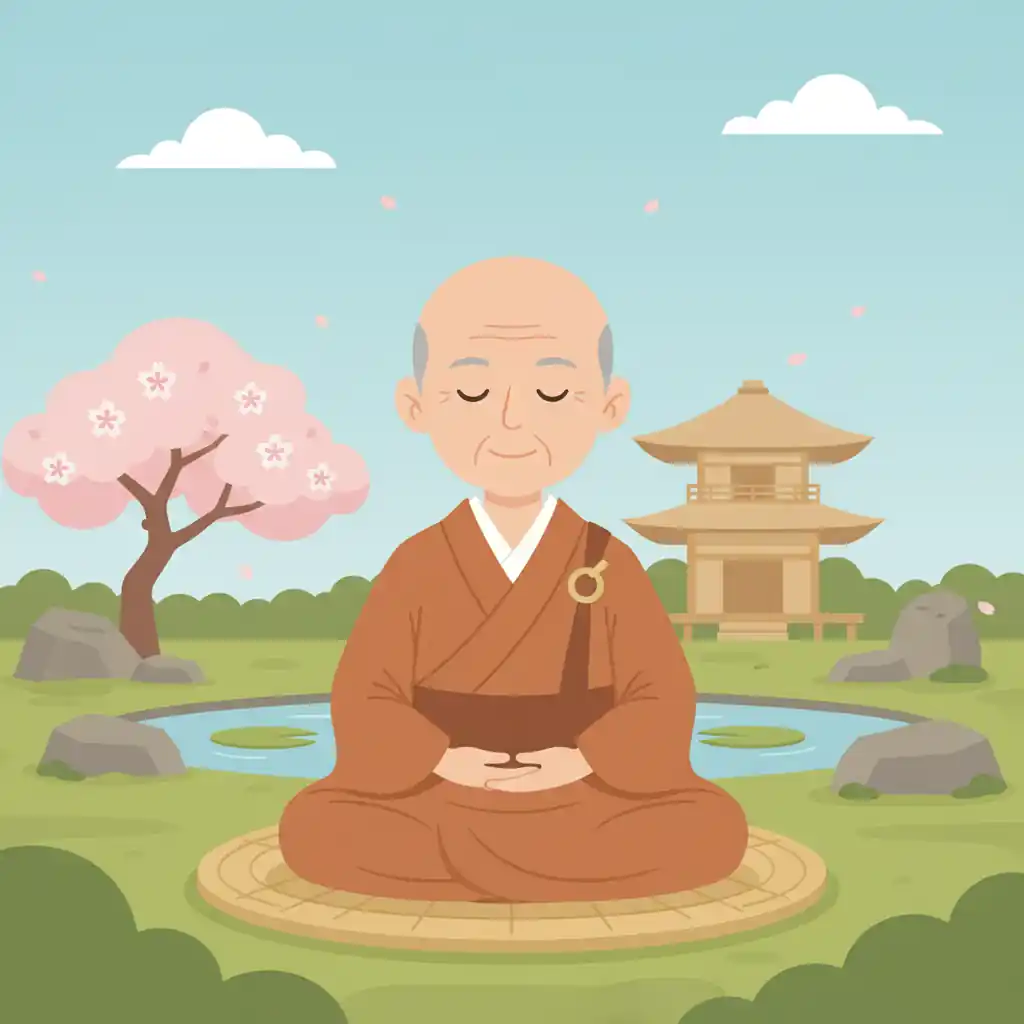
On a hill above the village stood a small temple. Inside lived an old monk named Koji.
Monk Koji spent his days in quiet meditation. His face held a calm that seemed to defy all earthly troubles.
A Mind Full of Ripples
One day, Ren climbed the winding path to the temple. He looked truly troubled, his shoulders slumped like he carried stones.
“Monk Koji,” he began, his voice strained, “I have heard another terrible rumor.”
He spoke of a merchant cheating, a minor drought in the next province, a rivalry brewing between two families.
Ren had gathered too much. His heart was heavy with worries that were not his own, not yet real.
He thought knowing these things would help him prepare. Instead, they just made him perpetually afraid.
He slept poorly. He ate little. His friends noticed his constant worry.
Monk Koji listened, his eyes gentle but observing. He saw the suffering caused by Ren's relentless hunger for information.
“Tell me, Ren,” the monk finally said, his voice soft like a breeze, “does knowing these things make your life easier or harder?”
Ren paused. He rubbed his temples. “Harder, Monk Koji. Much harder. But how can I not know? How can I ignore the world around me?”
“You do not ignore the world,” the monk replied. “You learn to discern what truly serves your peace.”
The Path Less Known
Monk Koji stood and gestured towards the garden. “Come, walk with me.”
They walked along a narrow path through the temple’s rock garden. Each stone was placed with purpose.
“Imagine two travelers,” the monk began, his voice a steady rhythm. “Both must reach the next village through a dense forest.”
“The first traveler spends days gathering every possible detail about the route. He learns of bandits possibly lurking in the north, a rickety old bridge to the west, a fierce boar often seen in the east.”
“He knows every potential danger. He maps every risk, every shadow.”
“Because of this knowledge, he begins his journey filled with anxiety. He jumps at every rustle in the leaves. Every shadow seems to hide a threat.”
“The second traveler knows only his destination. He walks the path, enjoying the sunlight filtering through the canopy. He listens to the birdsong, observes the wildflowers.”
“Which traveler,” Monk Koji asked, turning to Ren, “enjoys his journey more?”
Ren thought for a moment, picturing the two. “The second, of course. His mind is clear.”
“But what if the first traveler avoided a real danger because he knew it?” Ren countered, still holding onto his old belief.
“Perhaps,” the monk replied calmly. “But what if the dangers he feared never appeared? He suffered for nothing, for ghosts of the mind.”
“And what if the second traveler met a true danger, but faced it with a clear mind, not already exhausted and terrified by days of anticipation? His strength would be present, not wasted on worries.”