
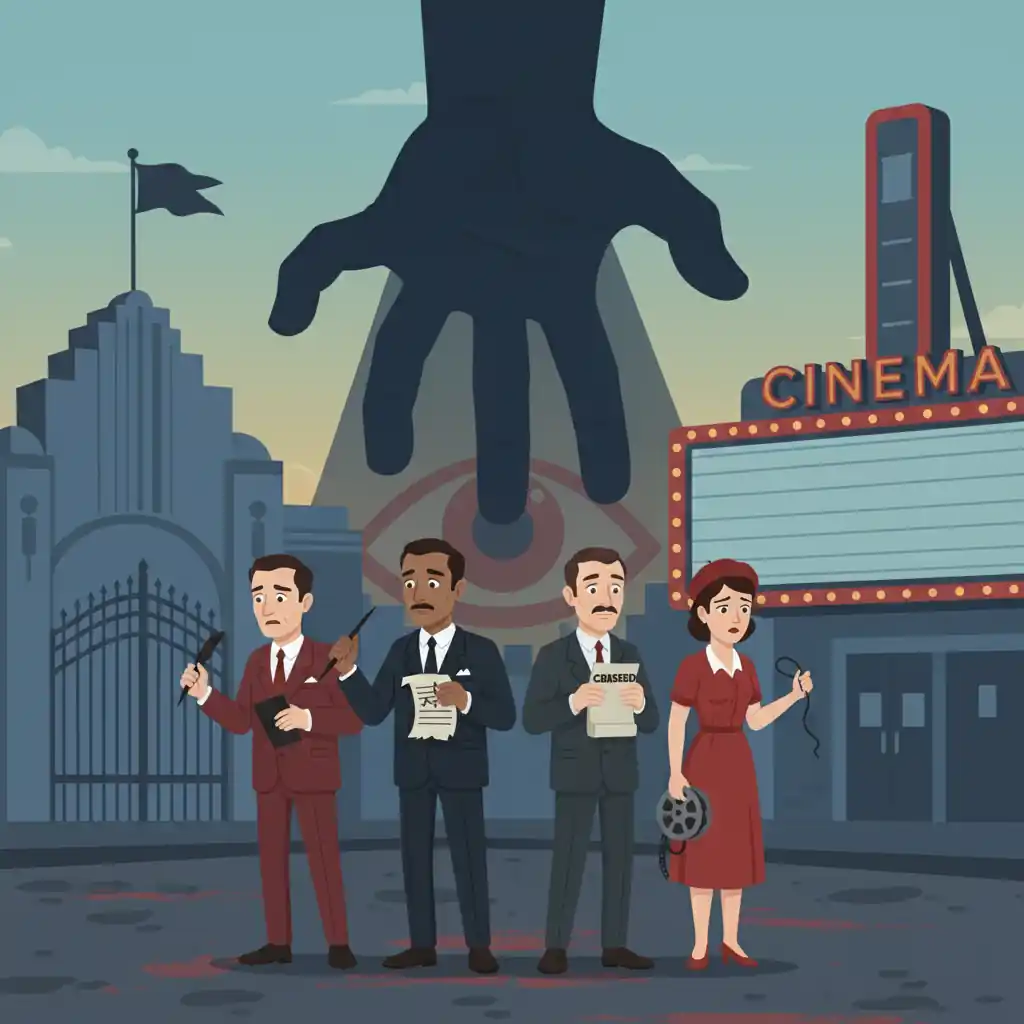
HUAC Established
The House Un-American Activities Committee (HUAC) is formed, initially tasked with investigating fascist and communist infiltration, but it gains notoriety for its anti-communist probes.
First Hollywood Hearings
HUAC begins its first investigation into alleged communist influence in Hollywood, subpoenaing various industry professionals, categorized as 'friendly' or 'unfriendly' witnesses.
The Hollywood Ten Defy
Ten writers and directors refuse to answer HUAC's questions about their political affiliations, citing First Amendment rights. They are subsequently cited for contempt of Congress.
The Waldorf Statement
Major studio executives, meeting at New York's Waldorf-Astoria Hotel, issue a statement agreeing to suspend and ultimately fire the Hollywood Ten, signaling the official start of the blacklist.
'Red Channels' Published
A notorious anti-communist pamphlet, 'Red Channels: The Report of Communist Influence in Radio and Television,' is published, listing 151 alleged communist sympathizers and effectively extending the blacklist beyond film.
Second Wave of HUAC Hearings
HUAC resumes its Hollywood investigations, expanding its scope and putting immense pressure on witnesses to 'name names' of alleged communist associates, leading to a surge in blacklisted individuals.
Elia Kazan Testifies
Acclaimed director Elia Kazan testifies before HUAC, identifying former members of a communist cell, a decision that would spark decades of debate and controversy.
Trumbo Credited for 'Exodus'
Director Otto Preminger publicly announces that blacklisted writer Dalton Trumbo will receive screen credit for the film 'Exodus,' a significant crack in the blacklist's wall of silence.
Trumbo Credited for 'Spartacus'
Actor-producer Kirk Douglas, defying industry pressure, ensures Dalton Trumbo is credited for 'Spartacus,' further eroding the blacklist's power and legitimacy.
WGA Restores Credits
The Writers Guild of America West posthumously restores screen credits to dozens of blacklisted writers who had been forced to work under pseudonyms or through 'fronts.'
PROLOGUE: THE SHADOW OVER CELLULOID
This story draws on historical investigations, journalism, and academic research into one of Hollywood's most controversial periods. The events described were the subject of intense public debate and legal scrutiny. Allegations, accusations, and varying interpretations are presented as reported claims or historical analysis, rather than definitive conclusions, acknowledging that some aspects of this era remain debated by historians.
Imagine a world where a whispered accusation could end a career, where political belief—or perceived belief—was deemed a greater threat than any on-screen villain. This was the reality of Hollywood during the Red Scare, a chilling chapter where Cold War paranoia cast a long, dark shadow over the film industry, transforming the dream factory into a crucible of fear and suspicion. This isn't just a story of politics; it's a tale of shattered lives, moral compromises, and the slow, arduous fight for artistic freedom.
ACT I: THE GHOST OF MCCARTHYISM
The Hollywood Blacklist didn't emerge in a vacuum. Its roots lie deep in the turbulent post-World War II landscape, a time when the globe was rapidly dividing into two ideological camps: the capitalist West and the communist East. The Soviet Union, once an wartime ally, quickly became the perceived enemy, and domestic fears of communist infiltration escalated into a pervasive societal anxiety. This era, widely known as the Red Scare, found its most visible institutional form in the House Un-American Activities Committee (HUAC).
The Committee's Shadowy Origins
HUAC, initially established in 1938, had a meandering history, sometimes investigating suspected Nazi sympathizers, sometimes the Ku Klux Klan. However, by the late 1940s, its focus sharpened almost exclusively on rooting out alleged communist subversion within American institutions. According to historians, Hollywood, with its immense cultural influence and high visibility, became an irresistible target. Critics argued that the committee viewed the film industry as a powerful propaganda machine, susceptible to ideological manipulation.
Journalists reported that prominent figures within the committee, such as J. Parnell Thomas, believed that Hollywood was a hotbed of radicalism, capable of injecting subversive messages into films that reached millions of American homes. This belief, however unsubstantiated by concrete evidence of overt communist propaganda in major studio productions, fueled the committee's determination.
Seeds of Suspicion
Even before HUAC's direct intervention, Hollywood had a history of political engagement. Many writers, directors, and actors, deeply affected by the Great Depression, had gravitated towards left-wing politics, including communism, in the 1930s. These associations, often born of genuine idealism and a desire for social reform, would later be used against them. Critics of HUAC have argued that the committee exploited these past affiliations, many of which had long since faded, to create a climate of fear.
What began as a genuine, if often exaggerated, concern over national security, quickly morphed into a politically charged spectacle. The stage was set for a dramatic confrontation between Washington and the dream factory, a confrontation that would forever alter the lives of hundreds and cast a chilling pall over creative expression. The 'witch hunt,' as some historians and contemporary commentators called it, was about to begin its most public and destructive phase.
ACT II: HUAC'S HOLLYWOOD DEBUT
In October 1947, HUAC brought its theatrical brand of investigation to Hollywood, turning committee hearings into a national media spectacle. The committee’s primary goal, according to its official statements, was to investigate whether communists were secretly inserting propaganda into American films. However, many observers, including numerous journalists at the time, suggested the true intent was to expose and punish those with left-leaning sympathies, regardless of their impact on film content.
The 'Friendly' and 'Unfriendly' Witnesses
The hearings began with what were known as 'friendly witnesses'—prominent figures in Hollywood who willingly testified and, in some cases, named individuals they believed to be communists. Among the most notable were Jack L. Warner, head of Warner Bros. Studio, who reportedly named screenwriters he considered subversive, and actors Ronald Reagan (then president of the Screen Actors Guild) and Gary Cooper, who expressed concerns about communist influence in the industry. These testimonies, documented in congressional records, lent an air of legitimacy to the committee's claims, even as they stoked internal divisions within Hollywood.
The atmosphere changed dramatically when the 'unfriendly witnesses' were called. These were individuals who refused to answer the committee’s central question: 'Are you now or have you ever been a member of the Communist Party?' They argued that the question violated their First Amendment rights to freedom of speech and association, and their Fifth Amendment rights against self-incrimination. Their defiance was a direct challenge to the committee's authority and tactics.
The Hollywood Ten: A Standoff
Among the 'unfriendly' were ten writers and directors, including Dalton Trumbo, Alvah Bessie, Herbert Biberman, Lester Cole, Edward Dmytryk, Ring Lardner Jr., John Howard Lawson, Albert Maltz, Samuel Ornitz, and Adrian Scott. These men became known as the Hollywood Ten. Their strategy was not to deny communist affiliation, but to refuse to testify on principle, condemning the hearings as unconstitutional and a violation of civil liberties. Court transcripts show their passionate, often fiery, exchanges with committee members.
One of the most dramatic moments, as reported by contemporary media, involved John Howard Lawson, who declared, 'I am not on trial here, Mr. Chairman. This committee is on trial before the American people!' This defiance, however principled, came at a heavy cost. The Hollywood Ten were cited for contempt of Congress, leading to federal indictments and, ultimately, prison sentences ranging from six months to a year. Their incarceration sent a chilling message throughout Hollywood: cooperation was not optional.
This first wave of hearings established the pattern that would dominate the blacklist era: public accusation, demanded confession or denunciation of others, and severe professional consequences for non-compliance. The industry, initially divided, was about to make a fateful decision that would solidify the blacklist’s grip.
ACT III: THE WALDORF STATEMENT AND THE BLACKLIST'S GRIP
The convictions of the Hollywood Ten created a crisis for Hollywood studio executives. Faced with public pressure, potential boycotts, and the looming threat of further government intervention, the industry leadership convened a crucial meeting at the Waldorf-Astoria Hotel in New York City in December 1947. Their decision would formally establish the blacklist and plunge hundreds of careers into darkness.
The Waldorf Statement: Capitulation and Justification
Following intense deliberations, prominent studio heads, including Louis B. Mayer of MGM and Harry Cohn of Columbia Pictures, issued what became known as the Waldorf Statement. This declaration, as widely reported by news outlets, stated that the executives would 'forthwith discharge or suspend without compensation' the Hollywood Ten. Crucially, it also affirmed that 'we will not knowingly employ a Communist or a member of any party or group which advocates the overthrow of the Government of the United States by force or by any illegal or unconstitutional methods.'
Historians have debated whether this was an act of sincere anti-communism, a desperate attempt to protect the industry, or a combination of both. Regardless of the motivation, the Waldorf Statement effectively legitimized HUAC's investigations and provided the mechanism for an industry-wide exclusion. The 'unfriendly' were no longer merely defiant witnesses; they were now officially unemployable within the studio system.
The Expanding Net: 'Red Channels'
While the Waldorf Statement solidified the studio blacklist, the net of suspicion soon widened considerably. In June 1950, a small, anti-communist newsletter called Counterattack published a pamphlet titled 'Red Channels: The Report of Communist Influence in Radio and Television.' This infamous document, based on often dubious evidence and anonymous informants, listed 151 actors, writers, directors, and musicians, alleging their communist sympathies or affiliations.
Journalists later revealed that 'Red Channels' quickly became an unofficial bible for casting directors, producers, and advertising agencies in both Hollywood and New York. Simply appearing on the list, even without formal charges or hearings, was often enough to end a career. The economic consequences were immediate and brutal. As recounted by many victims in later interviews, phone calls stopped coming, agents dropped clients, and once-lucrative careers evaporated overnight, forcing individuals to seek work under pseudonyms, in other countries, or outside the entertainment industry entirely.
The blacklist was not a formal government decree, but rather an extra-legal industry practice, driven by fear and economic pressure. It became a self-perpetuating system where the mere accusation, however flimsy, was often tantamount to conviction. The era of secret screenings committees, loyalty oaths, and widespread professional sabotage had truly begun.