
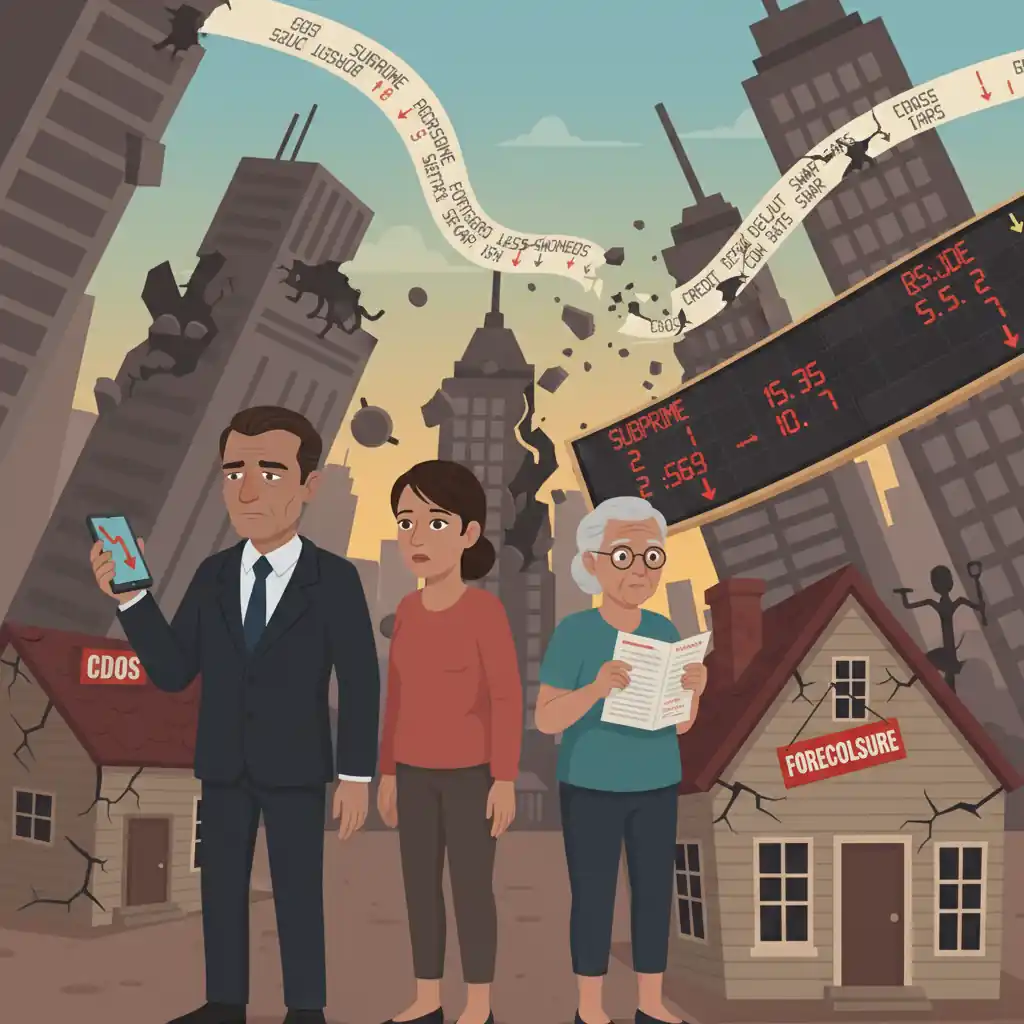
Glass-Steagall Repealed
The Gramm-Leach-Bliley Act effectively repeals key provisions of the Glass-Steagall Act, dismantling the separation between commercial and investment banking and paving the way for larger, riskier financial institutions.
Commodity Futures Modernization Act
This act explicitly exempted over-the-counter derivatives, including credit default swaps, from regulation by the Commodity Futures Trading Commission, creating a massive, opaque market.
SEC's Net Capital Rule Change
The SEC modifies its net capital rule, allowing five major investment banks to take on significantly more leverage, reportedly with less regulatory oversight, increasing their exposure to risk.
Subprime Lending Peak
The subprime mortgage market reaches its peak, with lenders issuing high-risk loans to borrowers with poor credit, often with adjustable rates that would reset to higher payments.
New Century Financial Files for Bankruptcy
One of the largest subprime lenders, New Century Financial, collapses, signaling the beginning of the end for the housing bubble and sparking wider market concerns.
Bear Stearns Collapse
Facing a liquidity crisis due to exposure to subprime mortgages, investment bank Bear Stearns is acquired by JPMorgan Chase in a fire sale, backed by a significant Federal Reserve loan.
Lehman Brothers Files for Bankruptcy
The 158-year-old investment bank Lehman Brothers files for the largest bankruptcy in U.S. history, sending shockwaves through global financial markets and freezing credit.
AIG Bailout
The U.S. government bails out American International Group (AIG) with an $85 billion loan, as the insurer's massive exposure to credit default swaps threatened a wider systemic collapse.
TARP Enacted
The Troubled Asset Relief Program (TARP) is signed into law, authorizing $700 billion to purchase distressed assets and inject capital into struggling financial institutions.
Dodd-Frank Act Signed into Law
The Dodd-Frank Wall Street Reform and Consumer Protection Act is enacted, aiming to increase financial regulation, create new agencies, and prevent future crises, though its effectiveness remains debated by critics and supporters alike.
PROLOGUE: THE UNRAVELING SILENCE
This story draws on historical investigations, journalism, and academic research. Some events described were the subject of public controversy or legal investigation. Allegations and interpretations are presented as reported claims rather than definitive conclusions. The narrative explores the complex, often opaque world of high finance, a realm where esoteric instruments and daring strategies intertwined, setting the stage for a crisis that would shake the global economy to its core.
In the mid-2000s, the U.S. housing market boomed with an almost surreal intensity. Prices climbed relentlessly, fueled by readily available credit and a widespread belief that real estate was a sure bet. Beneath this veneer of prosperity, however, a perilous game was being played, largely out of public view. Investment banks, mortgage lenders, and ratings agencies were constructing an intricate, highly leveraged edifice of debt, built on the increasingly shaky foundation of subprime mortgages. It was a house of cards, engineered with alarming ingenuity, whose eventual collapse would not only wipe out trillions in wealth but also expose the profound vulnerabilities of an interconnected global financial system.
What began as a localized problem in the mortgage market quickly metastasized, revealing a web of speculative practices and regulatory blind spots that, according to numerous investigations, had been developing for years. The tale of the 2008 banking collapse is not simply one of market cycles; it is a complex narrative involving the quiet unraveling of long-standing financial safeguards, the fervent belief in self-regulation, and the extraordinary human capacity for both innovation and hubris. As the cracks in the foundation began to show, the world would learn just how deeply the fate of Main Street was tied to the high-stakes wagers of Wall Street.
ACT I: THE FINANCIAL ALCHEMY AND THE SUBPRIME GAMBIT
To comprehend the scale of the 2008 financial crisis, one must first grasp the esoteric financial instruments that proliferated in the years leading up to it. At the heart of the crisis were subprime mortgages, loans granted to borrowers with questionable credit histories who typically would not qualify for conventional loans. These loans often featured low initial 'teaser' rates that would later reset to much higher, unaffordable payments. According to the Financial Crisis Inquiry Commission (FCIC) report, subprime lending surged, reaching over 20% of all mortgage originations by 2006.
The real 'alchemy,' as many financial critics argued, began when these individual subprime mortgages were bundled together into complex financial products. The first layer was the Mortgage-Backed Security (MBS). Thousands of individual mortgages—some good, many increasingly bad—were pooled and sold as bonds. Investors received payments from the aggregate pool of mortgage interest.
But the financial engineers didn't stop there. They then sliced these MBSs into further tranches, creating Collateralized Debt Obligations (CDOs). These CDOs were structured into different risk levels: a 'senior' tranche, considered safest and therefore rated highest; a 'mezzanine' tranche; and an 'equity' or 'toxic' tranche, which absorbed the first losses but offered the highest potential returns. As journalists like Michael Lewis detailed, these tranches were designed to create highly-rated securities even from pools dominated by subprime debt, convincing investors they were safe.
A crucial, and later notorious, innovation was the Credit Default Swap (CDS). These were essentially insurance policies against a bond defaulting, but with a critical difference: anyone could buy them, even if they didn't own the underlying bond. This allowed for massive speculative bets against the housing market. As the FCIC report highlighted, the market for CDSs ballooned from less than $1 trillion in 2000 to over $60 trillion by 2007—an unregulated shadow insurance market that vastly amplified the risk across the entire system. Critics argued these swaps functioned less like insurance and more like unregulated side bets, massively increasing systemic risk.
The oddity of this system, as many analysts later pointed out, was that the very institutions originating the risky subprime mortgages were often the same ones structuring and selling the complex derivatives, and even placing bets against them. Some journalists reported that certain firms allegedly encouraged the issuance of more subprime loans, knowing they could offload the risk through securitization or profit from shorting the market via CDSs. The Financial Crisis Inquiry Commission later investigated allegations that some banks knowingly packaged and sold securities they believed would fail, raising serious ethical, if not legal, questions about their conduct.
ACT II: THE BLIND WATCHMEN AND THE RATINGS GAME
The intricate financial architecture built on subprime debt could not have reached such perilous heights without, according to critics, a significant failure of oversight. The role of financial regulators, and their reported shortcomings, became a central point of contention in post-crisis investigations. Many historians and economists point to a prevailing ideology of deregulation that characterized the preceding decades. The repeal of the Glass-Steagall Act in 1999, which had separated commercial and investment banking since the Great Depression, allowed institutions to become 'too big to fail' and engage in both safer deposit-taking and riskier trading activities.
Furthermore, the Commodity Futures Modernization Act of 2000 explicitly exempted over-the-counter derivatives, including the burgeoning credit default swap market, from federal regulation. This created a massive, opaque shadow financial system, as later documented by various Senate investigations. As investigators for the FCIC noted, this lack of transparency and regulatory scrutiny allowed risk to accumulate unchecked within the system.
Another critical player in this ecosystem were the credit ratings agencies—Standard & Poor's, Moody's, and Fitch. These agencies were tasked with assessing the creditworthiness of the complex MBS and CDO products. Investors relied on their ratings (AAA, AA, etc.) to gauge the safety of their investments. However, as numerous inquiries later revealed, the agencies were paid by the very banks whose products they were rating, creating an inherent conflict of interest. Critics argued this payment structure incentivized inflated ratings.
The FCIC report concluded that the ratings agencies were 'essential cogs in the wheel of financial destruction,' having stamped AAA ratings—the safest possible—on billions of dollars' worth of CDOs packed with subprime mortgages. Journalists later reported on internal emails from ratings agency employees allegedly expressing skepticism and even mockery about the quality of the products they were rating, even as they assigned them top scores. This practice, critics argued, misled investors globally and enabled the reckless behavior of the banks.
The concept of 'regulatory capture' also became a dominant theme in post-crisis analysis. Critics argued that regulators, often former industry insiders, were either too close to the banks they oversaw or lacked the resources and expertise to understand the increasingly complex financial instruments. The Securities and Exchange Commission (SEC), for instance, made a critical change to its net capital rule in 2004, allowing the five largest investment banks to dramatically increase their leverage, reportedly with minimal additional oversight. This meant these firms could borrow more money for every dollar of their own capital, significantly amplifying their potential gains—and losses. This shift, according to historical accounts and several investigative reports, further loosened the reins on institutions that were already pushing the boundaries of risk.
ACT III: THE CRACKS APPEAR AND THE BEAR ROARS
By 2006, the first fissures began to show in the seemingly impenetrable facade of the housing market. The rising interest rates meant that many adjustable-rate subprime mortgages began to 'reset' to significantly higher payments, pushing homeowners into default. As foreclosures surged, housing prices, which had only ever seemed to go up, began to fall. This triggered a cascade of problems for the financial institutions holding the MBS and CDOs based on these mortgages.
Initially, the market downturn was dismissed by many as a localized 'subprime issue' that would not infect the broader economy. However, the interconnectedness of the financial system meant that the losses quickly spread. Banks and investors who had bought the 'highly rated' CDOs suddenly found their assets plummeting in value. The opaque nature of these instruments meant that no one truly knew who held what, or how much risk they were exposed to, leading to a profound crisis of confidence.
The first major casualty on Wall Street arrived in March 2008: Bear Stearns. A 158-year-old investment bank, Bear Stearns was heavily invested in subprime mortgages and the derivatives built upon them. As the value of these assets collapsed, other banks became unwilling to lend to Bear Stearns, fearing it would not be able to repay its debts. This sudden withdrawal of credit—a 'run on the bank' in the modern sense—triggered a liquidity crisis. Reportedly, the firm's collapse was so rapid that it went from denying liquidity problems on a Monday to being on the brink of bankruptcy by Thursday.
In an unprecedented move, the Federal Reserve orchestrated the sale of Bear Stearns to JPMorgan Chase for a mere $2 per share, backed by a $29 billion government loan to cover Bear's toxic assets. This emergency intervention, as historians later detailed, signaled to the markets that the government was willing to step in to prevent a systemic collapse. However, critics argued it also set a dangerous precedent, creating a 'moral hazard' where large institutions might take on excessive risk, believing they would be bailed out.