
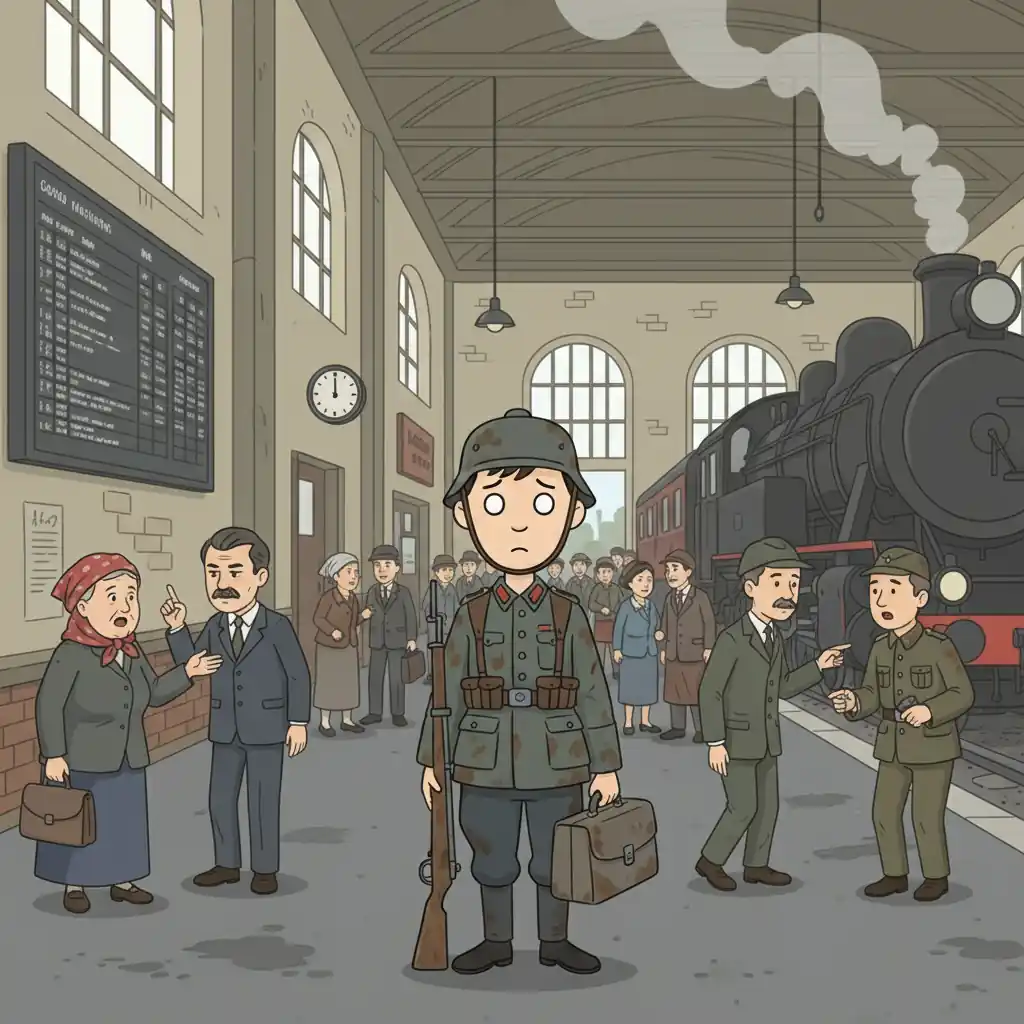
The Long Road Home: Mind and Mud
The year was 1918. Europe groaned under the weight of four brutal years of war.
Across the Western Front, German soldiers endured constant mud. They faced relentless shelling.
The cold, wet fear was a constant companion. They were tired. So incredibly tired.
Their uniforms were rags. Their boots were heavy with clay, if they still had any.
Their bodies ached from endless marches, back-breaking labor, and freezing nights in damp trenches.
Their minds, however, were even more exhausted. Numb from constant danger, endless deprivation, and gut-wrenching loss.
They had seen too much. Heard too much. Fought too much.
Battles still raged fiercely. Commanders barked orders. Maps, stained and creased, lay on makeshift tables.
Discussions about strategies, supply lines, troop movements filled the air.
But for many, these grand plans meant less than nothing. It was just noise.
Their focus had narrowed to a single, burning desire: to go home. To escape this hell.
Any conversation not related to that escape simply washed over them. Their ears heard sounds, but their brains refused to process the words.
It was a desperate act of self-preservation. Their last energy reserved for one thought.
They dreamed of green fields instead of barbed wire. Warm beds instead of cold earth. Silence instead of explosions.
Above all, they yearned for departure. The signal to leave. The chance to end it.
There was only one concept that symbolized this longed-for escape. This promised return. This end to the nightmare. It was the gateway back to life.
The Unspoken Understanding: Just "Bahnhof"
Imagine a typical scene: A young, energetic officer stands before a small group of seasoned veterans.
He clutches a new dispatch. His eyes are bright with earnest conviction.
He unfurls a diagram of a new grenade. Explains its fuse mechanism. Its throwing arc. Its potential impact radius.
"Gentlemen," he announces, his voice full of academic enthusiasm, "this design will revolutionize trench warfare!"
He speaks of efficiency. Of clearing enemy lines. Of unprecedented impact. He elaborates on the physics, the metallurgy, the tactical advantages.
The soldiers listen. Or, they appear to. Their faces are grim, etched with years of weariness.
Their eyes fix somewhere beyond the officer's shoulder. On a distant cloud. A buzzing fly.
They nod slowly. A practiced motion of deference, not comprehension.
Finally, the officer finishes his lengthy, technical explanation. "Are there any questions about the new device?" he asks, beaming.
A grizzled private named Klaus, his uniform caked in mud, slowly raises a hand. "Sir," he says, his voice flat, "Bahnhof."
The officer blinks. He frowns. "Bahnhof? What are you talking about, Private? We're discussing ordnance!"
Klaus doesn't elaborate. He just shrugs, a heavy, world-weary gesture. He repeats, a little louder, "Nur Bahnhof."
Another soldier, Corporal Erich, steps forward. "He means, Lieutenant," Erich explains gently, "he understands nothing of your talk."
"His mind is only on the train station. On getting on a train. On going home."