
The Weight of Words and Leather
Centuries ago, paper was a luxury. Most important documents lived on parchment.
Parchment came from animal skins. Often, it was cowhide – tough, durable, and plentiful enough for official use.
Scribes were vital. They were the town's memory keepers. They wrote everything down: laws, debts, accusations, family histories.
Every lord, every wealthy merchant, every town council had one. They ensured order.
In the small, bustling town of Bärlingen, nestled by the river, lived a scribe named Heinrich.
Heinrich was a man of meticulous order. His quill was always sharp, his inkpot brimming with fresh, dark ink.
He kept all official records for Baron Klaus, a stern but ultimately fair ruler.
Heinrich's small, quiet study always smelled of old leather, dried herbs, and beeswax candles.
His most prized possessions were the heavy, rolled scrolls of finished cowhide.
Each scroll held stories: detailed land disputes, binding marriage contracts, complex tax records.
A single, carefully stretched and prepared cowhide could hold a remarkable amount of text. Pages upon pages of meticulous script.
It was considered an endless canvas for human affairs.
But even Heinrich, with his disciplined hand and boundless diligence, would soon face a challenge that would stretch the limits of his belief.
A challenge so immense, it seemed too big for even the largest, most robust piece of cowhide.
The Woes of Wilhelm the Weaver
The trouble, as it often does, began with one man: Wilhelm. Wilhelm was a weaver by trade.
However, he was not a good weaver. In fact, he was famously terrible.
His threads snapped mid-loom. His patterns were always crooked. His expensive dyes ran and bled, ruining entire batches of fabric.
He owed money to nearly half the town. He took orders for fine cloaks, then delivered threadbare rags.
First, the baker, Franz, arrived at the Baron's court. Wilhelm hadn't paid for a year's supply of flour.
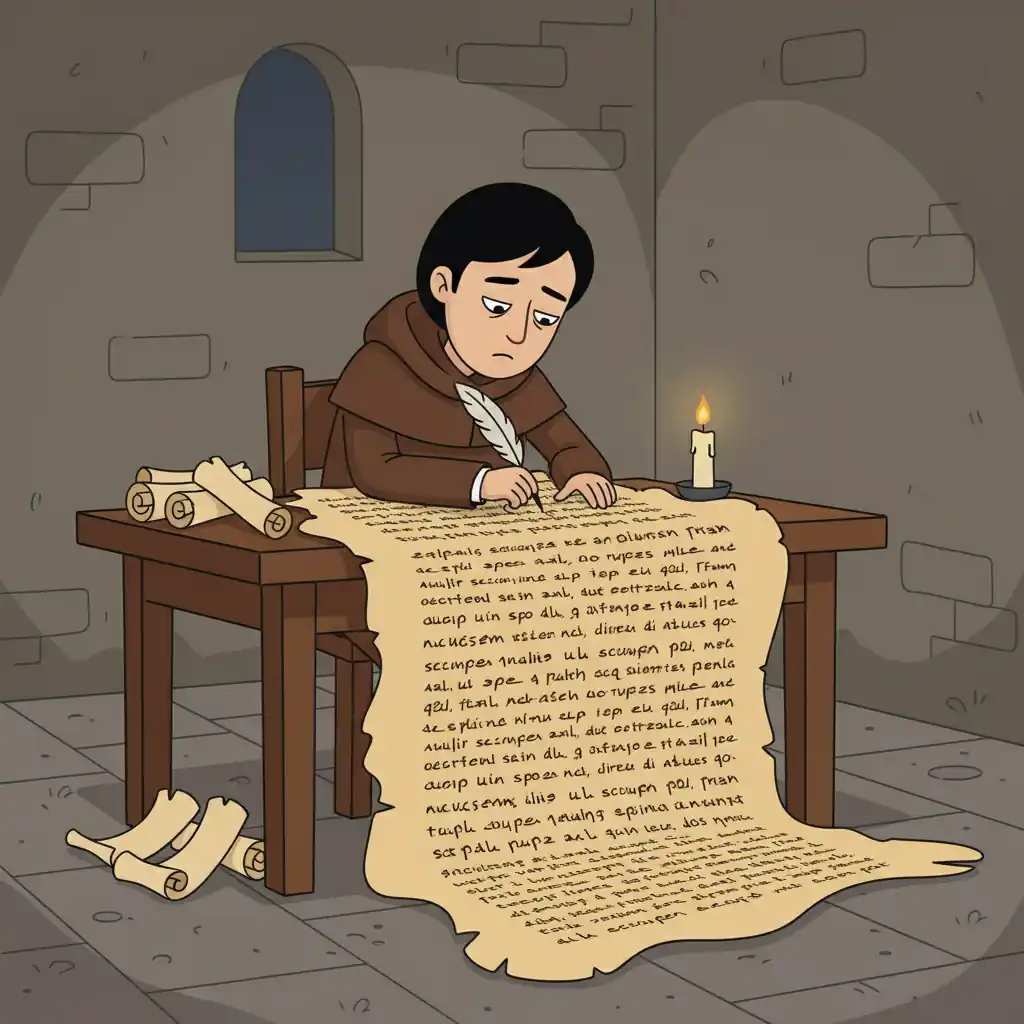
Heinrich carefully dipped his quill. He wrote it down. A single, clear line on the fresh cowhide.
Then came the butcher, Greta, her hands on her hips. Wilhelm owed her for three plump pigs, consumed months ago.
Another accusation. Another line on the cowhide. Still, the parchment was mostly empty.
But soon, the individual complaints began to merge into a flood.
The blacksmith reported Wilhelm never settled his bill for repairing his loom's broken parts.
The innkeeper complained that Wilhelm drank on credit every night, promising payment, then vanished at dawn.
The tailor declared Wilhelm had stolen his best pair of shears, vital tools for his livelihood.
Each morning, more people queued outside Heinrich's study. Each day, another accusation, another broken promise, another act of negligence.
Heinrich meticulously recorded every single grievance. Every unpaid debt. Every ruined garment. Every instance of Wilhelm's appalling character.
The small piece of cowhide he started with, once so vast, began to fill rapidly.
He unrolled a new section. And then, surprisingly quickly, another one.
Wilhelm's reputation for deceit and incompetence was growing almost as fast as Heinrich's ledger.
A List Without End
Baron Klaus sat on his high-backed chair, his brow furrowed, listening to the unending litany of Wilhelm's misdeeds.
“Heinrich,” the Baron boomed one particularly frustrating afternoon, “is there truly no end to this man's offenses? Does his conscience know no bounds?”
Heinrich sighed, a weary sound, as he looked at the growing stack of thick cowhide scrolls dedicated solely to Wilhelm.
“My Lord,” Heinrich replied, his voice strained, “I fear not. Each day brings new revelations, new victims.”
He had already filled three full pieces of carefully prepared cowhide just for Wilhelm's file.