
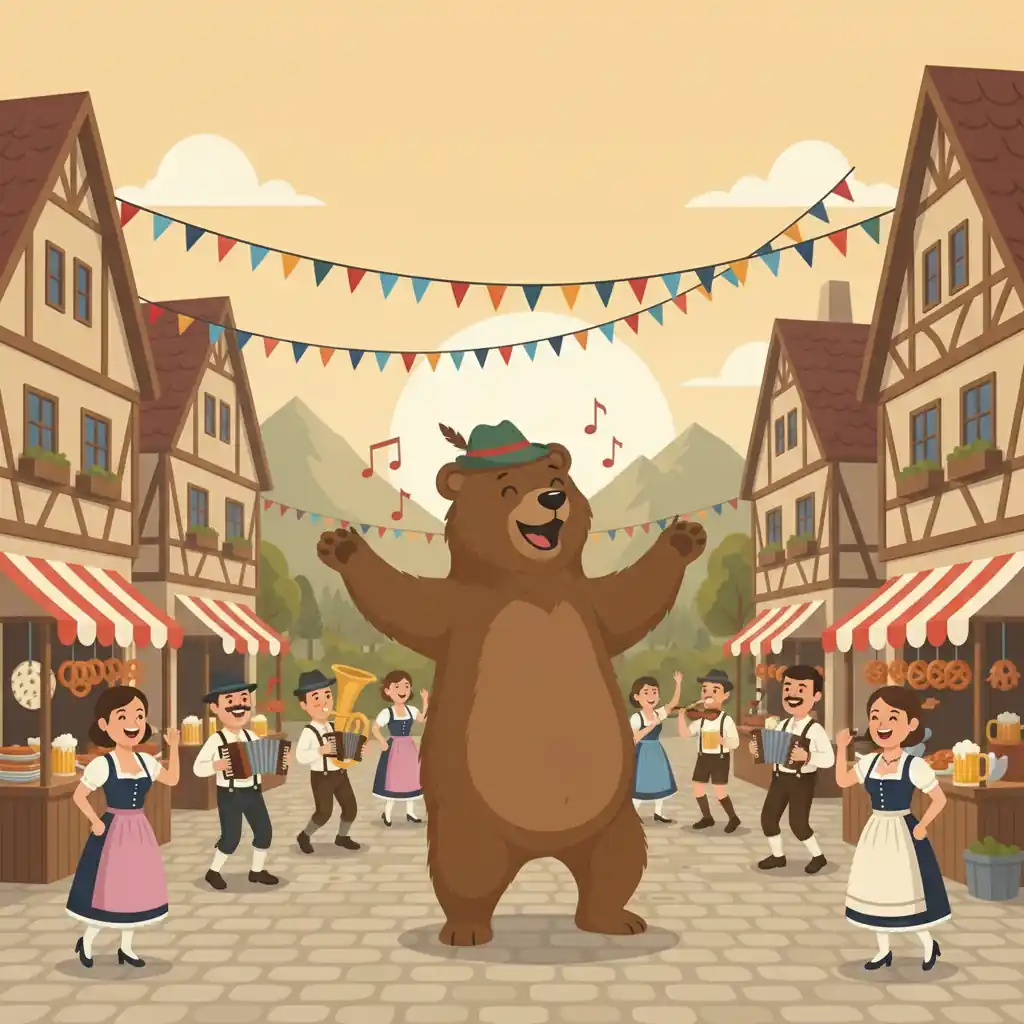
The Quiet Village of Birkenau
Many years ago, nestled deep in the Black Forest, lay the small village of Birkenau. It was a peaceful place, known for its thick woods and the gentle murmur of the river that snaked through it.
The villagers of Birkenau were a calm and orderly folk. Their annual harvest festival, the Erntedankfest, was a tradition they held dear.
Each year, the festival followed a familiar pattern. There was good food, of course – freshly baked bread, roasted meats, and sweet berry tarts.
There was also music, played by old Hans on his accordion and young Grete on her fiddle. The tunes were always the same, comforting and familiar.
People would sway gently to the melodies. They would chat politely, share news, and enjoy the company of neighbors.
Children would play games, but even their laughter was usually subdued, echoing softly against the ancient trees.
No one in Birkenau expected a festival to be wild or boisterous. It was a time for gratitude and quiet celebration.
But one particular year, something shifted. A change arrived with the autumn leaves, and it promised to shake the quiet foundations of Birkenau.
A Spark of Energy
It began with the traveling merchant, Herr Schmidt. He arrived a week before the Erntedankfest, bringing not just goods, but stories from the bustling cities.
Herr Schmidt was a man of great energy. He laughed loudly and spoke with animated gestures. He seemed to carry a spark of excitement wherever he went.
He told tales of city fairs, of music so fast it made your feet tingle, and dances so lively that everyone, young and old, spun with joy.
The villagers listened with polite interest, but most assumed such wildness was for 'city folk,' not for quiet Birkenau.
Yet, a seed was planted. When the Erntedankfest finally arrived, the usual musicians, Hans and Grete, found themselves playing with a little more zest.
Perhaps it was Herr Schmidt’s influence, or perhaps a particularly bountiful harvest had filled everyone with extra cheer. The fiddle sang a little brighter, the accordion pulsed with more rhythm.
Soon, the gentle swaying turned into actual steps. Feet began to tap, then shuffle, then twirl. More and more people joined the improvised dance floor in the village square.
The air filled with the sound of stomping boots, rustling skirts, and hearty laughter. It was unlike any Erntedankfest Birkenau had ever seen.
Even the sternest old farmer found himself tapping a foot under the table. The children, usually shy, were now spinning in circles, their faces red with delight.
The energy was infectious. It grew with each passing hour, fueled by lively music and the sheer joy of the crowd.