
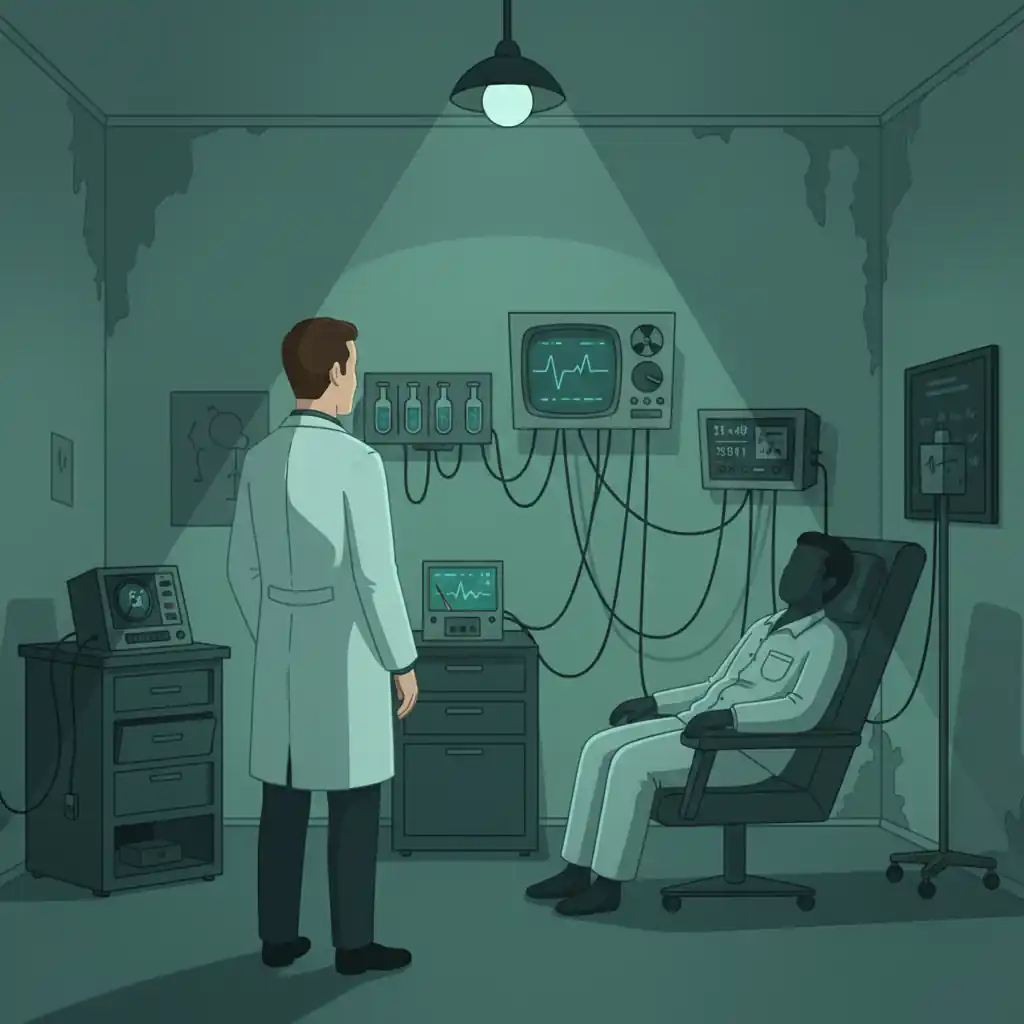
PROLOGUE: THE SHADOW OF THE ATOM
The year is 1945. The mushroom clouds over Hiroshima and Nagasaki have just receded, but their terrifying glow lingers. Humanity has unleashed a power that can redefine warfare, medicine, and life itself. In the shadow of this new atomic age, a chilling question arises in the halls of power: What exactly does radiation do to the human body?
This wasn't an academic curiosity. This was the Cold War, and the stakes were existential. The United States, having birthed the bomb, found itself in a desperate race against the Soviet Union. Understanding the precise effects of radiation – its lethality, its hidden damages, its potential as a weapon and a defense – became a national imperative. But in this urgent quest for knowledge, a dark chapter unfolded: one where the very people the government swore to protect became unwitting guinea pigs in a series of secret experiments.
For decades, the full extent of these Human Radiation Experiments remained buried under layers of classification and denial. These weren't isolated incidents of rogue scientists; they were a vast, coordinated network of studies, often funded and directed by the Atomic Energy Commission (AEC), the Department of Defense, and other government agencies. From the late 1940s through the 1970s, thousands of American citizens—patients, prisoners, soldiers, even children—were unknowingly exposed to radioactive materials, all in the name of national security and scientific advancement.
The narrative we are about to explore is not just a tale of scientific inquiry gone awry, but a stark reminder of how easily ethical boundaries can erode when fear and ambition hold sway. It's a story of doctors betraying trust, government agencies sacrificing morality for intelligence, and the enduring human cost hidden beneath the sterile veneer of medical research.
The Dawn of a Nuclear Obsession
Post-WWII, the United States was gripped by what one historian called 'radiophobia' alongside an almost fetishistic fascination with atomic energy. The public was simultaneously terrified of fallout and mesmerized by the promise of 'atoms for peace.' This duality created a fertile ground for unchecked scientific exploration. Doctors and scientists, many with wartime experience, believed they were at the vanguard of a new medical frontier. The ethical guidelines that govern research today simply didn't exist in a meaningful form, or were conveniently ignored, under the intense pressure of the Cold War. The question wasn't if they should conduct these tests, but how many and how quickly.
The imperative was clear: if American soldiers might be exposed to radiation on a battlefield, the government needed to know the exact dosage that would incapacitate or kill. If the nation faced a nuclear attack, they needed to understand survival rates and medical interventions. And if they were to develop their own nuclear arsenal, they needed to grasp the biological pathways of these new, invisible poisons. The ends, they reasoned, justified the means.
ACT I: THE PLUTONIUM INJECTIONS – A GRIM START
The most notorious, and perhaps most emblematic, of these experiments began almost immediately after the war. The Manhattan Project, which developed the atomic bomb, had produced a terrifying new element: plutonium. Its toxicity was a complete mystery. How much was too much? How quickly did the body excrete it? Was it truly a bone-seeker, lodging itself in the marrow indefinitely? There was only one way, they concluded, to find out: administer it directly to humans.
Project F: The Plutonium Files
Between 1945 and 1947, a series of experiments known as 'Project F' involved injecting minute but radiologically significant doses of plutonium into at least eighteen unsuspecting patients across the country. These were not healthy volunteers; they were typically hospitalized individuals, often with terminal illnesses, who were deemed to have only a short time to live. Their consent was either nonexistent or woefully inadequate, reduced to a vague signature on a form for a 'new treatment' or 'experimental procedure' with no mention of radioactive material.
One of the first was Albert Stevens, a house painter suffering from stomach cancer, admitted to the University of California Hospital in San Francisco in 1945. He was injected with plutonium-238 and plutonium-239. Doctors told him he was receiving a 'new experimental substance' for diagnostic purposes. Stevens lived for another 20 years, dying not from the cancer that was believed terminal, but from heart disease. His body, however, had been exposed to the equivalent of 70,000 times the permissible lifetime dose of plutonium. He was, in essence, a human Geiger counter.
Another tragic case was Ebb Cade, a 53-year-old African American railroad porter who suffered severe leg injuries in an automobile accident in 1946. He was admitted to Oak Ridge Hospital, a facility closely tied to the Manhattan Project. Without his knowledge or consent, he was injected with 4.7 micrograms of plutonium. The stated rationale was to study how plutonium would be metabolized in a person with broken bones, mimicking a battlefield injury. Cade was kept in a locked room for months, his urine and feces meticulously collected and analyzed for plutonium excretion. He was then released, still unaware of the radioactive material coursing through his body, only for his data to become a footnote in classified reports.
The 'Convenient' Subjects
The choice of subjects was not random. Scientists often sought patients with existing conditions that might obscure any adverse effects of radiation, or those deemed 'expendable.' This included individuals with cancer (even if misdiagnosed), psychiatric patients, and the economically disadvantaged. The medical community of the era often operated under a paternalistic doctrine where doctors made decisions without comprehensive patient disclosure. For the plutonium experiments, this was twisted into a grotesque form of covert research.
The precise effects of these injections on the patients' subsequent health are difficult to pinpoint, given their pre-existing conditions. However, the ethical violation was clear: human beings were deliberately irradiated without true informed consent, often under false pretenses, purely for the acquisition of data. These initial experiments set a dangerous precedent, opening the door for even wider and more diverse radiation tests in the coming decades.
The scientists involved, many of them brilliant and highly respected, often claimed they believed the doses were harmless or that the knowledge gained would ultimately save countless lives. They operated in an atmosphere of intense secrecy and nationalistic zeal, where the lines between medical research and military intelligence were dangerously blurred. The fear of a nuclear attack, and the imperative to understand the enemy's potential weapons, justified almost any means.
ACT II: A NATION OF UNWITTING GUINEA PIGS
The plutonium injections were just the tip of a vast, radioactive iceberg. As the Cold War intensified, the scope and variety of human radiation experiments exploded, touching nearly every facet of American society. From the hallowed halls of prestigious universities to the grim confines of state prisons, thousands became unwitting subjects in a grand, morally bankrupt scientific endeavor.
From Hospitals to Orphanages
Total Body Irradiation (TBI) experiments became a common, horrifying practice. At institutions like the University of Cincinnati, cancer patients, predominantly poor and often African American, were subjected to massive doses of radiation. They were told these were experimental treatments for their cancer, but the primary goal was often to study the effects of high-dose radiation on humans, mimicking battlefield exposure. Many suffered excruciating pain, vomiting, hair loss, and severe burns, often without any therapeutic benefit, and sometimes hastening their deaths.
Even more disturbing were the studies involving children. In the 1950s and 60s, researchers at the Fernald State School for intellectually disabled children in Massachusetts, and other similar institutions, fed oatmeal laced with radioactive iron and calcium to their young residents. The 'Quaker Oats' experiment, as it became known, aimed to study nutrient absorption. The children, unaware they were consuming radioactive isotopes, were simply told they were joining a 'science club' or participating in a special research program. Their parents' consent, when obtained, was often vague or misleading, never disclosing the radioactive nature of the 'special diet.'
Prisoners and the Military
Prisons, with their captive populations and institutional control, became ideal sites for unethical research. At facilities like the Oregon State Penitentiary and Washington State Prison, hundreds of inmates were subjected to testicular irradiation experiments from the 1960s to the early 1970s. The goal was to study the effects of radiation on male reproductive function, including sperm counts and genetic damage. Prisoners were offered incentives like monetary payments or early parole, making their 'consent' highly coercive. Many suffered severe burns, sterility, and an elevated risk of cancer, a fact often dismissed as an unavoidable side effect.
Beyond medical settings, the military also engaged in extensive human radiation testing. Tens of thousands of 'atomic veterans' were ordered to witness nuclear bomb tests at close range, serving as living measurements of blast effects and fallout. Many were not adequately protected, often simply told to 'shield their eyes' from the blinding flash. These soldiers later suffered from higher rates of cancer and other radiation-related illnesses, their pleas for recognition and compensation often met with government denial for decades.
The Oddities: Radioisotope Cocktails and Brain Scans
The sheer range of experiments was staggering. Pregnant women were given radioactive iron to study placental transfer; healthy individuals were injected with iodine-131 or phosphorus-32 to trace metabolic pathways; even schoolchildren were exposed to radiation from X-ray machines, some designed to test fallout shelters, others simply for diagnostic purposes that were disproportionate to their medical need. One particularly bizarre proposal, though likely never fully implemented on a large scale, involved dosing entire communities with radioactive tracers through municipal water supplies to simulate enemy biological warfare attacks. The casual disregard for the long-term health of these subjects speaks to a profound ethical disconnect.
These experiments weren't designed to find cures; they were designed to collect data. The data points were human lives, and the scientific community, caught in the grip of Cold War paranoia and scientific hubris, largely turned a blind eye to the profound moral implications. The narrative that emerged from these secret tests painted a grim picture of a government willing to sacrifice its own citizens for the perceived greater good, blurring the lines between protector and perpetrator.
ACT III: THE COLD REALITY OF CONSENT AND CONCEALMENT
The core of the ethical catastrophe surrounding the human radiation experiments wasn't just the exposure itself, but the systematic betrayal of trust through the manipulation or outright absence of informed consent. In an era where patient rights were nascent, the government and medical establishment exploited this vulnerability with chilling efficiency, shrouding their actions in secrecy and bureaucratic jargon.
The Pretext of 'Therapy'
Many subjects were told they were receiving experimental therapy for their conditions. Cancer patients, often terminally ill, were desperate. Doctors presented radiation as a last resort, but often failed to mention the experimental nature, the risks, or that the primary purpose was data collection, not healing. This was particularly true for the total body irradiation studies, where massive doses were administered. The word 'radioactive' or 'plutonium' was conspicuously absent from conversations, replaced by euphemisms like 'tracers,' 'special nutrients,' or 'new diagnostic techniques.'
For children and psychiatric patients, consent was obtained from parents or guardians who were either ill-informed, coerced, or simply trusted authority figures unquestioningly. The concept of a child's assent or dissent was virtually nonexistent. The 'Quaker Oats' experiments, for instance, involved institutionalized children whose parents were simply told their child would join a 'science club' for 'nutritional studies.'