
PROLOGUE: THE DAWN OF THE ATOMIC AGE
The year is 1951. The world is less than a decade removed from the blinding flash over Hiroshima and Nagasaki. The Cold War is tightening its icy grip, and a new, terrifying question haunts the strategists in Washington D.C.: What happens when the bomb drops, not on a city, but on a battlefield? How do soldiers fight, survive, or even function in the aftermath of atomic fire?
The answer, born of a chilling pragmatism, was both simple and deeply disturbing: find out firsthand.
This is the story of Operation Desert Rock, a series of U.S. military exercises conducted between 1951 and 1957. A period when thousands of young American servicemen were deliberately placed in close proximity to live nuclear detonations. They were marched towards ground zero, ordered into trenches within miles of the blast, and made to witness the raw, unfettered power of the atomic bomb—all in the name of understanding its effects on men and materiel. They were, in essence, the original 'Nuclear Soldiers.'
For the generals and politicians, these men were data points, living experiments in the crucible of atomic warfare. For the soldiers themselves, it was an experience that warped their understanding of reality, etched itself into their bones, and cast a long, radioactive shadow over the rest of their lives. This isn't just a tale of scientific inquiry; it's a stark, gritty narrative of patriotism exploited, trust betrayed, and the enduring human cost of preparing for the unthinkable.
The U.S. government detonated over 200 atmospheric nuclear bombs in the continental United States and its territories between 1945 and 1962. A staggering 100,000 to 250,000 military personnel, known today as 'atomic veterans,' were exposed during these tests. Operation Desert Rock was the most notorious of these ground tests, transforming the Nevada desert into a terrifying laboratory.
ACT I: PROJECT BUSTER-JANGLE AND THE 'ATOMIC VOLUNTEERS'
The genesis of Desert Rock lies in Project Buster-Jangle in late 1951. This wasn't just about blowing things up; it was about meticulously observing the aftermath on combat troops. The Nevada Test Site, a vast, desolate expanse of federal land, became the stage for humanity's most dangerous theatrical production.
Who were these 'volunteers'? Primarily, they were young, often inexperienced draftees. Many were just out of basic training, eager to prove their patriotism, or simply following orders. Recruitment wasn't always explicit. Soldiers were told they were participating in 'tactical exercises' or 'new weapon demonstrations.' The full, terrifying scope of what they would witness was often obscured behind vague military jargon and reassurances of 'complete safety.'
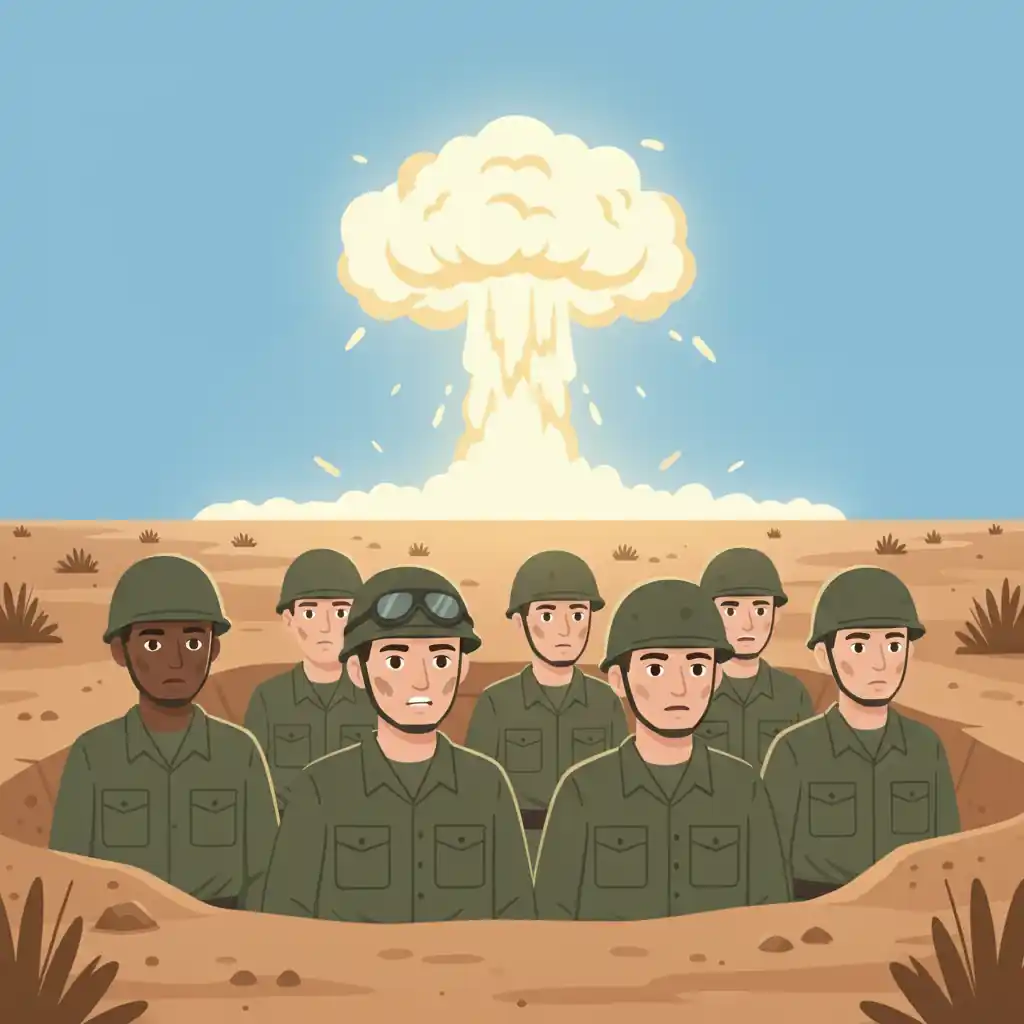
The setup for a typical Desert Rock exercise was a chilling tableau. Thousands of soldiers would be trucked out into the desert before dawn, arrayed in long, shallow trenches roughly 3 to 6 miles from ground zero. Equipment—tanks, jeeps, artillery—was strategically placed at varying distances. Dummy soldiers, dressed in uniforms, stood in foxholes, silent proxies for the living men who watched from nearby. Psychologists and sociologists were also on hand, observing troop morale and reactions, quantifying fear and effectiveness.
Then came the countdown. The atmosphere was a surreal mix of adrenaline and quiet dread. As the numbers ticked down, soldiers were ordered to squat in their trenches, facing away from the blast, hands covering their eyes. The instruction was clear: 'Do not look directly at the flash.'
The Light That Burned Through Eyelids
One veteran described the experience: 'Even with my hands over my eyes, and my head buried in my arms, I could see the bones in my hands light up. It was like an X-ray, only brighter.' This initial flash, hotter than the surface of the sun, was followed almost instantaneously by a searing heat pulse, capable of charring paint and igniting materials many miles away.
Moments later, the ground would tremble, and a colossal shockwave, a physical hammer blow, would roll over the men. Dirt and rocks would rain down, and the roar would deafen. Then, the signature mushroom cloud, a terrifyingly beautiful emblem of pure destruction, would climb skyward, boiling and roiling in hues of orange, red, and purple.
The Order: 'Advance!'
But the terror didn't end with the mushroom cloud. Often within minutes or hours, the command came: 'Advance!' These 'atomic soldiers' were then ordered to walk directly into the newly created wasteland. They passed through areas where trees had been vaporized, where tanks were twisted wreckage, and where the air itself seemed to crackle with an unseen menace. They were told to assess damage, retrieve equipment, and practice maneuvers in a landscape fundamentally altered by atomic power. Many would later recall the smell of ozone and a strange metallic taste in the air.
During some tests, military observers were positioned in trenches as close as 2,500 yards (about 1.4 miles) from ground zero. For comparison, the radius of total destruction at Hiroshima was about 1 mile.
ACT II: THE LABYRINTH OF LIES AND 'MINIMAL RISK'
The official narrative surrounding Operation Desert Rock and similar tests was meticulously crafted: these exercises posed 'minimal risk' to the troops involved. Soldiers were repeatedly assured they were perfectly safe, that any radiation exposure was equivalent to a chest X-ray, or even less significant than sunbathing. This was a labyrinth of lies, designed to maintain morale, prevent panic, and justify the unthinkable.
The 'Safety' Briefings
Before each detonation, soldiers received briefings that would be laughable if not for their tragic consequences. They were told about radiation being 'good for you' in small doses, that 'clean' bombs were being developed, and that the biggest danger was sunburn. Geiger counters, if present, were often calibrated to show low readings or were simply waved around without proper explanation. Individual dosimetry badges (film badges to measure radiation exposure) were sometimes worn, but their readings were rarely shared with the soldiers, and in many cases, badges were lost, misread, or never properly processed.
The psychological impact of these reassurances, juxtaposed with the overwhelming reality of the blast, created a profound sense of cognitive dissonance. How could something so utterly destructive be 'safe'? Yet, in the rigid hierarchy of military service, questioning orders was not an option. Patriotism, fear of reprisal, and a deep-seated trust in their superiors kept most men in line.
The true purpose of these exercises was multifaceted. Beyond studying the physical effects on troops, the Pentagon sought to answer crucial questions: Can troops advance through a contaminated area? How does equipment fare? What is the psychological breaking point? The military wanted to integrate nuclear weapons into conventional warfare doctrine, and for that, they needed living data.
The Myth of Tactical Nuclear War
During the 1950s, there was a widespread belief that 'tactical' nuclear weapons could be used on the battlefield without escalating into a full-scale global exchange. Desert Rock was part of proving this doctrine. Soldiers were trained in 'atomic maneuvers,' learning to spread out, dig in, and rapidly advance after a blast. The underlying assumption was that future wars would involve small, contained nuclear exchanges, a fantasy that thankfully never fully materialized.
However, the term 'minimal risk' utterly failed to account for the unseen killer: radioactive fallout. While the initial blast might be 'distant' enough to avoid immediate fatality, the radioactive particles thrown high into the atmosphere would inevitably drift downwind, often blanketing troop positions and civilian areas days or even hours later. This unseen contamination was the true betrayal, exposing soldiers to doses far beyond what was ever officially acknowledged.
In one particular test (Shot 'George' in Operation Greenhouse, 1951, though not Desert Rock specific), a photographer assigned to document the blast was so close that the flash temporarily blinded him, leaving him with a lasting aversion to bright lights and a persistent sense of dread related to the experience.