
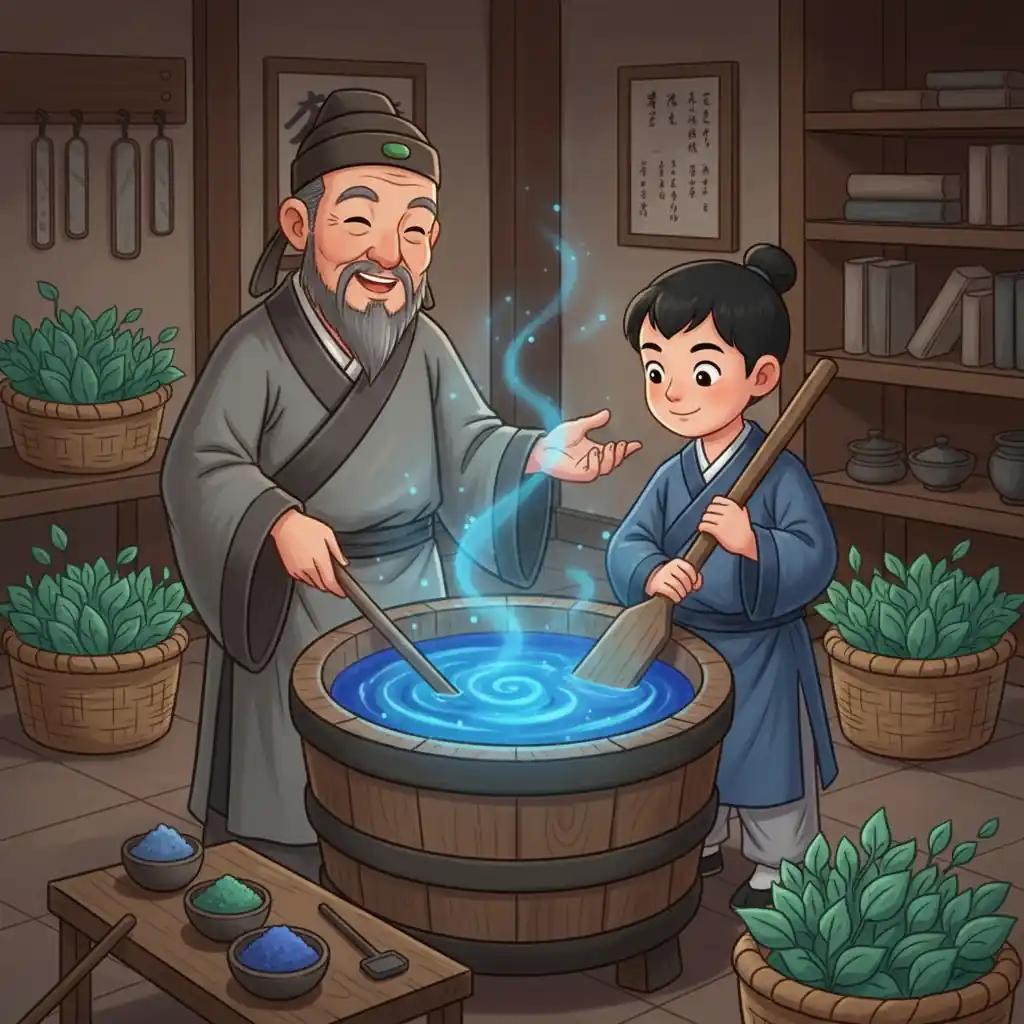
The Humble Blue Plant
Long ago, in a land blessed with fertile soil and endless curiosity, the world admired color. Among all the hues, blue held a special place. It mirrored the sky, the deep rivers, and the distant mountains. But the most prized blue, the one that made emperors and peasants alike gasp, was indigo.
People knew indigo came from a plant. A rather ordinary-looking plant, truth be told. Its leaves were green, perhaps with a faint bluish tint, nothing dramatic. You wouldn't look at it growing in a field and think, 'Here lies the soul of the deepest ocean blue.' Yet, from this humble beginning, came a color so profound, it seemed to glow from within.
The secret lay not in the plant's surface, but in its hidden chemistry. Extracting this color was an art, a science, and a bit of magic. It required patience, precise timing, and the keen eye of a true master.
Master Wei and His Apprentice, Ling
In a village known for its dye houses, Master Wei was a legend. His indigo was the benchmark. His vats bubbled with a rich, dark liquid, capable of transforming plain cloth into garments fit for royalty. His methods were ancient, refined over generations, and guarded with quiet pride.
Master Wei had an apprentice named Ling. Ling was young, eager, and observant. He spent his days crushing leaves, stirring vats, and hanging fabric to dry. He watched Master Wei’s every move: the way he checked the water temperature, the specific herbs he added, the subtle changes in the fermentation process.
Ling absorbed everything. He learned to distinguish the faint scent of a healthy vat from one that was struggling. He understood the delicate balance between too much air and too little. He saw the world through the lens of blue.
But Ling wasn't just a copier. He had a restless mind. He noticed tiny variations. Sometimes, the sun hit a particular vat just so, or a new batch of leaves seemed unusually potent. He started to wonder: could there be a way to make the blue even deeper, even more vibrant?
The Quest for Deeper Blue
Master Wei taught Ling that the indigo plant, qing (青), held the initial blue, but the final, brilliant dye was the lan (蓝). He often said, “The lan comes from the qing.” He meant that the raw material was essential, but the process made it superior.
Ling took this to heart. He respected Master Wei's wisdom, but his curiosity wouldn't let him rest. In his spare time, he conducted small experiments. He tried different fermentation periods, used slightly varied water sources, even experimented with tiny additions of new minerals. Many attempts failed. The dye was weak, or the color muddy. But he kept trying.
One day, after weeks of subtle adjustments, Ling prepared a small batch of dye. He used a slightly longer fermentation and introduced a unique aeration technique he'd quietly developed. When he dipped a piece of silk into his vat, the result was stunning. The fabric emerged a blue so profound, so luminous, it seemed to drink the light around it.
It was deeper, richer, and more intense than any blue Master Wei had ever produced. It was beyond the blue Master Wei usually achieved.
The Master's Revelation
Master Wei, with his years of experience, immediately saw the difference. He picked up the silk Ling had dyed. His eyes, usually so calm, widened slightly. He compared it to his own best work. There was no denying it.