
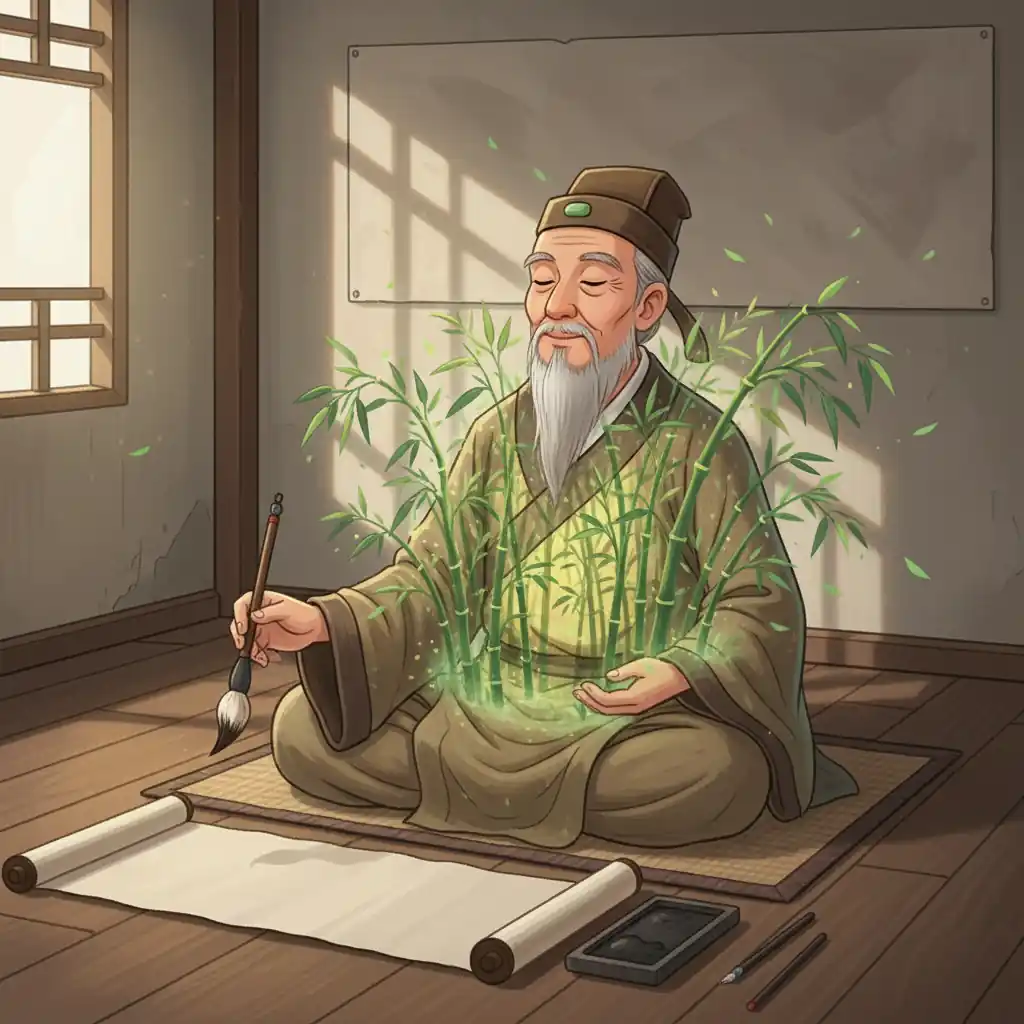
The Seeker of Bamboo's Soul
Long ago, in a quiet corner of ancient China, lived a painter whose passion was as singular as it was profound: bamboo. This wasn't just any painter. He was a master, known not only for his art but for his unusual, almost obsessive, methods.
He didn't just paint bamboo; he lived with it. He spent countless hours, not with a brush in hand, but with his eyes and heart wide open. He would sit for days in the bamboo groves, in all seasons, letting the environment soak into his very bones.
He watched the bamboo sway gracefully in the soft morning breeze, its leaves rustling like soft whispers. He saw it stand defiant against the fiercest winter storms, its stalks bending but never breaking. He felt its quiet strength and its unwavering elegance. He experienced the dampness of the earth beneath, the cool shade it offered, and the way sunlight dappled through its canopy.
He studied every detail. He knew how the joints connected, creating a ladder to the sky. He understood the delicate curve of each leaf, how it caught the light, how it danced when the wind stirred through the grove. He noticed the subtle variations in color, the deep greens of maturity, the fresh vibrancy of new shoots after a spring rain.
This wasn't mere observation. It was an absorption. He allowed its essence to seep into his being. He sought to understand not just its form, but its spirit, its resilience, its elegant simplicity. For him, bamboo was more than a plant; it was a living philosophy, a silent teacher etched into the landscape. He was creating a complete, internal library of every possible bamboo configuration, every mood, every light.
The Question of the Empty Canvas
People in the village admired his work, yet they often puzzled over his process. Other painters would set up their easels directly in front of their subjects, meticulously sketching and adjusting. But this master often sat in his studio, sometimes for days, with a blank scroll of silk or paper before him, not touching his brush.
Students and patrons, eager for new masterpieces, would respectfully inquire. 'Master,' one might ask, 'the bamboo grove flourishes outside. Why do you sit idle with an empty scroll? Do you not feel the urge to capture its beauty?' Another might wonder, 'Your talent is legendary. Why do you delay so long before beginning your work?'
The master would simply smile, a knowing glint in his eyes. He wasn't procrastinating. He wasn't stuck for ideas. On the contrary, his most intense work was happening internally. He wasn't waiting for inspiration; he was cultivating it from within, meticulously refining his vision.
For him, the real painting didn't begin when the brush touched the paper. It began in the silent hours of observation, in the quiet moments of contemplation. He was forging the entire bamboo forest in the forge of his mind, leaf by leaf, stalk by stalk, shadow by shadow, until it was perfectly formed.
He knew that true art wasn't about copying what was external, but about expressing what had been deeply internalized. He believed that to truly capture something, one must first possess it completely and flawlessly in one's heart and mind.
The Dance of Ink and Paper
Then, one day, the moment would arrive. The master would pick up his brush. There would be no hesitation, no preliminary sketches, no nervous adjustments. His movements were swift, confident, and utterly precise. His hand moved across the paper as if guided by an invisible, yet absolute, certainty.
Ink flowed onto the silk, creating stalks that seemed to grow right before the eyes of astonished onlookers. Each joint, each vibrant leaf, each delicate shadow, appeared with astonishing clarity and life. The strokes were fluid, powerful, and perfectly balanced, a dance between paper and ink.