
A Family of Scholars, A Life of Ink
In the bustling capital of the Eastern Han Dynasty, Luoyang, a family name shone brighter than most: Ban. They weren't just landowners or merchants. They were the intellectual giants of their age. Ban Biao, the patriarch, was a renowned historian who began the monumental 'Book of Han.' His eldest son, Ban Gu, dedicated his life to completing it. And his brilliant daughter, Ban Zhao, became a celebrated scholar and advisor to the empress. Their home was a library, their world defined by ink and parchment.
Among them was Ban Chao, Ban Biao’s third son. He possessed the family’s sharp intellect, a keen eye, and a quick wit. By all accounts, he was destined for a life of scholarly pursuit, just like his siblings. He absorbed knowledge, read ancient texts, and honed his calligraphy, but something was always amiss.
Despite his potential, Ban Chao found himself stuck in a rather uninspiring role: a low-level copyist in the Imperial Library. His days were a monotonous blur of transcribing documents. Official decrees. Historical records. Lengthy administrative reports. The rhythm was always the same: dip brush, write characters, repeat. Thousands upon thousands of them.
The air in the library hung heavy with the smell of ink and old paper. The quiet was only broken by the soft scratch of brushes. This wasn't merely boring; it felt like a slow suffocation. His hands moved, but his spirit yearned for something more. He felt like a caged hawk, meant for the open skies, forced to peck at grains.
He watched his brothers lose themselves in their studies, his sister navigate the complexities of court politics. Ban Chao, however, felt a different kind of calling. He didn’t want to passively document history. He wanted to actively forge it. The desk, the inkwell, the endless scrolls – they had become his prison, not his path.
The Brush Hits the Floor, History Turns a Page
One morning, the burden of his task felt heavier than usual. The stack of documents seemed to mock him with its height. The intricate characters blurred before his eyes. He imagined the rest of his life stretching out, an unbroken, monotonous line of identical days, each one defined by the scratch and drag of a brush on silk. The very thought made his stomach churn.
A sudden, powerful wave of frustration, long suppressed, surged through him. He looked at the brush in his hand – the symbol of his inherited path, but also of his current confinement. This was not his destiny. This was not the life for a man of his ambition.
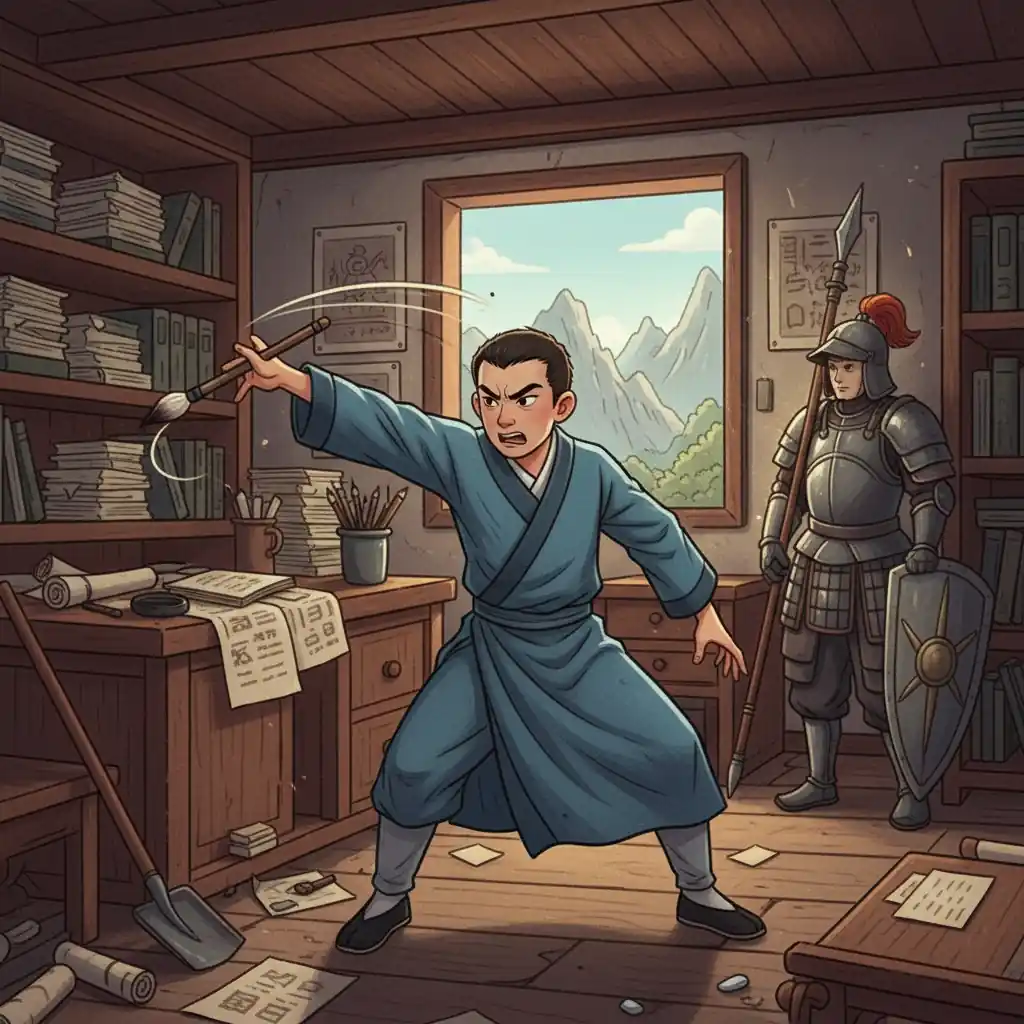
With a guttural cry, Ban Chao ripped the brush from the inkwell. He held it high, then, with a furious, decisive flick of his wrist, he hurled it across the room. It spun through the air, scattering dark ink droplets like angry tears, before clattering loudly against a faraway wall, its soft hairs splayed uselessly.
The other copyists, lost in their own silent work, jumped. Heads snapped up. The room, usually filled with soft scratching, fell into an astonished silence. All eyes were on Ban Chao, who now stood tall, chest heaving, his face set with fierce determination.
His voice, usually calm and quiet, boomed with newfound conviction. 'A true man,' he declared, his gaze sweeping across his stunned colleagues, 'should follow in the footsteps of Fu Jiezi and Zhang Qian! He should serve his country and make a name for himself in the Western Regions, not waste his life copying dusty documents in this cramped office!'
He was invoking the names of legendary Han Dynasty figures: Fu Jiezi, who assassinated a rogue king and brought his head back to the emperor, and Zhang Qian, the great explorer and diplomat who opened the Silk Road. Ban Chao’s meaning was unmistakable: his path was one of action, not academia. His glory lay beyond the inkwell, on the empire’s distant frontiers.