
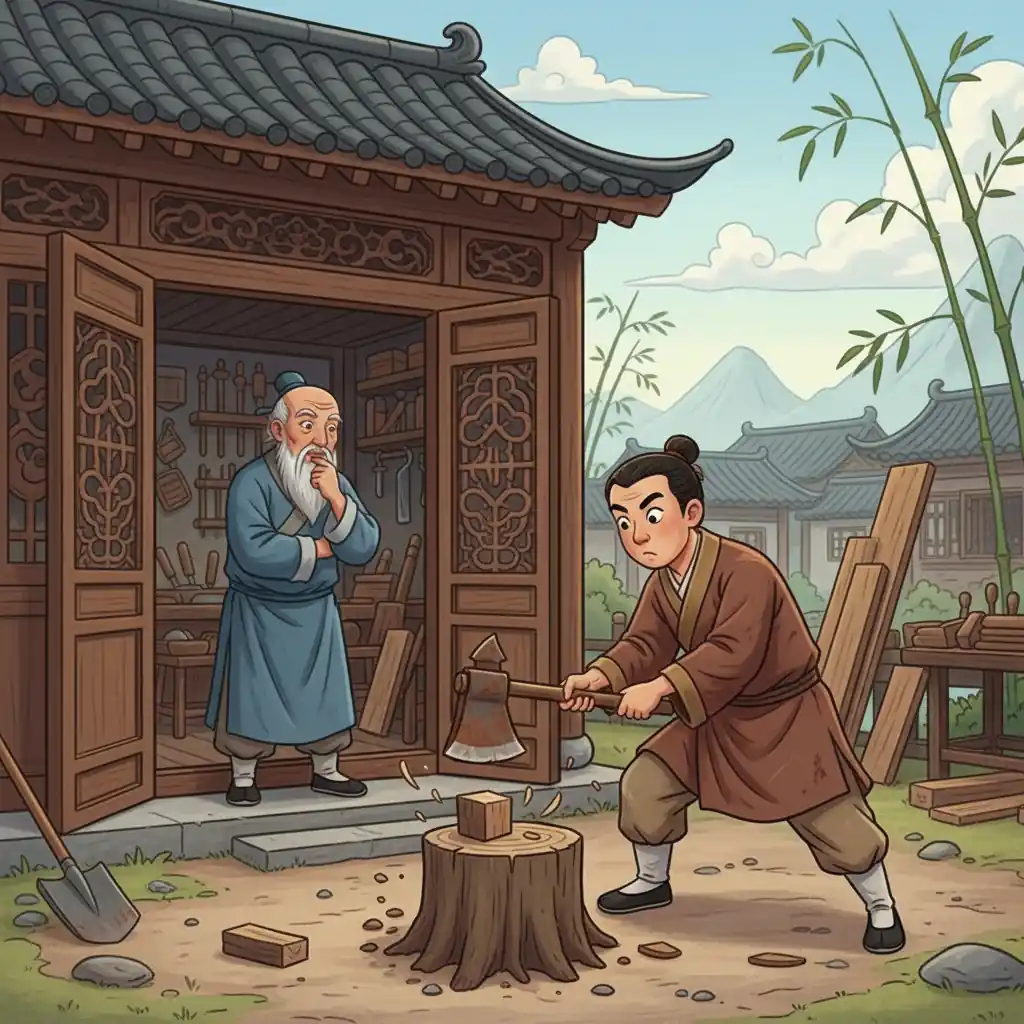
The Master of All Trades
In the annals of ancient China, few names commanded as much reverence as Lu Ban. He wasn't just a carpenter; he was the carpenter. A living legend from the Spring and Autumn period, he was credited with inventing the saw, the plane, the drill, and even the umbrella. His hands, it was said, could coax beauty and utility from the stubbornest timber. He wasn't just a craftsman; he was the patron deity of carpenters, architects, and engineers.
Lu Ban’s workshops were marvels of efficiency, his constructions testaments to precision. His reputation preceded him, traveling like a well-built ship across rivers and mountains. To speak of carpentry in ancient China was to speak of Lu Ban. His name was synonymous with mastery, skill, and unparalleled genius. To even approach his standards was a lifetime's ambition for most.
His legacy wasn't built on boastful words, but on perfectly interlocking joints, innovative designs, and structures that stood against the test of time. He was the quiet master, the ultimate professional, whose work spoke for itself. People traveled for miles not just to see his finished projects, but to catch a glimpse of his tools, hoping to absorb even a fraction of his wisdom.
Young A-Qiang's Grand Illusion
Now, imagine a young man, let’s call him A-Qiang. A-Qiang had recently finished his apprenticeship. He wasn't bad, not terrible, but certainly not great. He could cut a straight line, mostly. He could join two pieces of wood, usually without too much gap. In his own village, he might have been considered competent enough for simple tasks like mending a chair or building a basic fence.
But A-Qiang was not merely competent; he was convinced he was a genius. He had that peculiar kind of overconfidence born of limited experience. He saw his own rudimentary skills through a magnifying glass, turning small successes into monumental achievements. Every nail he hammered straight was proof of his inherent talent. Every joint that didn't fall apart immediately was a testament to his 'mastery'.
He yearned for recognition, not just from his neighbors, but from the world. He believed his skills were ripe for public display. He wanted to shock, to impress, to prove that a new star had risen in the carpentry firmament. The problem? He had only ever worked on simple projects. He hadn't yet faced the true challenges of complex joinery, intricate carvings, or large-scale construction. He was a small pond fish dreaming of the ocean.
A Misguided Performance
One fateful day, fueled by youthful bravado and a serious lack of self-awareness, A-Qiang decided to take his act on the road. He heard tales of Lu Ban's magnificent workshop, a place where innovation hummed and perfection resided. He saw it not as a place of learning or reverence, but as a stage. 'What better place to showcase my dazzling abilities?' he must have thought. 'Let the old master see what new blood can do!'
He arrived at Lu Ban's famous workshop, a modest but impeccably crafted structure, smelling faintly of sandalwood and fresh sawdust. There, right outside the main entrance, where any visitor or apprentice would pass, A-Qiang set up his impromptu 'demonstration.' He pulled out his own axe – not a finely honed blade, but a rather common, slightly dull tool he'd inherited. He found a piece of ordinary timber, probably a discarded scrap from Lu Ban's own workshop, and began to hack at it.
His movements were clumsy. The axe bit unevenly into the wood. Chips flew everywhere, not in clean, precise arcs, but scattered wildly. He struggled to maintain a consistent angle, his brow furrowed in concentration, but his effort yielded only jagged edges and wasted material. He was trying to split a log, perhaps, or shape a beam, but the result was crude, rough, and utterly lacking in grace. Anyone watching could see it was the work of an amateur, a beginner still finding his footing.
All this, mind you, was happening just feet from Lu Ban’s door. A door likely crafted with such precision that it would never creak, never stick, never betray the slightest flaw. A door built by the very hands that had invented the tools A-Qiang now clumsily wielded. It was a spectacle of misplaced ambition.
The Silent Observation
Inside the workshop, Lu Ban was likely engaged in some profound work—perhaps designing a new bridge, refining a tool, or simply meditating on the perfect curve of a roof tile. But apprentices, fellow craftsmen, and even passers-by couldn't help but notice the commotion outside. They gathered, quietly observing A-Qiang's energetic but futile efforts.