
The Merchant Who Ruled a Kingdom
Ancient China was a battlefield, not just of armies, but of ideas. Seven major states clawed at each other, each vying for supremacy. This was the Qin Dynasty era, a raw, ambitious time. And in the heart of this ambition was a man named Lü Buwei.
Lü Buwei wasn't born into silk robes. He started as a wealthy merchant, shrewd and calculating. He understood people, prices, and power. But the merchant life, even a successful one, wasn't enough for his soaring ambitions. He wanted to shape kingdoms, not just markets.
Through a masterful series of political chess moves, he orchestrated the rise of a young prince, Zi Chu, to the Qin throne. When Zi Chu became King Zhuangxiang, Lü Buwei reaped his reward: the powerful title of Prime Minister. He was now second only to the king, a man whose word could move mountains, or armies.
Yet, even with this immense political power, Lü Buwei felt a gap. Qin was known for its fierce warriors and strict laws, not its deep thinkers. Other states, especially the philosophical hub of Qi, boasted academies brimming with scholars and libraries filled with profound works. Qin, in the intellectual arena, was considered a bit of a brute.
This bugged Lü Buwei. He didn't just want military dominance. He wanted cultural prestige. He wanted to prove that Qin, under his guidance, could also be the center of wisdom. He aimed for intellectual supremacy, a lasting legacy beyond mere conquest.
So, he launched a colossal project. He gathered hundreds of the most brilliant minds from across all the warring states. Philosophers, strategists, historians—everyone was invited, and well-paid. Their mission: to compile a single, all-encompassing book. It would synthesize every school of thought, every debate, every piece of knowledge from their time.
This wasn't a casual endeavor. It consumed years, fortunes, and the collective genius of an era. The goal was to create something truly monumental, a definitive text that would rival, and even surpass, all existing classics.
The Public Proclamation
Finally, after years of tireless effort, the monumental work was complete. It was named the 'Lü Shi Chun Qiu,' or 'Spring and Autumn Annals of Master Lü.' Lü Buwei held the finished book with immense pride. He believed it was flawless, a perfect distillation of human wisdom, an undeniable testament to his own intellectual patronage.
But belief was one thing; public acclamation was another. He wanted to silence any critics, to definitively establish the book's perfection, and by extension, his own intellectual authority. He concocted a challenge as audacious as his rise to power.
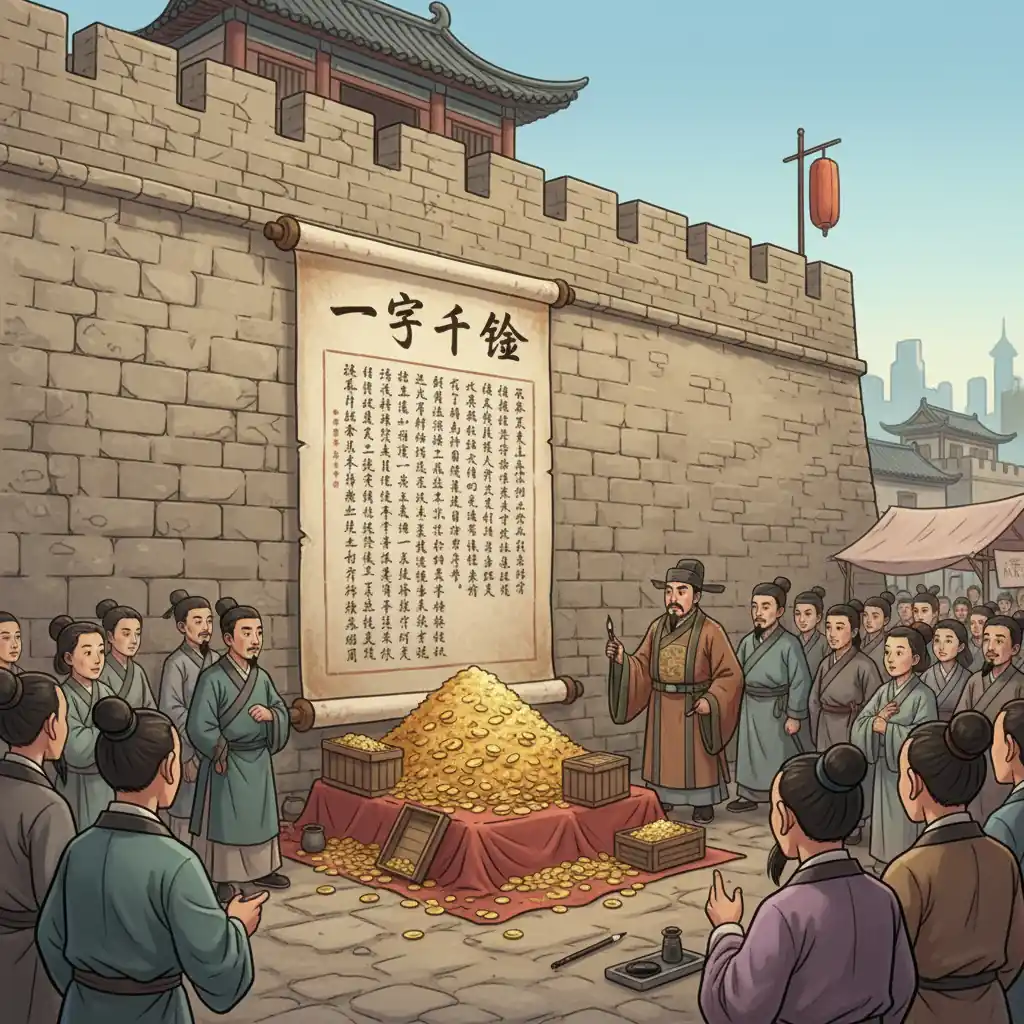
He ordered the entire manuscript, painstakingly copied onto long bamboo slips, to be publicly displayed. Not in a quiet library, but hung prominently outside the bustling main gate of Xianyang, the Qin capital. Every citizen, every visiting dignitary, every passing scholar, had to see it.
Beneath the long, swaying scrolls, Lü Buwei placed a large, ornate chest. And beside it, a powerful announcement was nailed to a wooden board, its words echoing through the marketplace: 'Anyone, from any state, who can add a single word, or remove a single word, to improve this book, will be rewarded with a thousand pieces of gold!'
A thousand pieces of gold. This was no trifling sum. It was enough to buy a vast estate, to live a life of unimaginable luxury. It was a king's ransom, offered for a single character. Lü Buwei was, in essence, putting his reputation, and a massive fortune, on the line. He was declaring his book unimprovable.
The Silent Scholars
The news spread like wildfire. A Prime Minister daring the entire intellectual world. Scholars from all corners of China flocked to Xianyang. They gathered at the city gate, a mix of genuine intellectual curiosity and the intoxicating lure of unimaginable wealth.
Crowds formed daily. Academics with their long beards and serious expressions craned their necks, reading the bamboo slips word by word. They traced characters with their fingers, whispered arguments with their peers, and scratched their heads in deep thought. The glint of the gold chest below served as a constant, shimmering reminder of the prize.