
The Cloud Battery
Imagine a battery the size of a city floating above your head. During a storm, a cloud becomes exactly that. We often think of clouds as soft and fluffy, but inside a thunderhead, it is a violent world of chaos and collision.
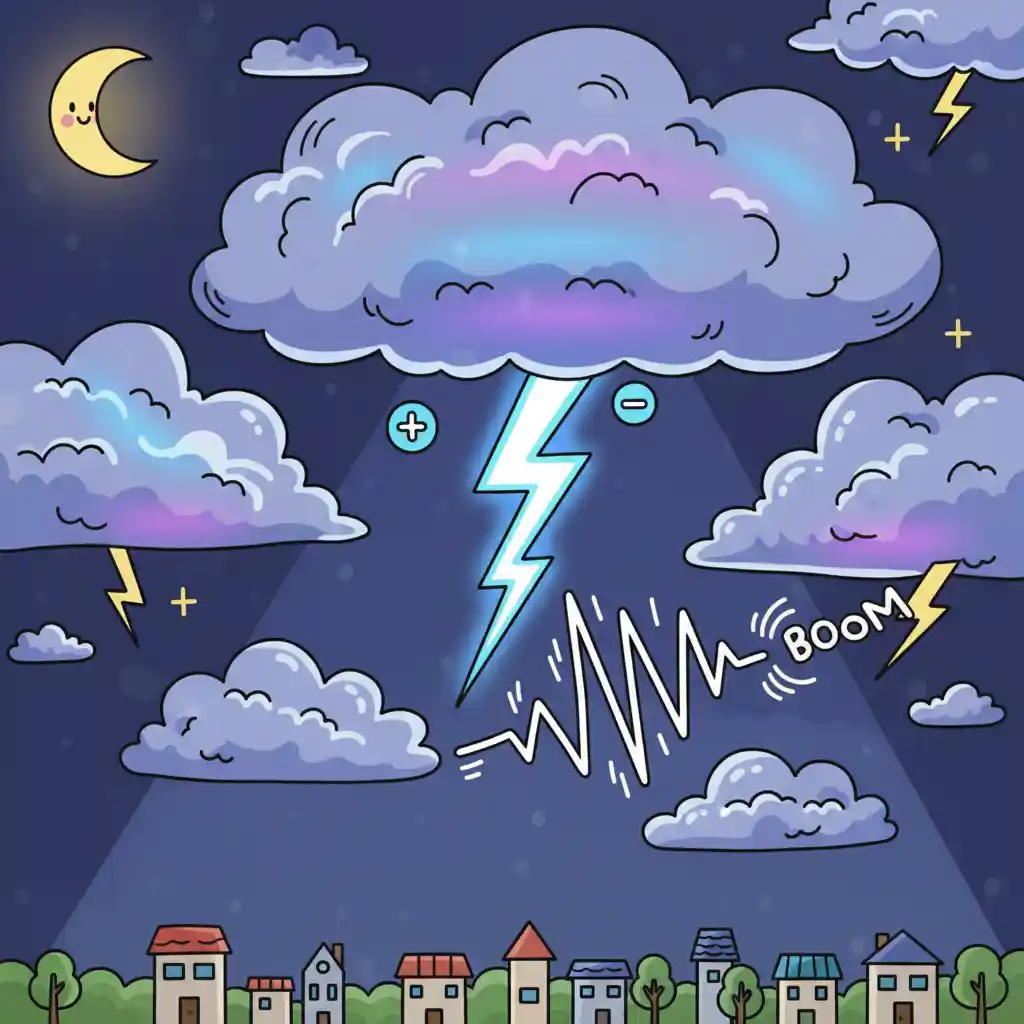
As warm air shoots upward, it carries water droplets, while cold air sends ice crystals falling downward. These two groups 'rub' past each other at high speeds. Just like rubbing your feet on a carpet, this friction creates static electricity. The top of the cloud becomes 'positive' and the bottom becomes 'negative.'
The Great Discharge
Nature always wants to be balanced. When the electrical difference between the cloud and the ground (or another cloud) gets too big, the air can no longer hold it back. The electricity 'breaks' through the air in a massive, zig-zagging spark.
This is lightning. It is the atmosphere's way of instantly 'resetting' its battery. Though it looks like one solid line, a lightning bolt is actually a series of rapid-fire pulses that happen so fast your eyes see them as a single flash.
The Sound of an Explosion
Why does lightning come with a growl? The riddle of thunder is actually a riddle of heat. A bolt of lightning is roughly 30,000°C (54,000°F). When that heat hits the air, the air doesn't just get warm—it explodes.
The air molecules expand outward faster than the speed of sound, creating a 'sonic boom.' This shockwave is what we hear as thunder. If you are close, it sounds like a sharp 'crack'; if you are far away, the sound waves bounce off hills and buildings, turning into a low 'rumble.'
Light vs. Sound
Have you ever noticed that you see the flash long before you hear the boom? This is because light is the fastest thing in the universe, traveling at $300,000$ kilometers per second. Sound, on the other hand, is a bit of a slowpoke, traveling at only about $0.34$ kilometers per second.