
The Invisible Giant
Imagine a force so powerful it can knock down houses, yet so thin you can walk right through it without seeing a thing. This is the riddle of the wind. We cannot see it, but we see its 'fingerprints' everywhere—in the swaying of grass, the spinning of turbines, and the drifting of clouds.
To understand wind, we have to look at the Sun. The Sun is like a giant cosmic radiator, but it doesn't heat our planet evenly. It hits the equator directly, making it hot, while hitting the poles at an angle, keeping them freezing. This temperature difference is the 'key' that starts the Earth's engine.
The Great Balancing Act
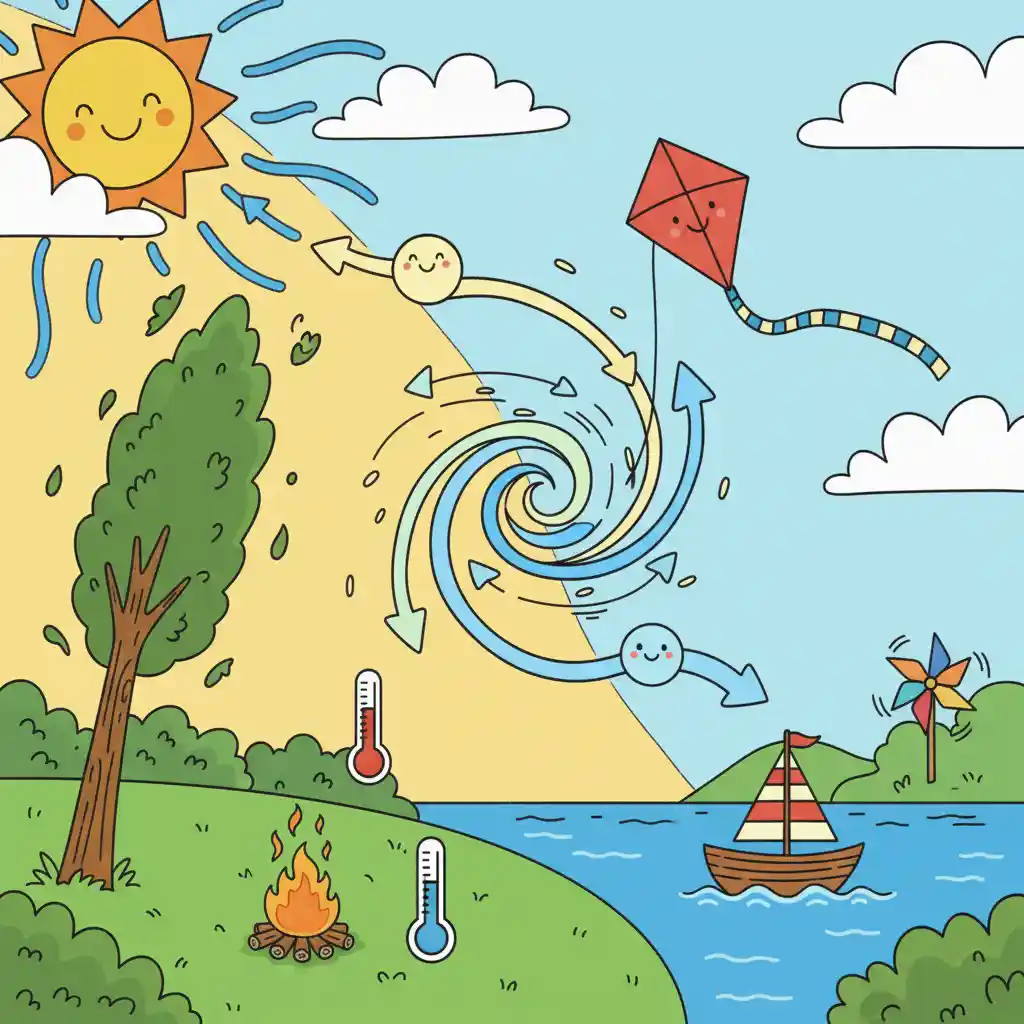
Physics hates a vacuum. When the Sun heats up a patch of land, the air above it warms up, too. Just like a hot air balloon, warm air becomes lighter and begins to rise high into the sky. As it floats upward, it leaves behind an area of 'low pressure'—basically an empty 'hole' in the atmosphere.
Nearby, colder air is huddling together, making it heavy and dense (high pressure). This cold air is the 'hero' of our story; it rushes in as fast as possible to fill the empty hole left by the rising warm air. That rushing movement is the wind you feel against your skin.
The Speed of the Chase
Why is the wind a gentle breeze one day and a howling gale the next? It all depends on the 'Pressure Gradient.' Think of it like a slide: the steeper the slide, the faster you go. If there is a massive difference in temperature between two areas, the air has to run faster to balance things out.
This is why coastal areas are so windy. During the day, the land heats up much faster than the ocean. The warm air over the sand shoots up, and the cool, heavy air from the sea crashes in to take its place, creating what we call a 'sea breeze.'
The Coriolis Twist
If the Earth stood still, wind would travel in a perfectly straight line from cold spots to hot spots. But our planet is spinning like a giant top at over 1,000 miles per hour! This spinning motion creates a mysterious force called the Coriolis Effect.
In the Northern Hemisphere, this spin pulls the wind to the right, while in the Southern Hemisphere, it pulls it to the left. This is why giant storms like hurricanes always spin in a circle rather than moving in a straight line. The wind is literally being curved by the planet's rotation.
High-Altitude Highways
Way up high, near the edge of space, the wind acts even crazier. There are 'rivers' of air called Jet Streams that move at speeds of over 200 miles per hour. These aren't caused by local heat, but by the massive boundary where cold polar air meets warm tropical air.
Airplanes actually look for these jet streams to save fuel. If a pilot 'hitches a ride' on a jet stream going east, the wind pushes the plane forward like a moving walkway at an airport, allowing them to reach their destination an hour early!
Wind as a Sculptor
Over thousands of years, wind acts like a slow-motion artist. In deserts, the wind picks up tiny grains of sand and blasts them against rocks, carving out arches and strange towers. It moves entire sand dunes, shifting the landscape like a giant puzzle.
Wind also helps life travel. Many plants, like dandelions and maple trees, have evolved seeds with 'wings' or 'parachutes.' They rely on the invisible currents of the air to carry their children to new homes miles away, ensuring the forest keeps growing.
Power from the Sky
Humans have learned to solve the riddle of the wind to power our world. By placing giant blades in the path of the wind, we capture its kinetic energy and turn it into electricity. It is one of the cleanest ways to make power because the 'fuel'—the Sun heating the Earth—never runs out.
By understanding the wind, we understand the heartbeat of our planet. It is the Earth’s way of breathing, moving heat from the hot tropics to the cold poles to make sure the world stays at just the right temperature for us to live.