
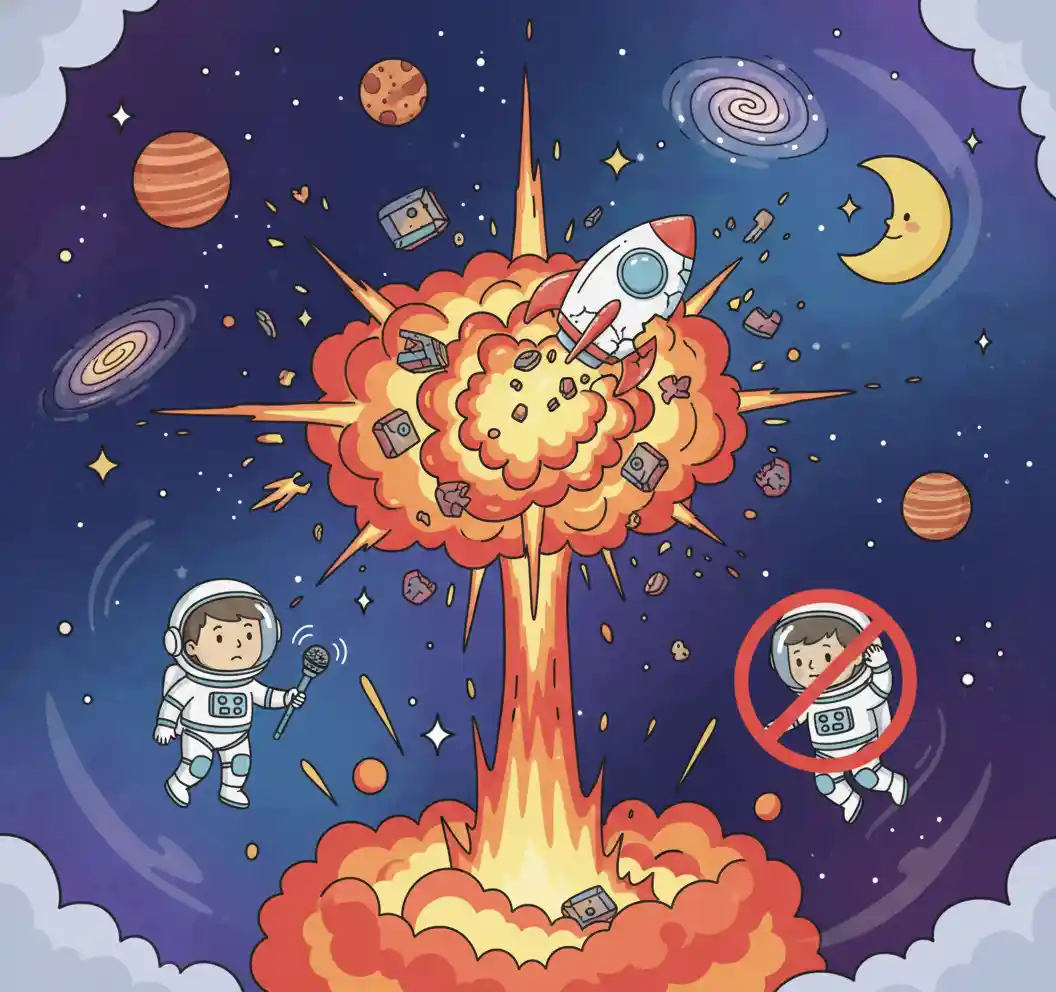
The Invisible Messenger
On Earth, we take sound for granted. Whether it's a bird chirping or a car horn, sound is actually a physical thing. It’s a vibration traveling through the air. You can think of air molecules as a line of dominoes.
When you speak, your vocal cords hit the first 'domino' (the air molecules in your throat). Those molecules bump into the next ones, and the next, until the vibration hits someone’s eardrum. No molecules? No message.
The Great Vacuum
Outer space is a vacuum. This doesn't mean it's a giant sucking machine like the one in your living room; it just means it is almost completely empty. In the vast gaps between stars and planets, there is no air, no gas, and no molecules.
Because there is nothing to 'bump into,' sound waves have no way to travel. If a giant star exploded right behind you in space, you wouldn't hear a single peep. It would be a massive, terrifying, and completely silent show.
The Science of Wiggles
Sound is a 'mechanical wave.' This means it needs a 'medium'—a substance to move through. Sound can move through gas (air), liquid (water), or solids (like a wall). In fact, sound actually moves faster through water than it does through air!
But in the vacuum of space, the 'medium' is missing. It’s like trying to swim in a pool that has no water. No matter how hard you kick and splash, you aren't going anywhere.