
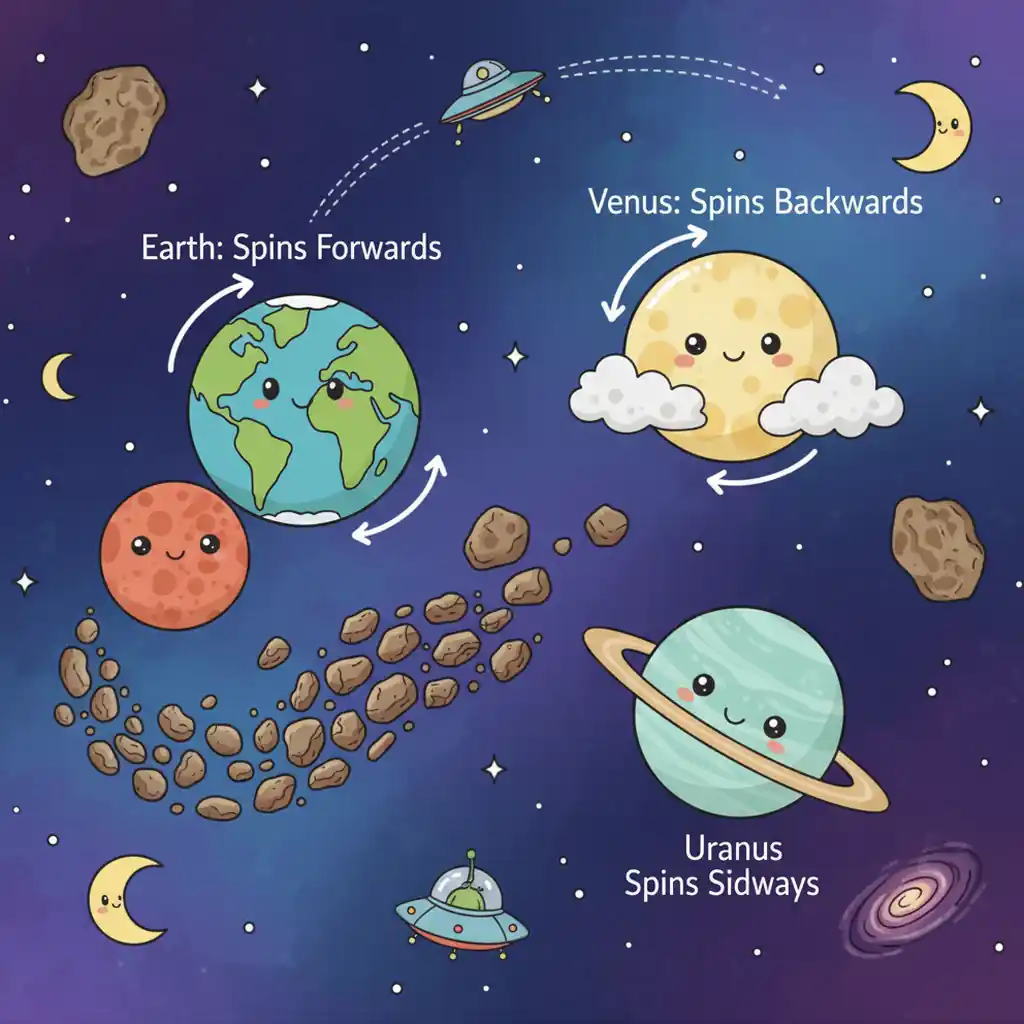
The Spin Cycle of the Solar System
Imagine you're watching a top spin. Most tops, when you set them going, spin in the same direction. Our solar system is a bit like that! Almost all the planets, including our home Earth, spin in the same direction, like a cosmic dance party where everyone follows the same beat. If you could look down on our solar system from far above the Sun's North Pole, you'd see nearly every planet twirling counter-clockwise.
This steady, predictable spin is what gives us day and night here on Earth. As our planet rotates, different parts face the Sun, getting sunlight (day), and then turn away into shadow (night). It’s a beautifully synchronized system that has been happening for billions of years.
But guess what? Just like in any big family, there are a few planets that march to the beat of their own drum, or rather, spin to the beat of their own drum! Some planets have decided that spinning 'backwards' is much more fun. This strange behavior has puzzled scientists for a long time, but we're starting to piece together the clues about these cosmic rebels.
How Planets Get Their Spin (The "Standard" Way)
To understand why some planets spin backwards, we first need to know how they usually get their spin. Our entire solar system began as a giant, swirling cloud of gas and dust called a nebula. Over millions of years, this cloud started to collapse under its own gravity. As it got smaller, it naturally started spinning faster and faster, much like an ice skater who pulls their arms in to spin quicker.
This spinning cloud flattened into a giant disk, a bit like a cosmic pizza. In this disk, tiny bits of dust and gas began to clump together, slowly forming bigger and bigger rocks, until eventually, they grew into the planets we know today. Because all this material was part of the same spinning disk, most of the planets inherited that same direction of spin.
So, the 'default' spin for a planet in our solar system is counter-clockwise. This is why when astronomers look at a new planet, they expect it to be spinning in that direction. Any planet doing something different immediately catches their eye and makes them wonder: what happened here?
Venus: The Very Slow Backwards Spinner
Meet Venus, often called Earth's 'twin sister' because it's so similar in size. But don't let the looks fool you; Venus is a very different kind of planet, especially when it comes to spinning! Instead of twirling counter-clockwise like Earth, Venus spins clockwise. That's right, it spins backwards, or 'retrograde,' as scientists say.
But wait, there's more to Venus's spin mystery! It also spins incredibly slowly. A single day on Venus (one full rotation) takes a whopping 243 Earth days. What's even crazier is that Venus orbits the Sun faster than it spins! Its year is only about 225 Earth days long. So, on Venus, a day is actually longer than a year!
Scientists have a few ideas about why Venus is such a slow, backwards spinner. One popular theory involves a giant impact early in its history, which we'll talk more about soon. Another idea, though harder to prove, suggests that the Sun's powerful gravity, combined with Venus's super-thick atmosphere, might have slowly flipped its spin over billions of years, like a cosmic tug-of-war.
Uranus: The Sideways Roller
Now let's zoom out to the ice giant Uranus, a planet that truly stands out in the spin department. While most planets spin upright (more or less), Uranus looks like it's been knocked completely on its side! Its axis, the imaginary line it spins around, is tilted almost 98 degrees. Imagine Earth spinning, but then someone tilted it so much that it's now rolling like a bowling ball on its side as it goes around the Sun.