
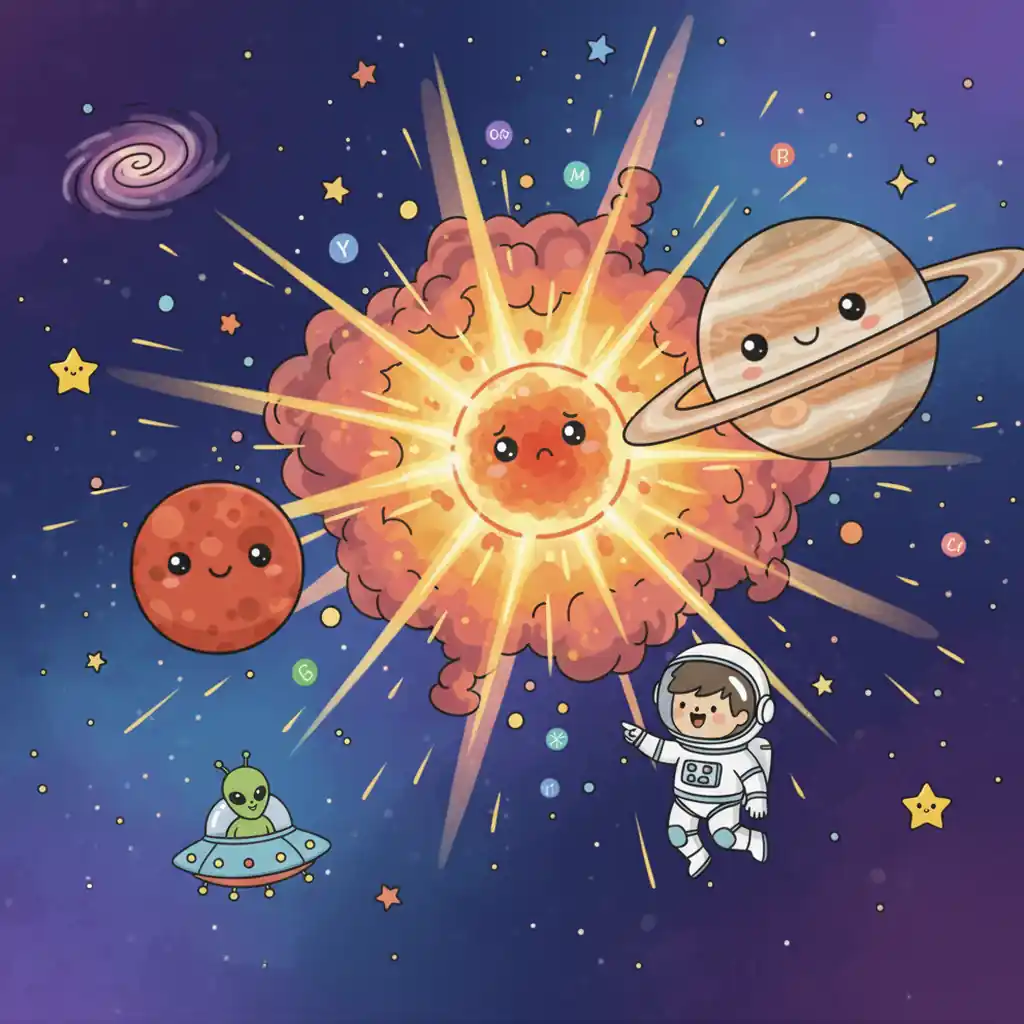
The Blazing Hearts of the Universe
Imagine a giant, glowing ball of gas, so hot and bright it can light up an entire solar system for billions of years! That's a star, and our own Sun is one of them. Stars are like cosmic power plants, constantly fusing tiny atoms together in their cores, much like a super-duper strong glue. This process, called nuclear fusion, releases an incredible amount of energy, which is what makes them shine so brightly. It's a delicate dance between two mighty forces: gravity, which tries to squeeze the star inward, and the outward pressure from all that heat and light, which tries to make it expand. For most of a star's life, these two forces are perfectly balanced, keeping the star stable and shining.
Not All Stars Are Created Equal
Just like people, stars come in all shapes and sizes, and their size really matters when it comes to their fate. There are small stars, medium stars like our Sun, and then there are truly massive stars—some can be hundreds of times bigger than our Sun! Think of a tiny pebble versus a giant boulder. The bigger a star is, the more 'fuel' (mostly hydrogen gas) it has, but surprisingly, massive stars burn through their fuel much, much faster than smaller stars. They're like super-fast race cars compared to a sturdy old tractor. This speedy burning leads to a much more dramatic and exciting end for these stellar giants.
Our Sun's Gentle Farewell
Before we dive into the explosive drama of big stars, let's take a quick peek at how our own Sun will likely end its life, which will be much quieter. In about five billion years, our Sun will run out of its main hydrogen fuel. When that happens, it will swell up into a 'Red Giant,' becoming so big it might even swallow Mercury, Venus, and possibly Earth! After this puffy phase, it will gently shed its outer layers, creating a beautiful cloud of gas. What's left behind will be a tiny, super-dense, leftover core called a 'White Dwarf,' which will slowly cool down and fade over trillions of years. No big bang, just a peaceful twinkling out.
The Race to the Finish: Massive Stars
Massive stars don't have time for a gentle fade. They are living life in the fast lane! Because they are so much bigger, their gravity is incredibly strong, which means their cores are much hotter and denser. This high-pressure environment makes them fuse elements much more rapidly. While our Sun is happy fusing hydrogen into helium for billions of years, a massive star quickly moves on to heavier elements. It will fuse helium into carbon, then carbon into oxygen, then oxygen into neon, and so on. It's like a cosmic chef cooking a meal in a super-hot oven, constantly making bigger and bigger ingredients. Each step uses up fuel faster than the last, leading to a desperate race against time.