
The Cosmic Detective Story
Imagine you're trying to solve a giant puzzle, but most of the pieces are invisible! That's kind of what scientists are doing with 'dark matter.' For a long time, we thought we understood the universe pretty well. We could see stars, planets, and glowing clouds of gas. But then, astronomers started noticing some really strange things happening in space that couldn't be explained by all the stuff we could see. It was like there was an invisible force at play, pulling things around.
This invisible 'stuff' is what we call dark matter. It doesn't shine, it doesn't reflect light, and it doesn't seem to bump into anything. It's completely dark and mysterious! We can't see it, touch it, or even directly detect it with our telescopes, but its effects are everywhere. It’s one of the universe's biggest mysteries, and unlocking its secrets could change everything we know about how the cosmos works.
Galaxies Gone Wild! (The Spinning Mystery)
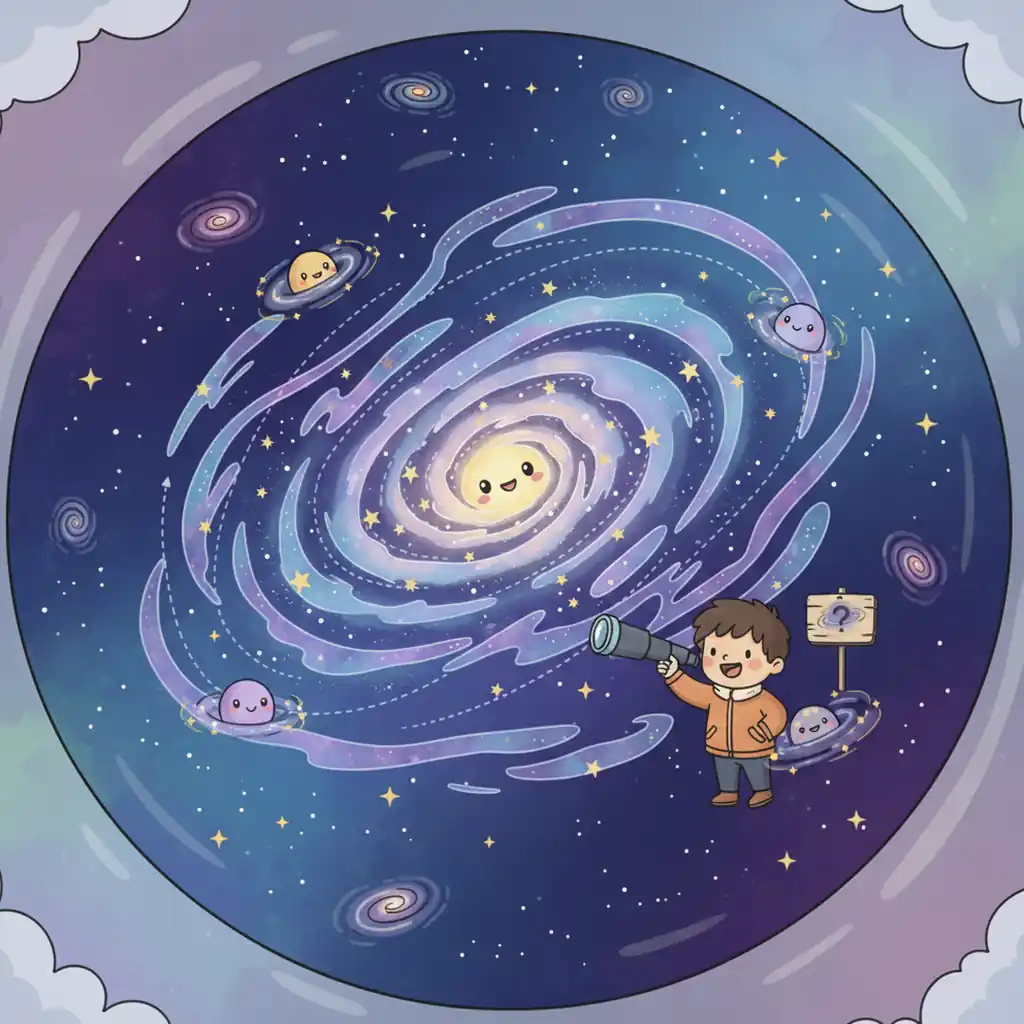
One of the first big clues about dark matter came from looking at how galaxies spin. Imagine a giant cosmic pinwheel, full of billions of stars! Just like planets orbit the Sun, stars within a galaxy orbit its center. Scientists expected that stars farther out from the center would move slower, because the pull of gravity from the visible stars and gas closer to the center would be weaker.
But when they actually measured how fast stars were moving, especially those on the very edges of galaxies, they found something astonishing: the outer stars were spinning much, much faster than they should have been! They were moving so quickly that they should have flown off into space, like kids being flung off a merry-go-round that’s spinning too fast. Yet, they stayed put, held in place by an invisible force. This invisible 'glue' had to be an enormous amount of unseen mass—dark matter!
Cosmic Magnifying Glasses (Gravitational Lensing)
Have you ever looked through a magnifying glass that bends light and makes things look bigger or distorted? Well, huge groups of galaxies, called galaxy clusters, can do something similar with light from even more distant objects! This amazing trick is called 'gravitational lensing'.
Albert Einstein taught us that really massive objects, like galaxy clusters, can actually bend space itself. When light from a far-away galaxy travels past one of these super-heavy clusters, the light gets bent and twisted, making the background galaxy appear warped or even creating multiple images of it. Scientists measured how much the light was bending around these clusters and discovered it was bending far more than it should, based on the visible matter alone. This extra bending told them there was much, much more mass in the cluster than they could see—more invisible dark matter!
The Baby Universe's Footprint (Cosmic Microwave Background)
Let's travel back in time, all the way to when the universe was just a tiny baby, only about 380,000 years old! At that incredibly early age, the universe was a super-hot, dense soup of particles. As it cooled, light was finally able to zoom freely through space, and we can still detect that ancient light today! It's called the 'Cosmic Microwave Background' (CMB), and it’s like a baby picture of the entire universe.