
What is Time, Anyway?
Tick-tock, tick-tock goes the clock. We all know what time is, right? It’s that invisible river that always flows forward, carrying us from yesterday to today, and then to tomorrow. We measure it in seconds, minutes, hours, and years. We wake up, go to school, eat lunch, and go to bed, all according to our trusty clocks. It seems like time is the same for everyone, everywhere, marching steadily onward. But what if that's not entirely true? What if time can actually stretch and squeeze, speeding up or slowing down depending on where you are and how fast you’re moving? That sounds like something out of a science fiction movie, but it's a real-life cosmic secret!
For hundreds of years, brilliant scientists like Isaac Newton thought of time as a universal, unchanging ruler for the entire universe. Everyone's clock, no matter where they were, would always tick at the exact same rate. He believed time was like a giant, invisible metronome, perfectly steady for everyone and everything. But then came a scientist with wild hair and even wilder ideas who completely changed how we understand time and space. His name was Albert Einstein, and his discoveries turned our everyday understanding of time on its head!
Einstein's Amazing Idea: Spacetime
Meet Albert Einstein, one of the smartest thinkers who ever lived! He gave us a mind-bending idea called 'relativity.' Imagine you’re watching a movie. You see things happening in 'space' (like characters moving around on screen) and you also see them happening over 'time' (the movie progresses). Einstein realized that space and time aren't two separate things. Instead, they are woven together into one giant, flexible fabric he called 'spacetime.' Think of it like a huge, invisible trampoline stretched across the universe.
This 'spacetime fabric' is where everything exists and happens. When you walk, when a planet orbits a star, or when light zips across the galaxy, you’re moving through this spacetime. What’s truly incredible is that this fabric isn't flat and still; it can be bent, stretched, and warped by massive objects and by speed. This means that time, which is part of this fabric, can also be affected. It's not just a steady tick-tock anymore; it's more like a stretchy ribbon that can be pulled and squished!
Speedy Travelers & Slowing Clocks (Special Relativity)
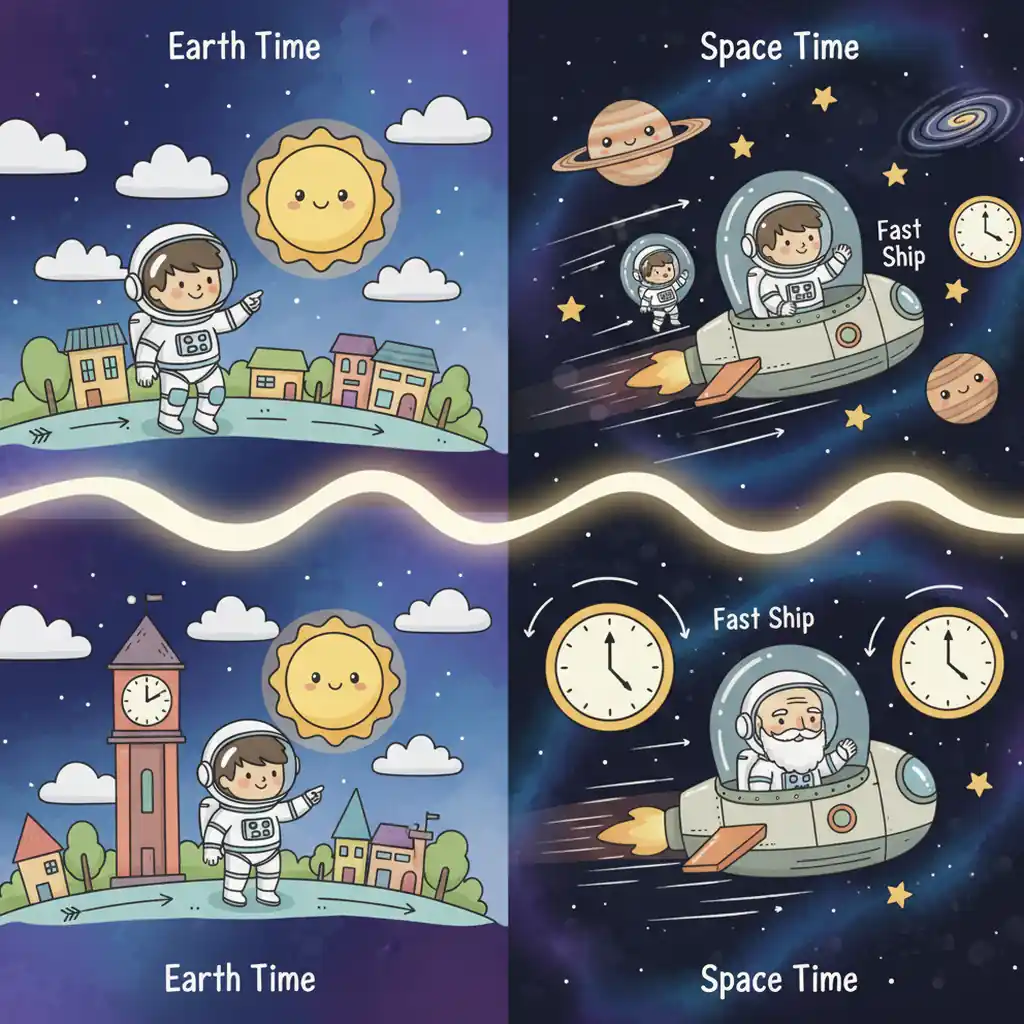
Einstein's first big discovery about time was that the faster you move, the slower time passes for you compared to someone standing still. This is part of his 'Special Theory of Relativity.' It sounds completely bonkers, doesn't it? Let’s imagine a special 'light clock.' This clock tells time by a beam of light bouncing back and forth between two mirrors. Each bounce is one 'tick.' Now, imagine this light clock is on a super-fast spaceship zooming through space.
From the perspective of someone inside the spaceship, the light is just bouncing straight up and down. But for someone outside the spaceship, watching it zoom by, the light has to travel a diagonal path to hit the mirrors because the clock itself is moving forward! A diagonal path is longer than a straight up-and-down path. Since the speed of light is always the same for everyone (another one of Einstein's amazing ideas!), the light inside the moving clock takes longer to complete each bounce. This means the clock on the spaceship ticks slower than a clock on Earth!
And it’s not just clocks! If you were on that super-fast spaceship, your heart would beat slower, your thoughts would happen slower, and you would actually age slower than someone who stayed on Earth. The effect is tiny at everyday speeds, but if you could travel close to the speed of light, you could return to Earth to find that everyone you knew had aged many years, while you had barely aged at all!
Gravity's Deep Dive (General Relativity)
But wait, there's more! Einstein later discovered that gravity can also bend time. This is part of his 'General Theory of Relativity.' Remember our spacetime trampoline? Well, massive objects like planets, stars, and especially black holes, create deep 'dents' or curves in this fabric. The bigger and heavier the object, the deeper the dent. And it turns out, time moves slower in these deeper dents.