
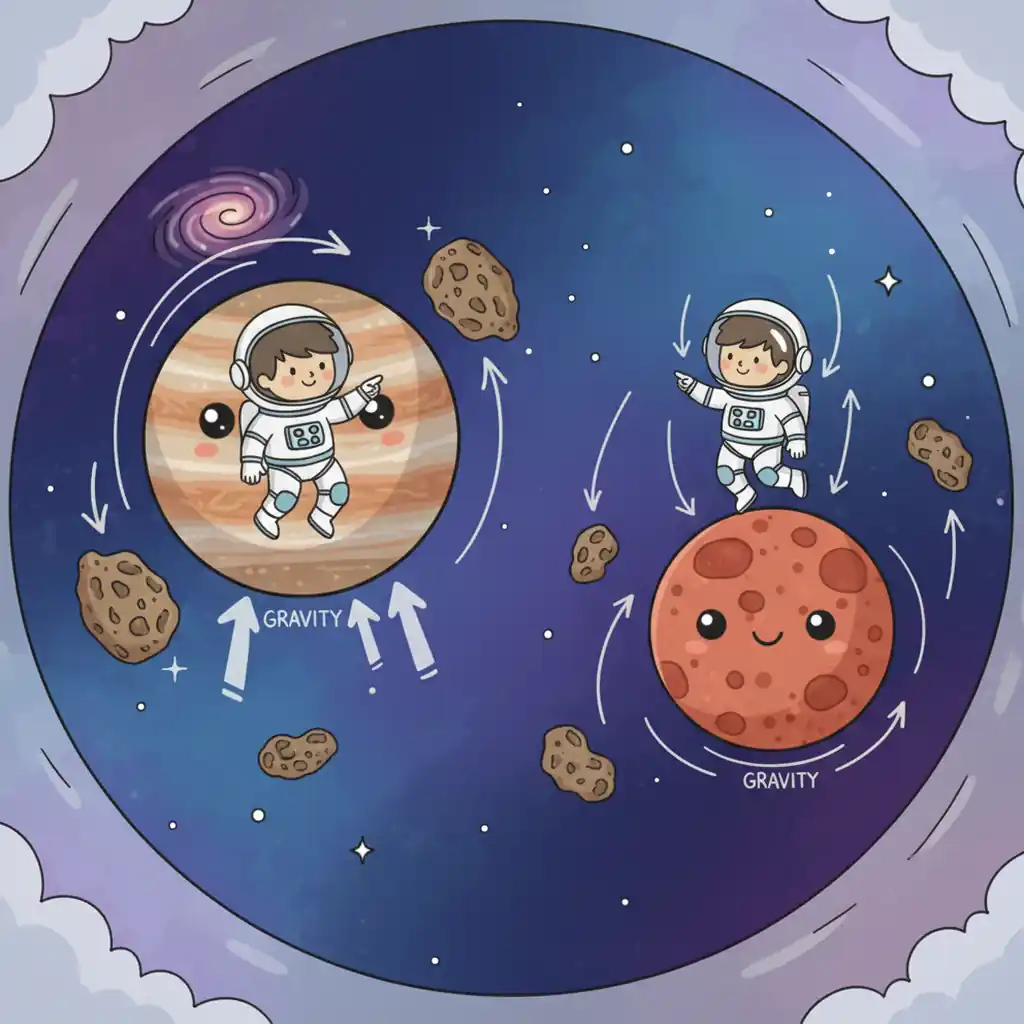
The Invisible Hug: Not All Hugs Are Equal!
Remember that amazing, invisible 'hug' we call gravity? It's the force that keeps your feet on the ground, prevents your juice box from floating away, and holds our entire Earth in orbit around the Sun. But here's a secret: this hug isn't the same everywhere in the universe! Imagine going to different planets—some would hug you tighter, making you feel super heavy, while others would barely give you a squeeze, making you feel light as a feather. Ever wonder why?
The strength of a planet's gravity depends mostly on two main things: how much 'stuff' it has inside it (which scientists call 'mass'), and how close you are to the center of all that stuff. Think of it like a giant cosmic tug-of-war. The more 'stuff' a planet has, the stronger its pull. And the closer you are to the planet's very middle, the stronger you'll feel that pull. Let's dive in and unravel this planetary mystery!
Mass is the Boss: How Much 'Stuff' Does a Planet Have?
When we talk about 'mass,' we're not just talking about how big something looks. Mass is the total amount of material, or 'stuff,' packed into an object. Imagine a giant, fluffy marshmallow the size of a car compared to a tiny metal ball the size of a pebble. The marshmallow is huge, but it has very little mass. The metal ball is tiny, but it has a lot of mass packed into it. Which one would you rather get hit by? The metal ball, because it has more mass!
In space, the rule is simple: the more mass a planet has, the stronger its gravitational pull. This is the number one reason why gravity is weaker on smaller planets. If a planet is small, it usually means it has less 'stuff' in it overall compared to a giant planet like Earth or Jupiter. Less stuff means less pulling power, like a smaller magnet not being able to pick up as many paperclips as a super big magnet.
Size vs. Stuff: Why Looks Can Be Deceiving
Now, you might think: 'Smaller planet equals less mass, right?' And usually, that's true! But not always. Sometimes, a planet can be really big, but made of mostly light, gassy 'stuff,' like a giant bubble. And other times, a planet can be smaller, but packed full of super heavy, dense 'stuff,' like a tiny, solid cannonball. So, while size is a clue, mass is the real superpower behind gravity.
Take our Moon, for example. It's much smaller than Earth, and it has much less mass. That's why when astronauts visited, they could bounce around like superheroes, taking enormous leaps! The Moon's gravity is only about one-sixth of Earth's. So, if you weigh 60 pounds on Earth, you'd only weigh 10 pounds on the Moon! Imagine how high you could jump with that kind of boost!
The Planetary Playground: Jumping Around the Solar System
Let's take a quick tour! On Earth, gravity feels 'normal' because we're used to it. On Mars, which is smaller and has less mass than Earth, gravity is about one-third as strong. So, you'd feel pretty spry, able to jump much higher and run faster with less effort. Think of it like having secret springs in your shoes all the time!