
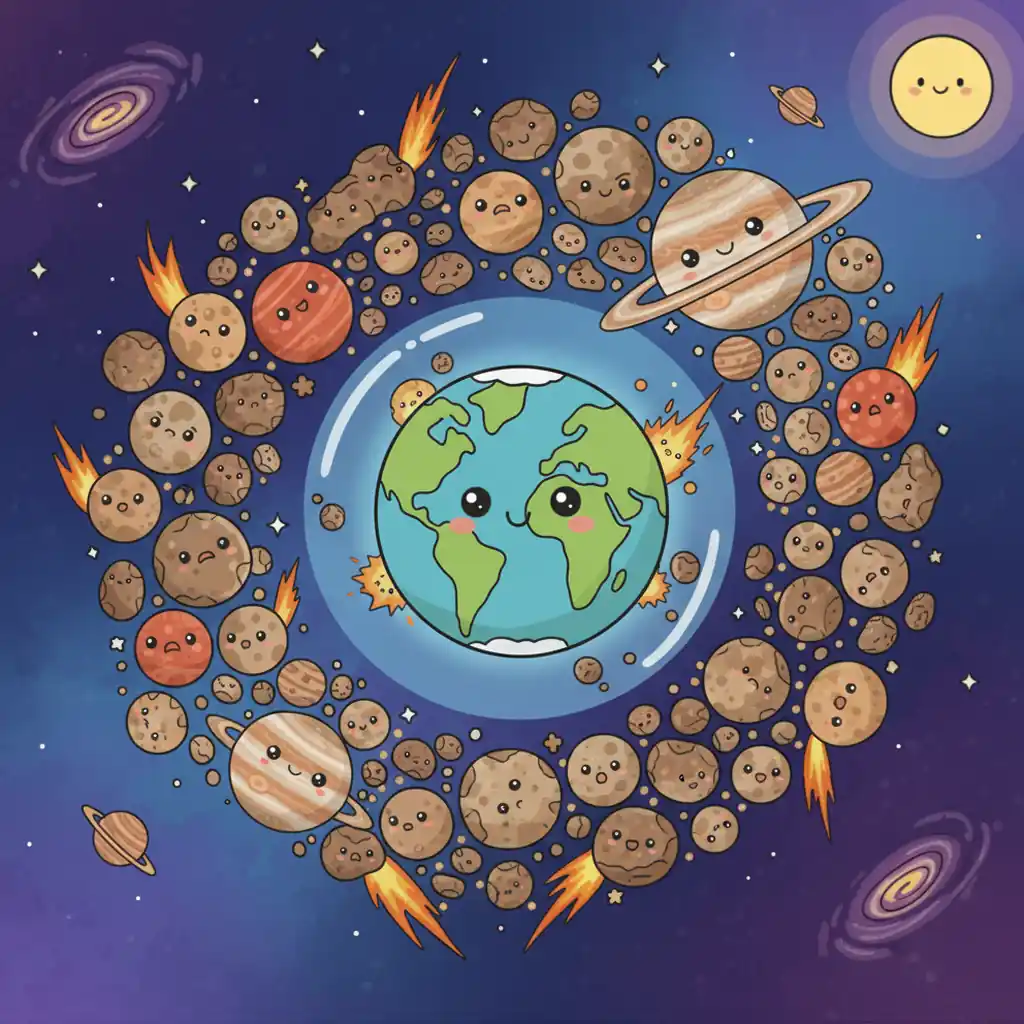
Cosmic Cannonballs: What Are Asteroids?
Imagine our solar system as a giant construction site. After the planets were built, there were lots of leftover bricks and rocks floating around. These aren't just any rocks; they are called asteroids! Most asteroids are found in a huge donut-shaped area between Mars and Jupiter, which we call the Asteroid Belt. These rocky wanderers can be as small as a pebble or as big as a small moon, like Ceres, which is nearly 600 miles wide!
While most asteroids happily orbit the Sun in their belt, sometimes, they get a little nudge. This nudge can come from bumping into another asteroid, or from the strong gravity of a giant planet nearby. When they get nudged, some asteroids might break free from the belt and start traveling in new directions, sometimes heading right towards Earth's neighborhood. But don't worry, our planet has some amazing natural defenses!
Earth's Fiery Force Field: The Atmosphere
One of Earth's greatest protectors is something you can't even see: our atmosphere! Think of it like a thick, cozy blanket of air wrapped all around our planet. When a space rock, called a meteoroid, starts speeding towards Earth, it first has to smash into this invisible blanket. And 'smash' is the right word, because it's moving incredibly fast—sometimes tens of thousands of miles per hour!
As the meteoroid zips through the atmosphere, the air in front of it gets squished and heats up tremendously, like rubbing your hands together really fast. This intense heat causes the meteoroid to glow brightly and often burn up completely, creating a spectacular 'shooting star' that you might see at night. Most space rocks are small, no bigger than a grain of sand, so they disappear high above us, never reaching the ground. Our atmosphere is like a super-effective cosmic shield, incinerating invaders before they can do any harm!
Jupiter, Our Giant Guardian
Beyond the asteroid belt, there's an even bigger hero in our solar system: Jupiter! This enormous gas giant is so massive that it's like a cosmic bouncer, keeping many rowdy asteroids away from the inner planets, including Earth. Jupiter's gravity is incredibly strong, like a giant invisible hand reaching out into space.
Imagine Jupiter's gravity as a super-powerful vacuum cleaner. When asteroids from the outer solar system or even from the asteroid belt get too close, Jupiter's gravity either sucks them in, causing them to crash into its swirling cloud tops, or it slingshots them out into the much colder, emptier reaches of the solar system, far away from Earth. Without Jupiter constantly sweeping up or redirecting these space rocks, our planet would likely be bombarded far more often!
The Moon's Scarred Face: A Warning and a Tiny Shield
Take a look at the Moon through a telescope. What do you see? Lots and lots of craters! These are like battle scars, left by countless asteroids and meteoroids that have slammed into its surface over billions of years. The Moon doesn't have an atmosphere like Earth, so there's nothing to burn up or slow down incoming space rocks. They hit the surface with full force, leaving a mark.