
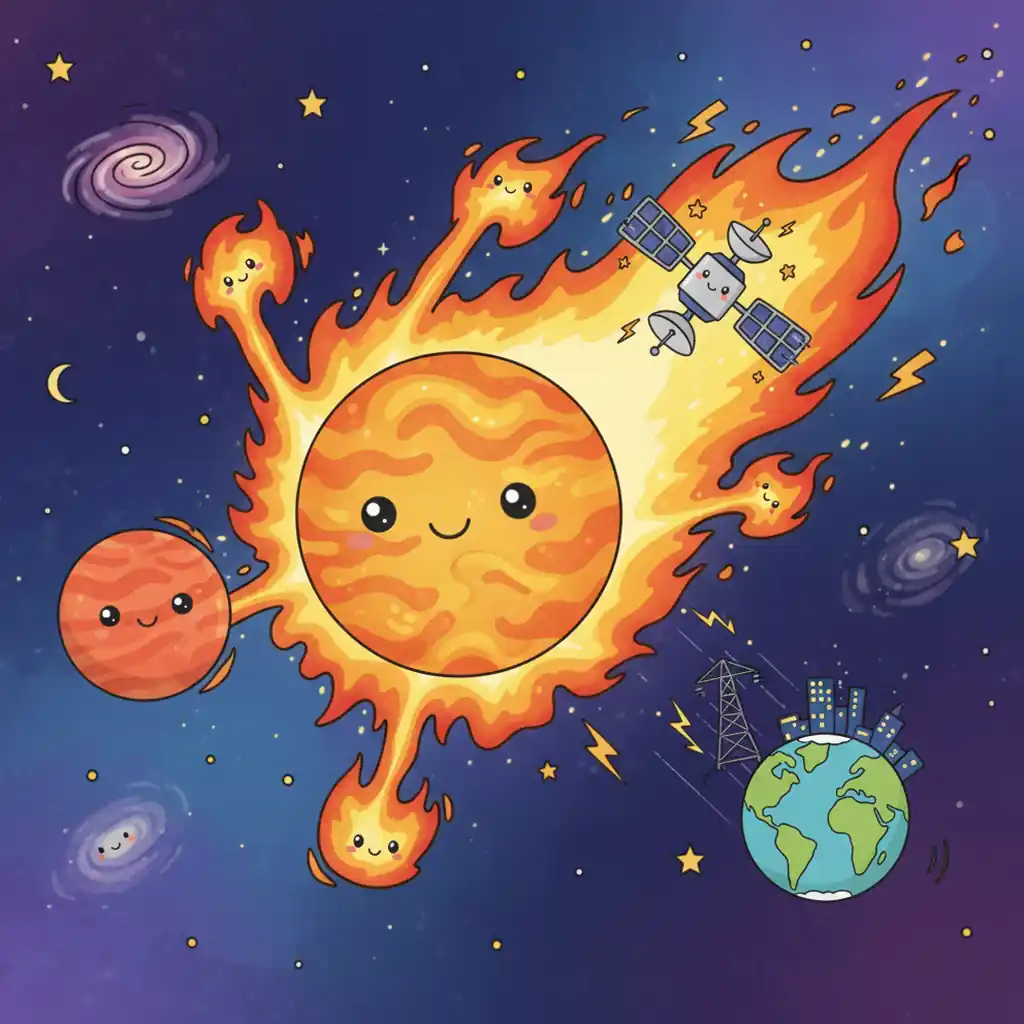
Our Super Star: The Sun!
Look up at the sky during the day, and what do you see? The Sun, our incredible, giant, fiery star! It’s like a colossal flashlight in the sky, giving us light to see, warmth to feel, and energy for plants to grow. Without the Sun, our Earth would be a frozen, dark, and very boring place to live. But did you know our Sun isn't just a calm, glowing orb? Oh no, it's a super active, super powerful giant that sometimes throws amazing, explosive tantrums called solar flares!
Imagine the Sun as a huge ball of super-hot gas, mostly hydrogen and helium. Inside, it's like a giant atomic furnace, constantly making energy through something called 'nuclear fusion.' This energy bubbles up to the surface, making the Sun's surface shimmer and churn, kind of like a pot of boiling water. But instead of water, it's a super-duper hot, electrically charged gas called 'plasma.' And because this plasma is moving and swirling, it creates powerful, invisible lines of force, just like the ones around a magnet!
Twisted Magnets and Sunspots
These invisible lines of force are called magnetic fields, and the Sun has millions of them! They twist and tangle and stretch all over its surface, like giant, invisible rubber bands. Sometimes, these magnetic fields get so strong and twisted that they pop out of the Sun's surface and create darker, cooler areas we call 'sunspots.' These sunspots look like tiny freckles on the Sun, but don't let their size fool you – a sunspot can be bigger than Earth!
These twisted magnetic fields and sunspots are like the stage where all the Sun's explosive drama happens. When the magnetic 'rubber bands' get too stretched and tangled, they can snap! And when they snap, they release a HUGE amount of energy all at once. This sudden burst of energy is what we call a solar flare.
What's a Solar Flare, Anyway?
A solar flare is like a gigantic, super-fast flash of light and energy that explodes from the Sun's surface. It's not a burning fire, but rather a burst of light (like X-rays and UV light) and super-fast particles. Imagine a humongous fireworks display, but instead of chemicals, it's pure magnetic energy turning into light and speedy tiny bits of matter! These flares are incredibly fast; their light and X-rays can reach Earth in just about 8 minutes, traveling at the speed of light!
Flares can be small or absolutely enormous. The biggest ones can be millions of times more powerful than a volcanic eruption on Earth! Sometimes, a solar flare is just a quick flash. Other times, it's followed by something even more dramatic and powerful: a coronal mass ejection.
The Big Bubble Blast: Coronal Mass Ejections (CMEs)
Imagine a giant bubble of super-hot, electrically charged gas (plasma) being blown off the Sun and hurtling into space. That's a Coronal Mass Ejection, or CME for short! While a solar flare is mostly light and radiation, a CME is a huge cloud of actual 'stuff' – billions of tons of plasma that blast away from the Sun at incredible speeds, sometimes millions of miles per hour.