
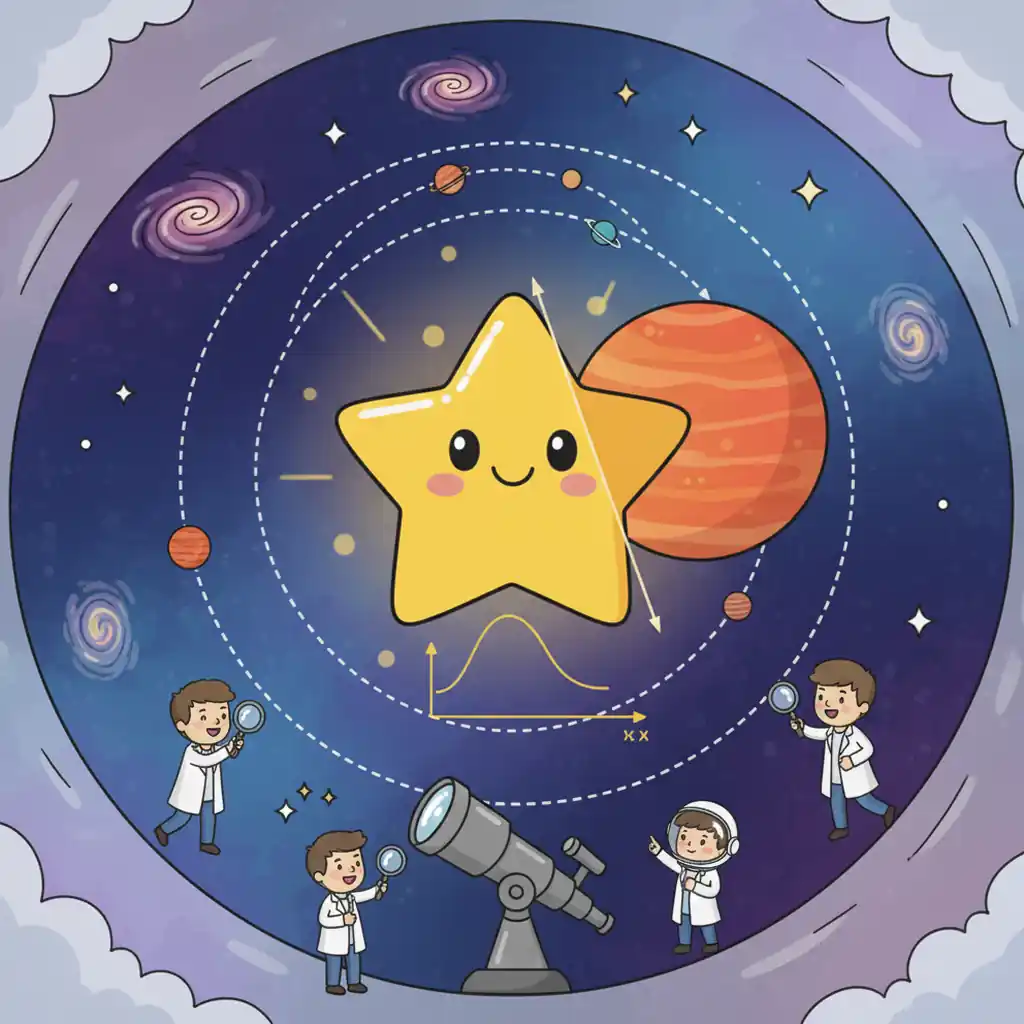
The Cosmic Treasure Hunt: What Are Alien Worlds?
Imagine looking up at the night sky, past our familiar Moon and the twinkling planets of our solar system like Mars and Jupiter. What if I told you there are thousands, maybe even billions, of other planets orbiting other stars, just like Earth orbits our Sun? These incredible faraway planets are called 'exoplanets' or 'alien worlds,' and for a long time, they were just a dream in the minds of scientists.
For thousands of years, humans could only wonder if other planets existed beyond our own cosmic neighborhood. It wasn't until the early 1990s that astronomers finally spotted the very first exoplanets! Since then, with super-smart telescopes and clever detective work, we've found over 5,000 of them, and we're discovering new ones all the time. Each new discovery brings us closer to answering one of humanity's biggest questions: Are we alone in the universe?
But here's the tricky part: these planets are incredibly far away, and they don't shine with their own light. They're usually tiny compared to their giant, blazing stars, making them almost impossible to see directly. Trying to spot an exoplanet is like trying to see a firefly buzzing around a lighthouse from hundreds of miles away! So, how do scientists find these invisible worlds?
The Star's Secret Dance: The 'Wobble' Method
One of the oldest and most successful ways to find exoplanets is called the 'Wobble Method,' or technically, the 'Radial Velocity Method.' It's based on a cool idea: even though a star is huge, its planets aren't just orbiting it; their gravity actually tugs on the star a little bit, too! Imagine you're walking your dog. While you're pulling the leash, your dog is also tugging on you a little, right? That's kind of how a star and its planet work together.
This tiny tug makes the star 'wobble' back and forth in space. It's not a huge wiggle, but it's enough for super-sensitive telescopes to notice. As the star wobbles towards us, its light waves get squished a tiny bit, making them look a little 'bluer' (called a blueshift). As it wobbles away, the light waves stretch out, making them look a little 'redder' (a redshift).
By carefully measuring these tiny color shifts in a star's light, astronomers can tell if it's dancing with an unseen planet. They can even figure out how big the planet is and how close it orbits its star! The bigger the wobble, the bigger or closer the planet. This method has helped us find many giant planets, especially 'Hot Jupiters,' which are huge gas giants orbiting very close to their stars.
The Star's Cosmic Blink: The 'Transit' Method
Another incredibly powerful way to find exoplanets is called the 'Transit Method.' Imagine you're watching a bright light bulb. If a tiny fly walks across the bulb, you'd notice the light dim just a tiny bit as the fly passes in front of it, right? That's exactly what astronomers look for with distant stars!
When an exoplanet passes directly in front of its star from our point of view, it blocks a tiny fraction of the star's light. This causes the star to 'blink' or dim slightly for a few hours. By measuring how much the star dims and how long the dimming lasts, scientists can figure out the size of the planet and how long it takes to orbit its star.
This method has been super successful, especially with special space telescopes like NASA's Kepler and TESS missions, which stared at thousands of stars at once. The Transit Method is great for finding planets of all sizes, including smaller, rocky worlds that might be similar to Earth. It can even give us clues about a planet's atmosphere if some starlight peeks through it!
A Rare Glimpse: Direct Imaging
Remember how we said seeing an exoplanet directly is like spotting a firefly next to a lighthouse? It's incredibly hard, but not impossible for very special cases! This method is called 'Direct Imaging,' and it's like taking a direct photograph of the planet itself. The challenge is that the star is usually billions of times brighter than its planet, making the planet completely invisible in its glare.