
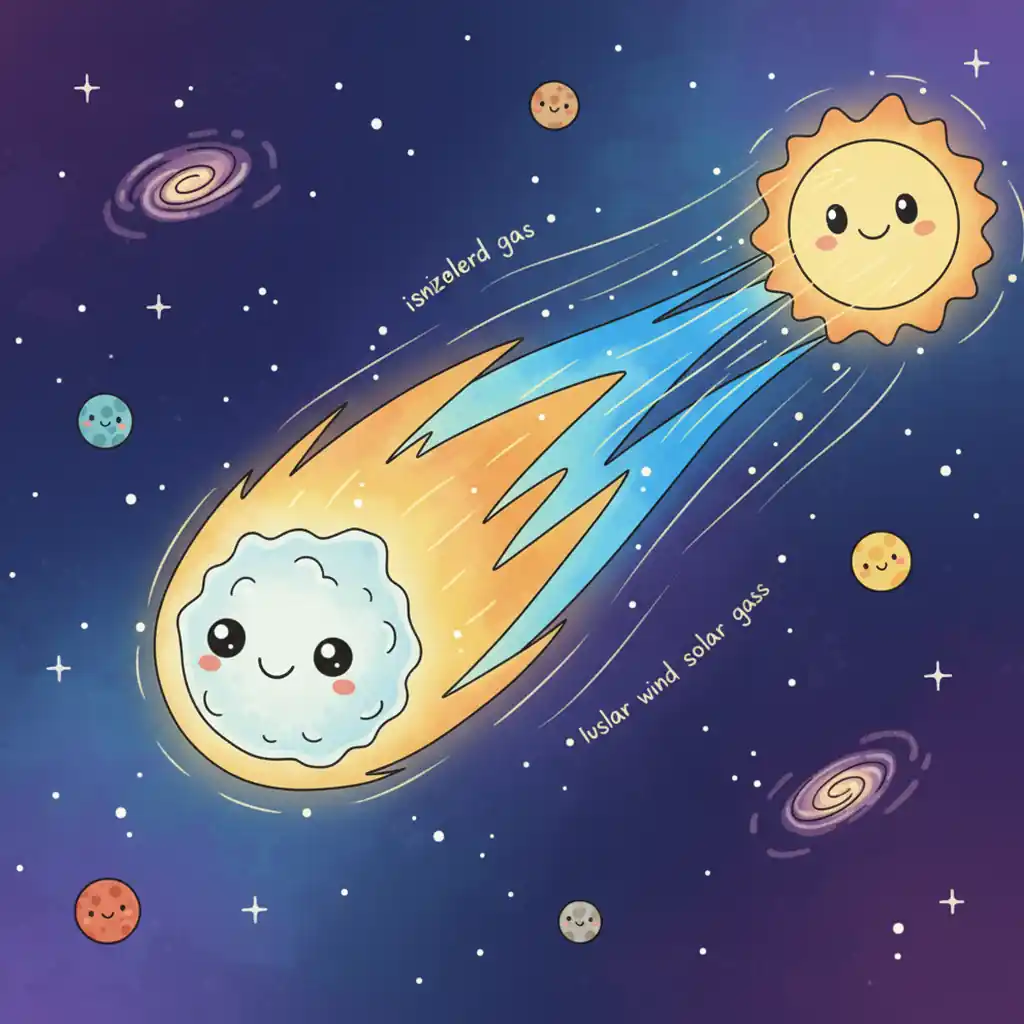
The Cosmic Ice Cream Cone!
Imagine a giant, frozen treat, but instead of ice cream, it’s made of ice, dust, and rock, zipping through space! That's a comet! Scientists often call them 'dirty snowballs' because they're basically giant chunks of frozen leftovers from when our solar system first began, billions of years ago. These icy wanderers hold ancient secrets, like cosmic time capsules flying through the vast emptiness.
Most comets spend almost all their lives far, far away from the Sun, in super-cold regions beyond the planets. They have huge, stretched-out orbits, taking them years, decades, or even thousands of years to complete just one trip around the Sun. They're like sleepy space bears, hibernating in the dark, cold outer reaches of our solar system.
When they finally do start their long journey inward, closer to the Sun's warmth, that's when the real show begins! The ice starts to wake up, and our dirty snowball transforms into a spectacular, glowing beacon with a majestic tail. It's like turning on the lights at a grand space party!
The Heart of the Comet: Nucleus and Coma
Every comet has a solid, icy center called the 'nucleus.' This is the actual 'dirty snowball' part, packed with water ice, frozen carbon dioxide, methane, ammonia, and mixed with rock and dust. It can be as small as a town or as large as a city! This tiny nucleus is where all the magic starts.
As the comet's nucleus gets closer to the Sun, the Sun's heat starts to warm it up. But instead of melting into liquid water, most of the ice turns directly into gas – a process called 'sublimation.' Think of dry ice fizzing, but on a cosmic scale! This gas, along with tiny bits of dust, streams off the nucleus.
This escaping gas and dust create a giant, fuzzy cloud around the nucleus called the 'coma.' It can be hundreds of thousands of miles wide, sometimes even bigger than Jupiter! The coma makes the comet look like a fuzzy star without sharp edges, and it’s the beginning of the incredible tails we see.
Two Tails, Two Different Paths
Did you know that most bright comets actually have two tails? It’s not just one big streamer following behind! These two tails are distinct and behave in different ways, each telling its own story about the forces at play in space. One is often straight and blue, while the other is usually curved and yellowish.
It’s like a cosmic ponytail with two different strands, each being styled by different forces. The reason for these two distinct tails lies in what they are made of and how the Sun interacts with those materials. Understanding these two tails is key to solving the mystery of why they point away from the Sun.
Imagine trying to blow bubbles and glitter at the same time – the bubbles would drift differently from the glitter, right? That's a bit like what happens with a comet's gas and dust, but on a much grander scale, influenced by the powerful energy of our Sun.
The Sun's Cosmic Breath: Solar Wind and Radiation Pressure
To understand why comet tails behave the way they do, we need to talk about the Sun. Our Sun isn't just a giant light bulb; it's also constantly blowing out a powerful stream of super-fast, charged particles called the 'solar wind.' Think of it as a hurricane-force breath blowing from the Sun in all directions!
This solar wind travels incredibly fast, sometimes over a million miles per hour! When a comet gets close enough, this solar wind slams into the gas and dust erupting from its nucleus. It's this powerful, invisible force that literally pushes the comet's material away.