
The Cosmic Mirror
The Moon is often the brightest thing in the night sky, but it’s hiding a secret: it has no light of its own. It isn't a giant lightbulb; it’s a giant mirror. The 'moonlight' we see is actually recycled sunlight bouncing off the Moon's dusty, grey surface.
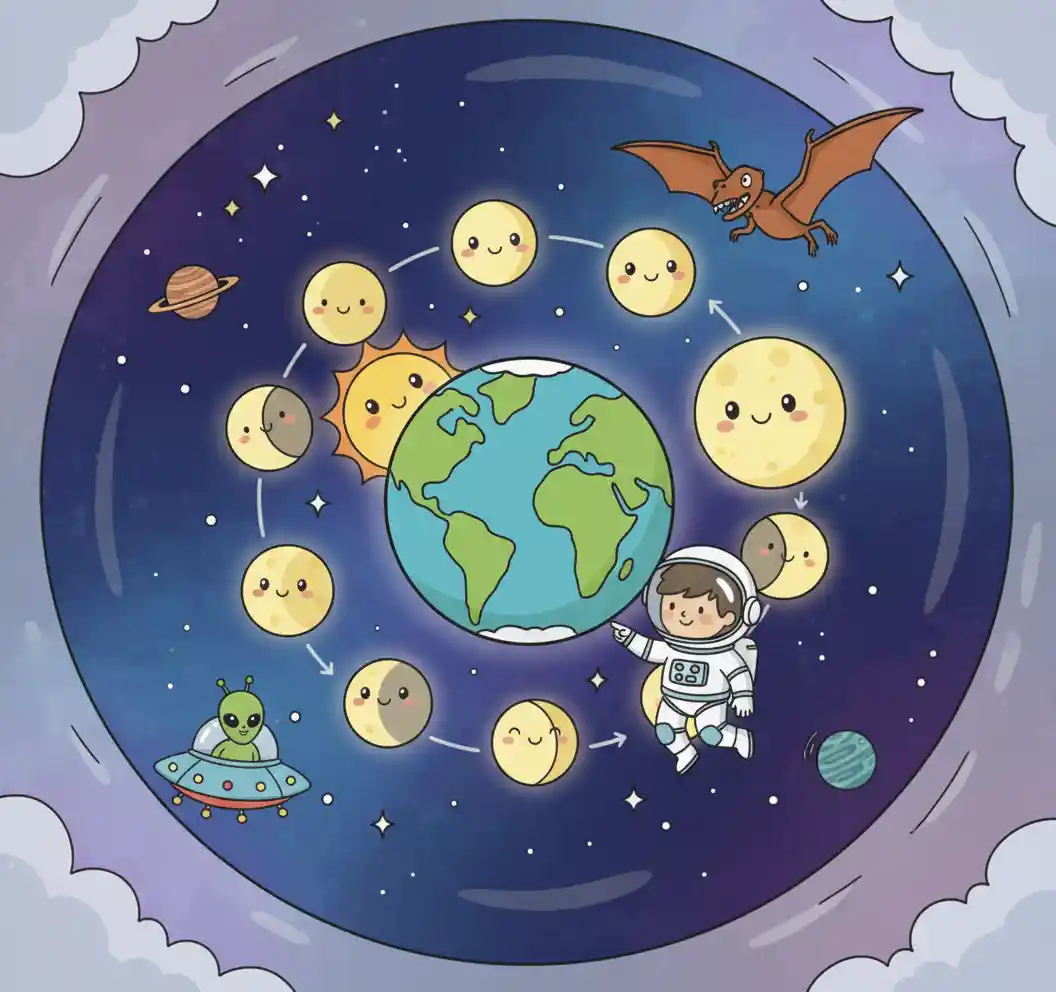
Because the Moon is a sphere, the Sun can only light up one half of it at a time. The side facing the Sun is 'daytime' on the Moon, and the side facing away is 'nighttime.' What we see from Earth depends entirely on where the Moon is in its month-long trip around us.
The New Moon: Total Stealth
The cycle begins with the New Moon. During this phase, the Moon is positioned between the Earth and the Sun. The sunny side is facing away from us, and the dark side is facing us. It’s like looking at the back of a mirror.
Since the sky is so bright during the day and the Moon's night side is so dark, the Moon becomes almost invisible to the naked eye. It’s there, hiding in plain sight, waiting for its journey to continue toward the next stage.
Waxing: Growing Bigger
As the Moon moves along its orbit, we start to see a tiny sliver of the illuminated side. This is called a 'Waxing Crescent.' In the world of astronomy, 'waxing' means growing. Night by night, that silver sliver gets wider.
Soon, it reaches the 'First Quarter' phase. Even though we call it a quarter, it looks like a perfect half-moon to us. This is the point where the Moon has completed one-quarter of its monthly journey around the Earth.