
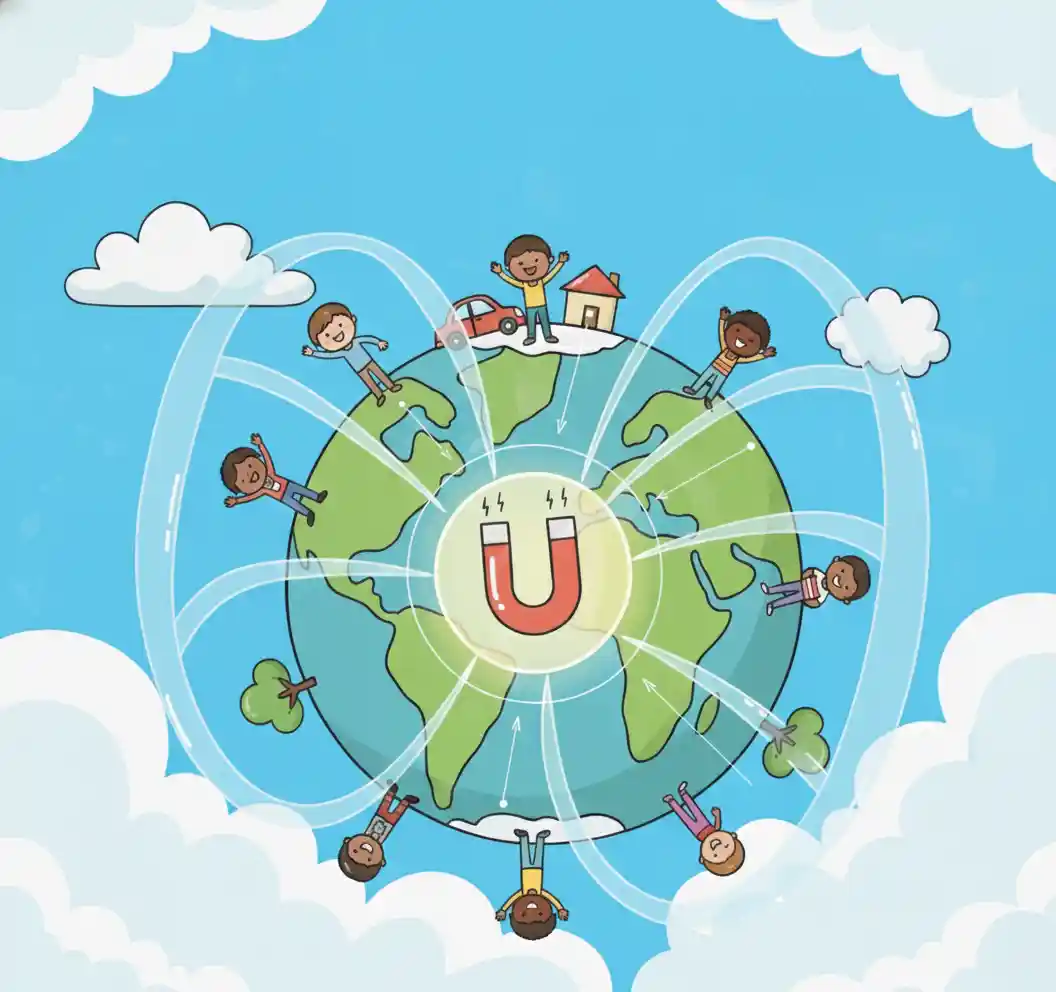
The Invisible Glue
Imagine you are standing at the very bottom of the Earth, near the South Pole. Why don't you simply fall off into the blackness of space? The answer is Gravity. Gravity is an invisible force that acts like a giant, friendly magnet, but instead of just pulling metal, it pulls everything that has 'mass' (basically, anything made of atoms).
Because the Earth is so incredibly massive, its pull is extremely strong. It doesn't just pull on you; it pulls on the atmosphere so we can breathe, and it pulls on the vast oceans so they stay in their basins. Without this 'invisible glue,' life as we know it would simply float away into the void.
The Great Space Dent
To understand how gravity works on a grander scale, we have to look at the ideas of Albert Einstein. He suggested that space isn't just empty nothingness—it's like a fabric. Imagine a giant trampoline stretched tight. If you place a heavy bowling ball in the middle, the fabric dents and curves downward.
If you then roll a marble onto that trampoline, it will naturally spiral toward the bowling ball. The Earth is like that bowling ball, and we are like the marbles! We aren't being 'sucked' down by a vacuum; we are simply following the curves in space created by the Earth's massive weight.
Weight vs. Mass
Did you know that your weight changes depending on where you are, but your 'stuff' stays the same? Mass is the amount of matter inside you. Whether you are on Earth or the Moon, you have the same number of atoms. However, weight is a measurement of how hard gravity is pulling on those atoms.
On a smaller planet like Mars, gravity is weaker. If you weigh 100 pounds on Earth, you’d weigh only 38 pounds on Mars! You’d feel like a superhero, able to jump over cars and run like the wind, all because the planet isn't 'hugging' you quite as tightly as Earth does.
The Moon’s Tug-of-War
Gravity isn't a one-way street. While Earth pulls on the Moon to keep it in orbit, the Moon actually pulls back on the Earth! Since the Moon is smaller, it can't move the whole planet, but it can move the liquid parts: our oceans.
This cosmic tug-of-war is what creates the tides. When the Moon passes over an ocean, its gravity lifts the water slightly, creating 'high tide.' It’s a literal liquid mountain moving across the globe every single day, powered by the invisible reach of a rock thousands of miles away.
Orbits: Falling Forever
If gravity pulls everything down, why doesn't the International Space Station (ISS) crash into the ground? The secret is speed. The ISS is actually falling toward Earth right now, but it is moving sideways so fast (17,500 mph!) that as it falls, the Earth curves away beneath it.
This state of 'falling but never hitting' is what we call an orbit. Astronauts aren't floating because there is no gravity; they are floating because they are in a state of 'freefall' around the planet. They are essentially riding a roller coaster that never ends.
Gravity’s Limit
Does gravity ever stop? Technically, no. Gravity has an infinite range, but it gets much weaker the further away you get. This is the 'Inverse Square Law.' If you double your distance from the Earth, the pull of gravity becomes four times weaker.
This is why deep-space probes eventually reach a point where Earth's pull is barely a whisper. However, they are always being pulled by something—be it the Sun, a distant star, or the center of our galaxy. In the universe, you can run, but you can't hide from gravity.