
The Great Distance Myth
Many people think that Earth gets closer to the Sun in the summer and farther away in the winter. It makes sense, right? If you move closer to a campfire, you feel hotter. But in space, this isn't how it works!
In fact, the Earth is actually at its closest point to the Sun in January—which is the middle of winter for the Northern Hemisphere! The secret to the seasons isn't about how close we are; it's about how we are leaning.
The Tilted Top
Imagine Earth is a spinning top, but instead of spinning perfectly straight up and down, it leans to the side. This lean is called an 'axis tilt.' Earth is tilted at an angle of 23.5 degrees.
As Earth orbits the Sun, this tilt stays pointed in the same direction. This means that for half the year, the North Pole is leaning toward the Sun, and for the other half, it is leaning away. This simple tilt is the engine of our seasons.
Direct vs. Angled Light
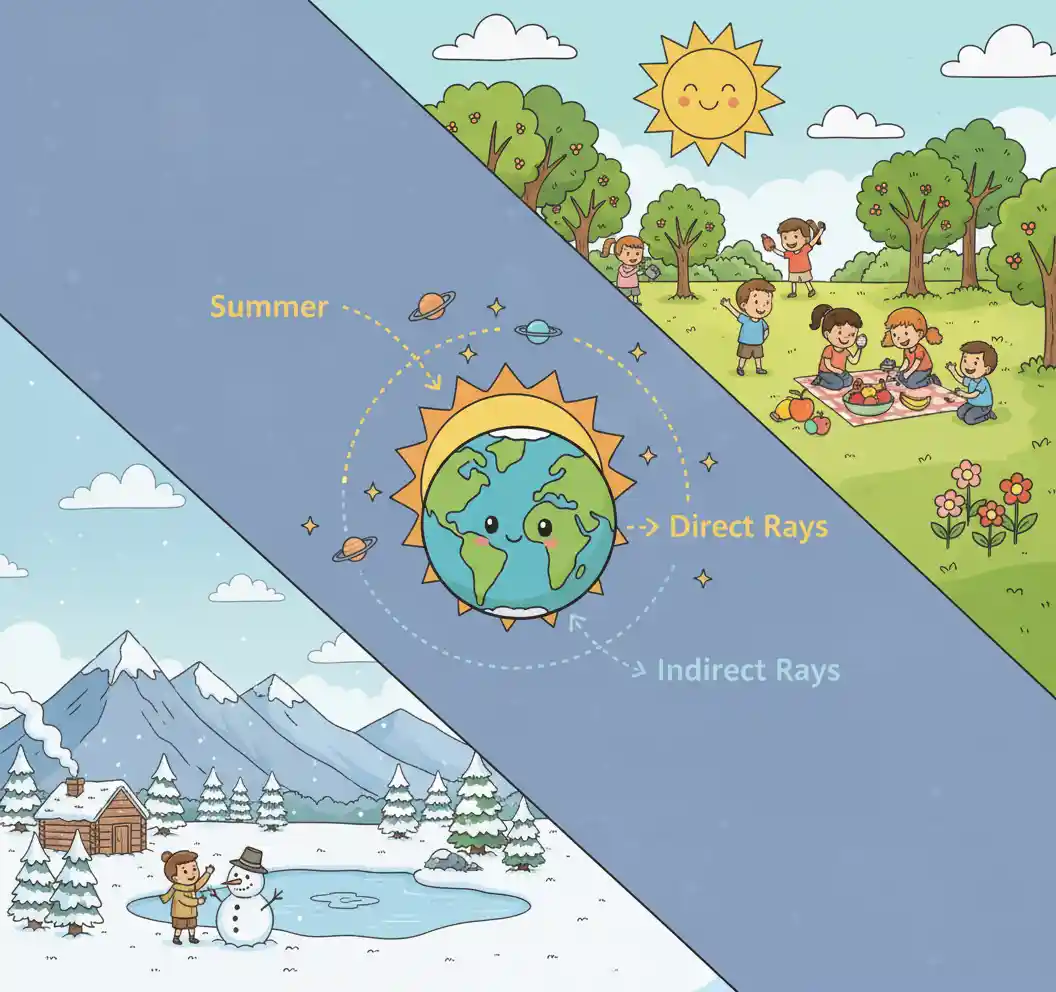
When your part of the world is leaning toward the Sun, you get 'direct' sunlight. The rays hit you head-on, concentrating all their heat in one small area. This is summer.
When you are leaning away, the sunlight hits at a steep angle. The same amount of energy is spread out over a much larger area, which makes it feel weaker and colder. Think of it like a flashlight: if you point it straight down, the spot is bright and hot; if you tilt it, the light stretches out and looks dimmer.