
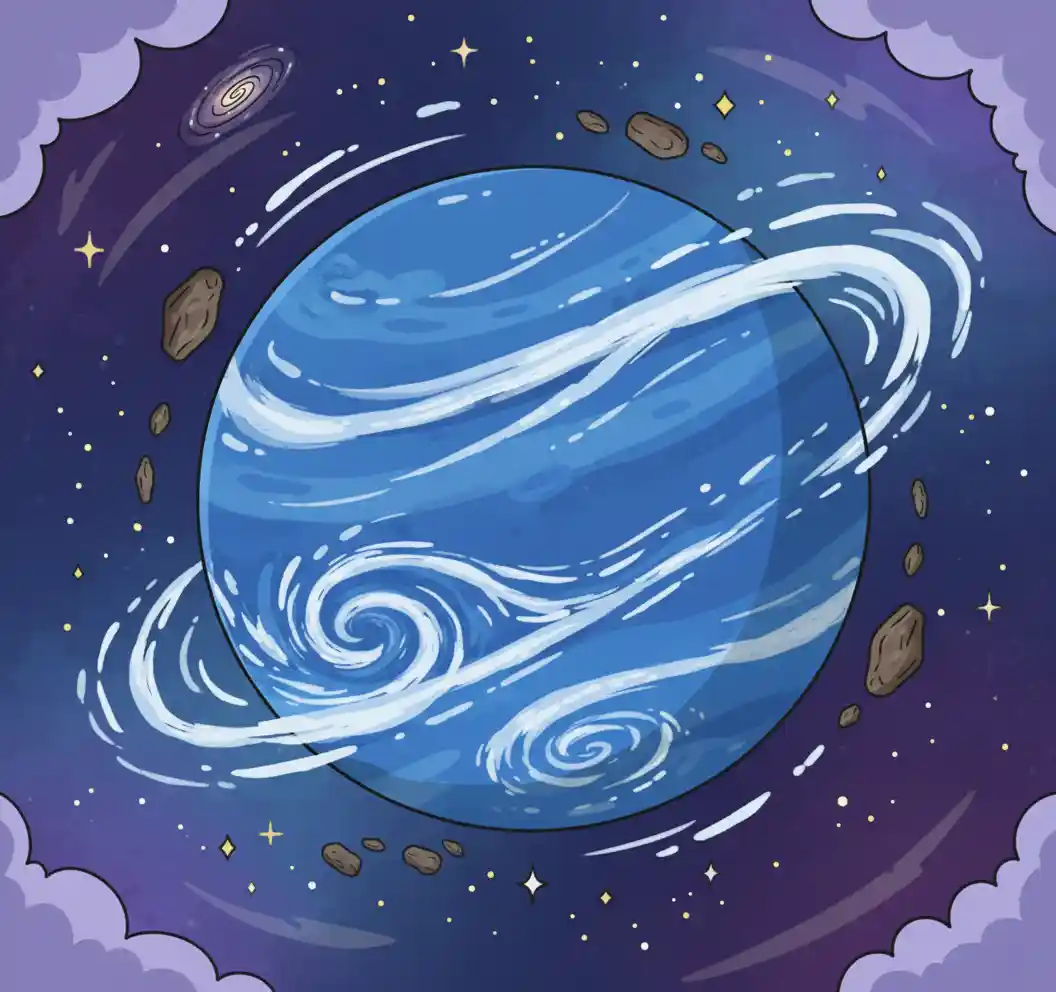
The Blue Giant
If you saw Neptune through a telescope, you would see a striking, vivid blue planet glowing in the dark void of space. It is often called an 'Ice Giant' because, while it is mostly gas, it contains a huge amount of frozen water, ammonia, and methane.
But water ice isn't actually blue, and neither are hydrogen or helium, which make up most of its air. So where does that royal blue color come from? The answer is hidden in a tiny amount of special gas.
The Methane Filter
Neptune's atmosphere contains a small amount of methane gas. Methane has a very specific superpower: it is a master at absorbing red light. When sunlight (which contains all the colors of the rainbow) hits Neptune, the methane soaks up all the red waves.
Because the red is gone, only the blue light is left to bounce off the clouds and travel back to our eyes. This makes Neptune act like a giant blue mirror, reflecting only the coolest colors of the spectrum.
Uranus vs. Neptune
Neptune has a neighbor named Uranus that is also an Ice Giant made of similar stuff. However, Uranus is a pale, light cyan color, while Neptune is a deep, rich blue. For a long time, this was a huge mystery for scientists.
Recent studies suggest that Uranus has a thicker layer of 'stagnant' haze. This haze acts like a white foggy sheet, washing out the blue. Neptune has a more active atmosphere that clears out this haze, letting the true, deep blue shine through.