
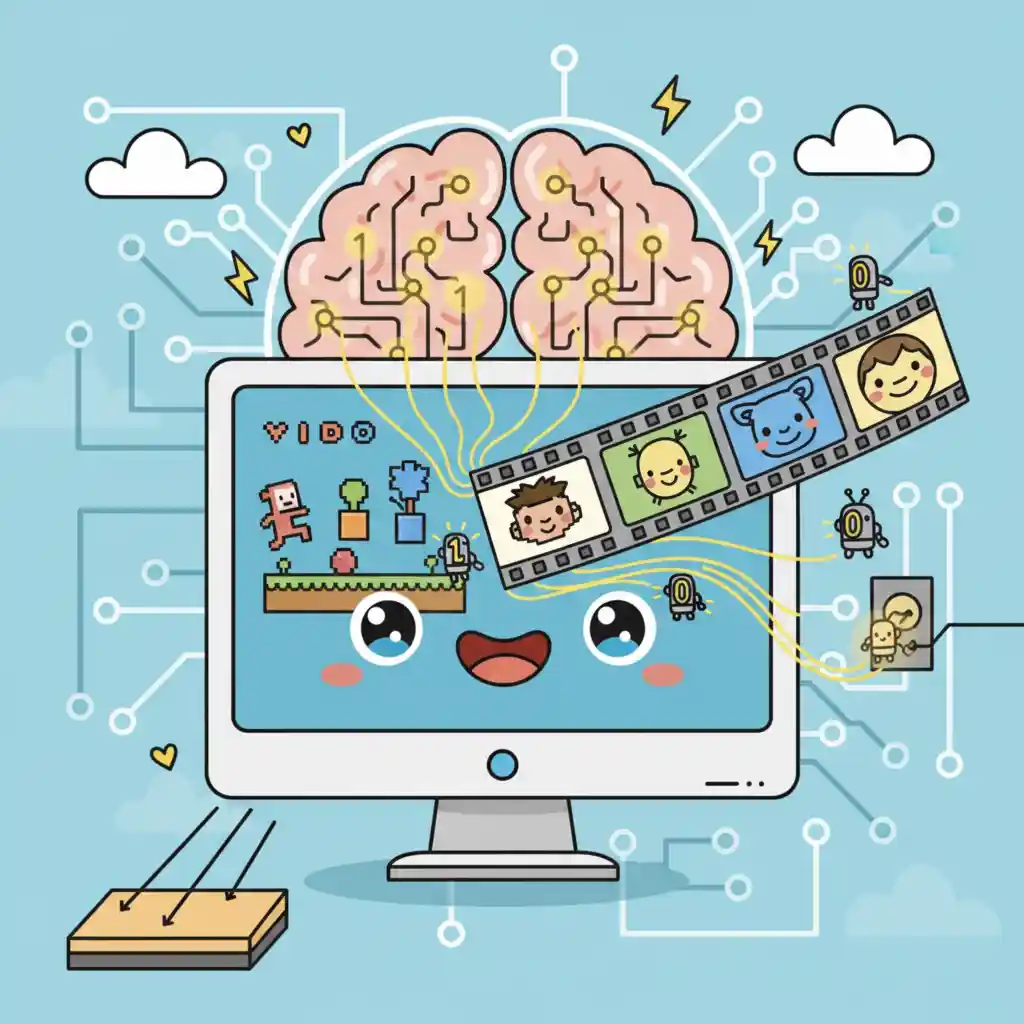
The Secret Language of Computers
Have you ever wondered how a computer, tablet, or smartphone 'thinks'? It doesn't use words or pictures like we do. Instead, it speaks a super-secret language made up of only two things: 1s and 0s! This amazing language is called 'binary,' and it's the invisible magic that makes all your favorite games, videos, and apps work.
Imagine a light switch: it can either be ON or OFF. In the computer's world, 'ON' is usually a 1, and 'OFF' is a 0. That's it! Every single thing a computer does, from showing you a picture of a cat to helping you do your homework, is just millions and billions of these tiny electrical switches flipping on and off at lightning speed. It's like a giant game of 'on-off' tag happening inside your device.
Bits and Bytes: The Building Blocks
A single 1 or a single 0 is called a 'bit.' Think of it as the smallest piece of information a computer can understand. It's like a single 'yes' or 'no' answer. But just one bit isn't very useful, so computers combine them. If you have two bits, you can have four different combinations: 00, 01, 10, and 11. Each new bit you add doubles the number of possibilities!
When you put eight bits together, you get something called a 'byte.' A byte is super important because it's usually enough to represent one letter, one number, or one small piece of a picture. So, when you type the letter 'A' on your keyboard, the computer sees a specific pattern of eight 1s and 0s, like 01000001, which it understands as 'A'.
Counting on Two Fingers
We usually count in a 'decimal' system, using ten different numbers (0-9). Binary is different; it only uses two numbers (0 and 1). In our system, when we run out of numbers (after 9), we add another column (tens, hundreds). Binary does the same thing, but much faster!
Here's how it works: 0 is 0, 1 is 1. When we want to say 'two,' we run out of numbers, so we move to the next 'place value,' which doubles the previous one. So, 10 in binary actually means 'two' (one 'two' and zero 'ones'). 'Three' is 11 (one 'two' and one 'one'). 'Four' is 100 (one 'four,' zero 'twos,' zero 'ones'). It's like a secret code for numbers!