
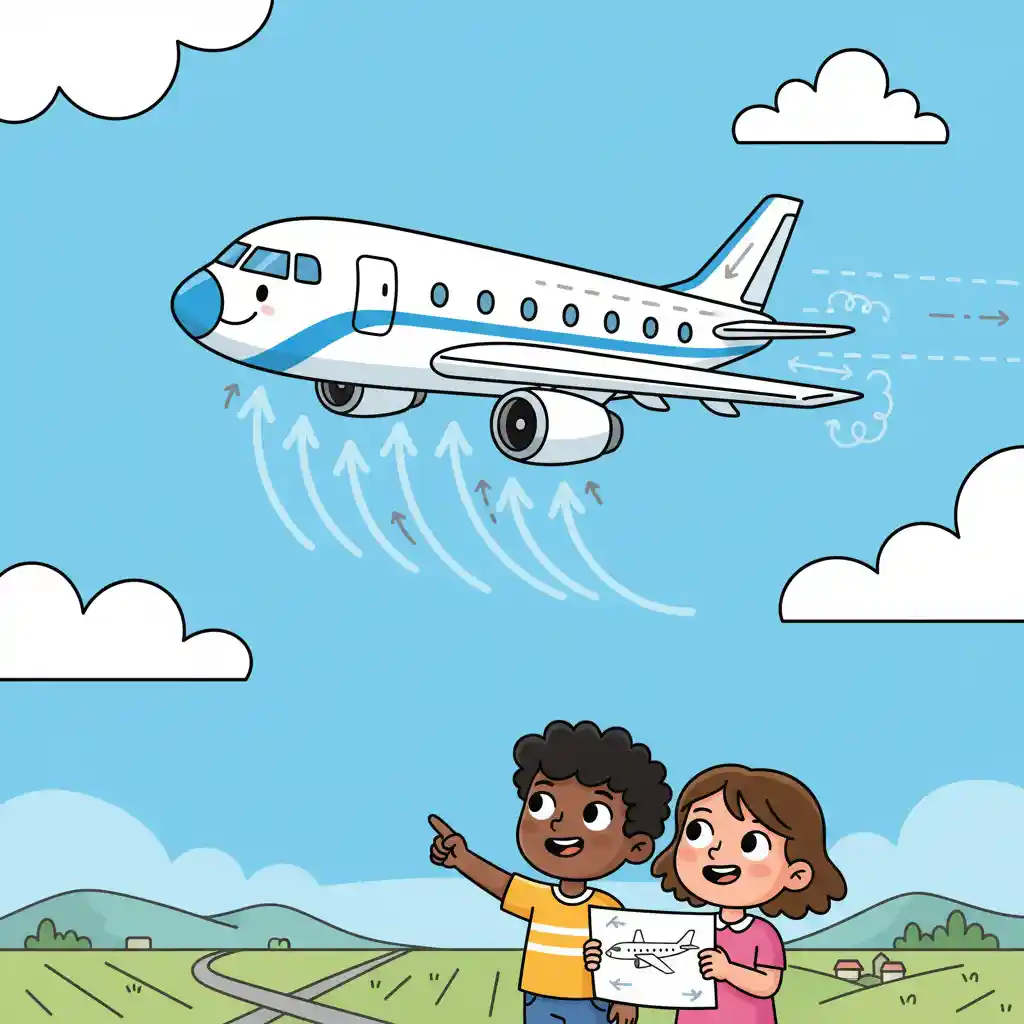
The Big Why: How Does a Metal Bird Fly?
Have you ever looked up at the sky and seen a giant airplane soaring like a magnificent bird? It's huge, made of heavy metal, and seems to defy all the rules! How can something so massive leave the ground and zip across the world? It’s not magic, but it is a super cool trick of science, using invisible air to create a powerful push!
Imagine trying to throw a brick through the air – it just plops down. But an airplane, which is way heavier than a brick, zooms thousands of feet up! The secret lies in a clever combination of shape, speed, and four amazing forces working together in a perfect dance.
The Wing's Secret Shape: The Airfoil
The most important part of an airplane's flight trick is its wing. Take a close look at an airplane wing (next time you see one at the airport or in a picture). Notice how it’s not flat? It’s curved on top and flatter or slightly curved on the bottom. This special, aerodynamic shape is called an 'airfoil'.
This isn't just for looking cool; this shape is designed to trick the air. When the plane rushes forward, the air has to split up and go around the wing. The air that goes over the curved top has a slightly longer journey than the air that goes under the flatter bottom. This difference in journey is the key!
Bernoulli's Magic: The Lift-Off
Here's where the real magic happens, thanks to a clever scientist named Daniel Bernoulli. Because the air going over the curved top of the wing has to travel faster to meet up with the air from the bottom at the same time, it actually creates less pressure up there. Think of it like a busy highway where cars speed up to get past a bottleneck – less time for bumping, less 'pressure'.
At the same time, the air going under the flatter part of the wing moves slower, creating more pressure. So, what happens? The higher pressure air underneath the wing pushes up towards the lower pressure air above the wing, giving the plane an upward shove! This upward push is called 'lift', and it's what fights against gravity to keep the plane in the sky.
The Mighty Push: All About Thrust!
For the wings to do their lift trick, the airplane needs to move forward super fast! That's where the engines come in. Whether they're propeller engines that spin giant fan blades to pull the plane, or powerful jet engines that blast hot air out the back to push it forward, their job is to create 'thrust'.
Thrust is the force that propels the airplane through the air, giving it the incredible speed it needs. Without enough thrust, the air wouldn't flow quickly enough over the wings, and there wouldn't be enough lift. So, thrust and lift are a super team, working together to get that heavy metal bird airborne!
The Sneaky Pull: Fighting Drag
As an airplane rushes through the air, the air doesn't just help; it also tries to slow the plane down! This resisting force is called 'drag'. It's like trying to run underwater – the water pushes back on you. Air does the same thing, just less noticeably, but it's always there.
Engineers design airplanes to be as smooth and sleek as possible to reduce drag. That's why planes have those pointy noses and smooth bodies, almost like a fish swimming through water or a racing car speeding down a track. Less drag means the engines don't have to work as hard to keep the plane moving fast and efficiently.
The Sky Tug-of-War: Four Forces of Flight
So, flying isn't just about one trick; it's a balancing act of four main forces: Lift, Thrust, Drag, and Weight. Think of it like a cosmic tug-of-war in the sky!
- Lift pulls the plane up (thanks to the wings and Bernoulli's principle).
- Weight (or gravity) pulls the plane down (because the plane is heavy).
- Thrust pushes the plane forward (from the powerful engines).
- Drag pulls the plane backward (from air resistance).
For an airplane to fly steadily, lift must be equal to or greater than weight, and thrust must be equal to or greater than drag. When these forces are balanced, the plane glides smoothly through the sky!
Steering Your Giant Bird: Control Surfaces
How does a pilot make the plane turn, climb, or descend? Airplanes have special moving parts on their wings and tail called 'control surfaces'. These tiny parts are like the rudders on a boat, but for the sky!
On the wings, there are 'ailerons' that help the plane roll from side to side. On the tail, the 'elevator' helps the plane pitch its nose up or down (to climb or descend), and the 'rudder' helps it 'yaw' or turn its nose left or right. By carefully moving these small parts, the pilot changes the airflow just enough to guide the massive aircraft precisely where it needs to go. It’s an incredible dance between metal, air, and human skill!